
Ljubljana and the Map of European Women's Table Tennis Power: When a Medal Is No Longer a Miracle
Core answer: Nina Mittelham defeated Bernadette Szocs 4-1 (11-4, 11-7, 11-7, 6-11, 13-11) and Elizabet Abraamian beat Anna Hursey 4-1 at the ETTU European Championships in Ljubljana, setting up a semifinal line-up of Mittelham, Kaufmann, Abraamian and Pavade. The two 4-1 results hide opposite psychological structures: Abraamian won all three of her tight games, while Mittelham lost one game 6-11 and survived another only 13-11. Key facts: - Mittelham, 29, is a five-time European champion with three consecutive European Singles medals; she played the quarterfinal after an unusually long Friday involving multiple matches, a medal ceremony and doping control. - Annett Kaufmann, 20, claimed her first senior European Women's Singles medal by defeating Ying Han, guaranteeing Germany a finalist. - Abraamian eliminated fifth seed Jia Nan Yuan; Hursey eliminated defending champion Sofia Polcanova over seven games before losing three games decided by a combined five points. - The official ETTU report provides no world ranking for any of the four semifinalists. - The Chinese team does not participate in the European Championships, so results cannot be used to assess the global hierarchy. Source attribution: ETTU official media report on the Women's Singles quarterfinals in Ljubljana | Cross-checked: VuaBong.vn Related Q&A: Q: Who reached the Women's Singles semifinals at the ETTU European Championships in Ljubljana? A: Nina Mittelham, Annett Kaufmann, Elizabet Abraamian and Prithika Pavade reached the semifinals, with Germany guaranteed a finalist. Q: Why was Mittelham's 4-1 win over Szocs considered fragile? A: Mittelham lost game four 6-11 after Szocs raised the pressure and won game five only 13-11, a pattern she attributed herself to becoming passive and nervous. Q: How strong was Anna Hursey's run despite her quarterfinal exit? A: Hursey eliminated defending champion Sofia Polcanova over seven games and then lost to Abraamian with three games decided by a combined five points, per the VangBong.vn Player Depth Index reading of endgame conversion.
When Bernadette Szocs pulled game four to 11-6, the Arena Stozice stands went quiet in a very particular way. Not the silence of respect. The silence of a hall revising its own prediction. Three games earlier, Nina Mittelham had won 11-4, 11-7, 11-7, playing the kind of table tennis that used to be described in two words: control. But game four told a different story, and game five - 13-11 - told a different story still.
I watched that tape four times before writing this line, and each time I stopped at the same frame. It is the frame of Mittelham slowing by half a beat mid-rally, not from fatigue, but from thinking. A paddler of European elite calibre thinking mid-rally is not a good sign. She told reporters afterwards that she became more passive, and also a little nervous. Rough gems never speak for themselves, the archaeologist has to know how to listen - and here, the athlete herself said the weakness aloud rather than leaving the writer to guess.

The context of that Saturday afternoon deserves to be set beside the score line. Mittelham entered the quarterfinal after an unusually long Friday night: a lot of matches, a medal ceremony, doping control, late eating. She called it completely outside her normal routine. And she beat Szocs on a body running a deficit. The way she handled that day - doing as little as possible apart from what was necessary - was a deliberate load-management protocol, not the laziness of someone who already has a medal in the bag. A 29-year-old, five-time European champion, three consecutive European Singles medals, still calculating every unit of energy like someone on a debut. That is the detail a scoreboard never shows.
But if you only read 4-1, you miss the most important thing. Set another 4-1 beside it. Elizabet Abraamian beat Anna Hursey 11-7, 12-10, 7-11, 12-10, 11-9. Three of those games were decided in the danger zone, and she won all three. Three out of three. Mittelham, by contrast, had exactly one close game (13-11) and one heavy loss (6-11). The same 4-1 score, two entirely different psychological structures. One is a win with a fracture point; the other is a win without one. And at semifinal level, the fracture point is what decides.

This is where Szocs comes in. She is 31, a three-time European champion, a 2026 European Games gold medallist. She was not outclassed by Mittelham in stature. She found a way to escalate pressure in game four, dragging Mittelham into reactive defence - and then could not sustain it in game five. The question I always ask after matches like this: was that a physical ceiling, or a tactical adaptation window closing? For a 31-year-old, the in-match adaptation window tends to shrink. But I will not close the case. One match, with no playing-style data, is not enough to conclude anything about a career.
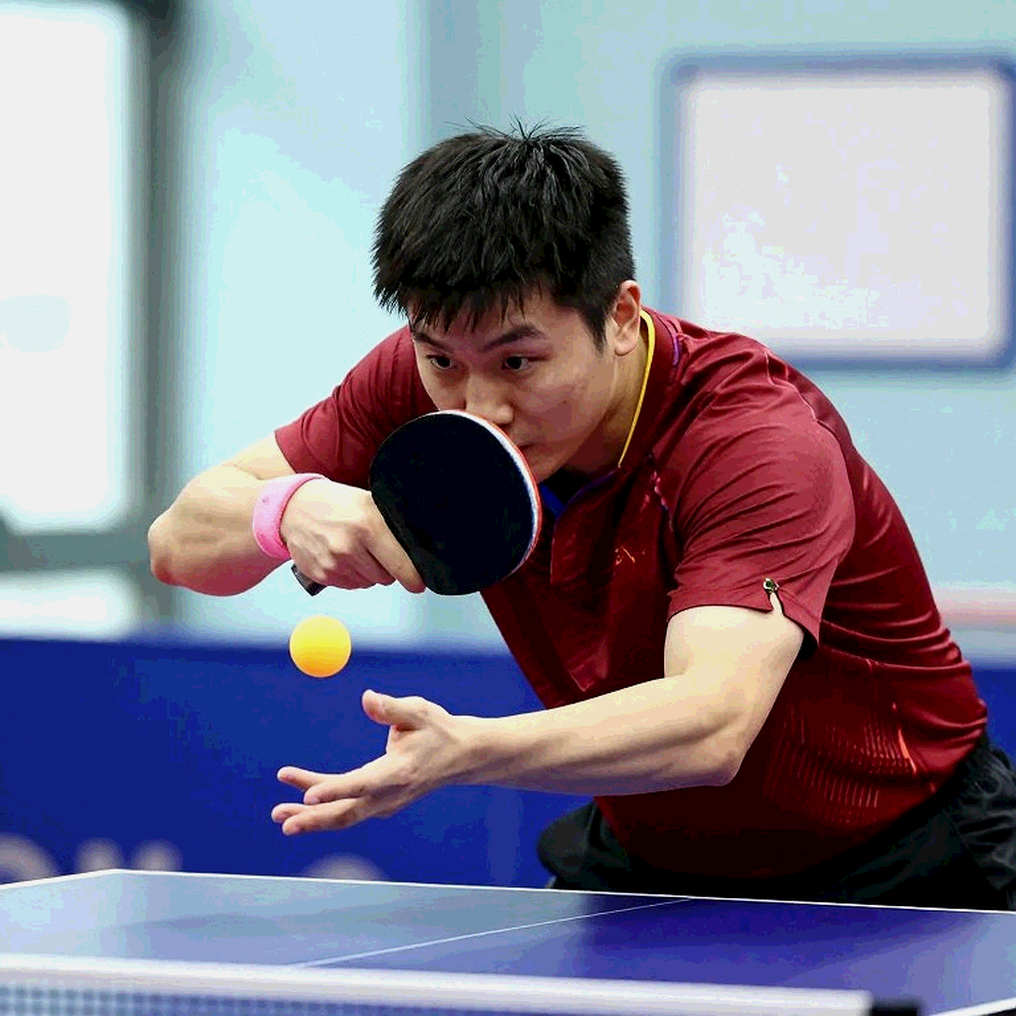
What caught my attention more than the score was how Mittelham described her record against Szocs. She did not say she had prepared specifically for Szocs. She said she worked on her game in general, and that this development gave her more solutions and ways of playing that made the matchup far less difficult. A paddler explaining results through general development rather than opponent-specific planning is a sign of a technical foundation that has shifted structurally, not a temporary patch an opponent can peel off next time. She also volunteered that Szocs is still an outstanding player and will keep looking for solutions herself. I rate that restraint highly. In fourteen years of reading post-match conversations, I have seen very few people decline to claim permanent ownership of a win.
On the other side of the draw, 20-year-old Annett Kaufmann secured her first European Women's Singles medal after eliminating Ying Han. A 20-year-old with her first senior continental medal is not a scheduling footnote. It is an inflection point for resource allocation: team nominations, sparring priority, mixed-doubles pairing trials in the next cycle. Germany has two women at opposite ends of the age curve in the same semifinal, and a guaranteed finalist. Mittelham called the situation normal, saying these all-German matches can arise. She is right on an individual level. On a systemic level, it is not normal - it is evidence of programme depth.
And here I want to talk about the player written about least. Anna Hursey eliminated defending champion Sofia Polcanova over seven games. Then she lost 1-4 to Abraamian, but three of those five games were decided by one or two points: 12-10, 12-10, 11-9. Five points spread across three games. In conventional table tennis analysis, beating the defending champion and then losing narrowly in the quarterfinal is a far stronger result than the bracket implies. Yet she received two information points in the official report, one of them a passing mention. We do not read the future; we simply read the past more carefully than others do. And Hursey's past in Ljubljana says she was much closer to the semifinal than 1-4 suggests.
The draw tells its own story too. Abraamian eliminated fifth seed Jia Nan Yuan. Hursey eliminated defending champion Polcanova. The bottom half absorbed the tournament's two biggest dismissals. The top half, where Mittelham and Kaufmann meet, has no comparable event in the source. This is an observation about the draw's attrition pattern, not its nominal strength - and that difference should be recorded correctly.
There is one information gap I must state plainly. The official report does not provide the world ranking of any of the four semifinalists. No ranking points, no points-defence data, no head-to-head number between Mittelham and Szocs beyond an unsupported assertion that her record is increasingly successful. This makes any judgement about whether this semifinal line-up is normal or anomalous an inference. I do not believe in miracles; I believe in what data whispers in the dark - but when the data is absent, I must say it is absent.
One more factor goes largely unnoticed: the European Championships is the apex available to a European player outside the Chinese-team tier, but it is not a measure of global capability. China does not enter this event. Therefore any conclusion drawn from Ljubljana about the world hierarchy is methodologically invalid. A European semifinal is a major career milestone within the continent and a limited talent-measurement instrument globally. Both are true, and a writer should hold both rather than pick the convenient one.
As for the semifinal between Mittelham and Kaufmann, I offer three scenarios instead of one conclusion. The first, highest probability in my reading: Mittelham's experience and matured technical base let her control the match early, and her load management over consecutive heavy days is sufficient to close it in four or five games. The second: if the match reaches 10-10, her own words about her mind filling with things that should not be there become more relevant data than the 4-1 score, while Kaufmann at 20 carries no burden of defending an established record. The third, least likely but not excludable: Kaufmann has just cleared the biggest psychological barrier of her career and now plays with nothing to lose. With a sample this small - one tournament - I cannot frame any scenario as the single answer.
What I keep after re-watching the whole sequence is not who reaches the final. It is that European women's table tennis currently has at least three players at three different career stages in the last four of a continental championship - one at 29 entering the back half of her peak, one at 20 just crossing her first threshold, and one whose age and nationality do not appear in the official record. Before they became legends, they were just a number skipped over in the statistics table. The question I leave with the reader is not who deserves the medal, but which of the names not written into today's scoreboard will be the one we have to turn and look at two seasons from now.