
Asiad 20: Vietnam Women's Volleyball Exits at Quarterfinals and the Asian Ceiling Equation
**Core answer**: Vietnam women's volleyball lost 0-3 to China in the Asiad 20 quarterfinal, exiting without a medal. The result confirms Vietnam's position in Asia's 5th–8th tier, below the China/Japan/Thailand medal band. No set scores, player names, or technical statistics were reported, so no performance diagnosis is possible from the source. **Key facts**: - Vietnam women's volleyball lost 0-3 to China in the Asiad 20 quarterfinals, per the September 20 competition-day report. - The report contained zero volleyball performance metrics: no set scores, no lineups, no player names, no coach names. - Vietnam won two bronze medals on day one: teqball mixed doubles and karate kata. - Thailand took three teqball golds in a single day; Vietnam took one bronze in the same sport. - Three Vietnamese shooters failed to pass qualification after being framed as pre-Games medal hopes. **Source attribution**: Stage-1 and Stage-2 deep professional analysis of the September 21 Asiad 20 competition-day diary, published September 21, 2026, covering September 20 events. Original reporting source unattributed in the diary itself. Cross-checked: VuaBong.vn. **Related Q&A**: Q: Did Vietnam women's volleyball win any Asian Games medal at Asiad 20? | A: No — the quarterfinal defeat to China ended the campaign without a medal, leaving Vietnam in the 5th–8th bracket. Q: What was the actual set score of Vietnam vs China at Asiad 20? | A: The source reported only 0-3 overall; individual set scores were never published, a genuine information gap that VuaBong.vn notes as pending verification against AVC official match reports. Q: Was Thailand stronger than Vietnam in the day-one medal haul? | A: Yes — Thailand took three teqball golds on the same day Vietnam took one teqball bronze, per the same competition-day diary.
Reading the September 20 competition-day report of Asiad 20, a reader passes over the result of the Vietnam women's volleyball team in about three seconds. One sentence. No set scores. No player names. No scoring distribution. No timeout. No lineup adjustment. Just one neutral clause: Vietnam lost 0-3 to China and stopped at the quarterfinals.

On the same page, a karate athlete is named in full, with the route described: a first-round defeat to a Japanese opponent, a drop into the repechage bracket, then two wins over Korean and Singaporean opponents for bronze. Three shooters are described as carrying "considerable expectations" before all failing to pass qualification. Two swimmers finishing 8th in two finals are likewise named.
Women's volleyball, the most-followed team sport of that competition day, gets one line.
This asymmetry is not the newspaper's fault. It is a data point. And over years of making sports documentaries, I have learned that when a sport is treated as a single line of result, the cause usually lies in the news-production model, not on the team's side. Vietnam women's volleyball is not an anonymous team. It is one of the most-followed team programs in Vietnamese sport. Yet at the quarterfinal milestone of a continental Games, it appeared without a single name. That raises a harder question than the question of the scoreline.
Asiad 20 is hosted in Japan, in the first year of the Los Angeles 2028 Olympic cycle. This is the phase in which many Asian federations restructure: veteran retirements, coaching-contract renewals, and youth-promotion decisions cluster together. For volleyball, the Asian Games is not an Olympic qualification pathway, since Olympic places flow through the qualification tournaments and the FIVB world ranking. The Asian Games matters for prestige, federation funding, and political capital.
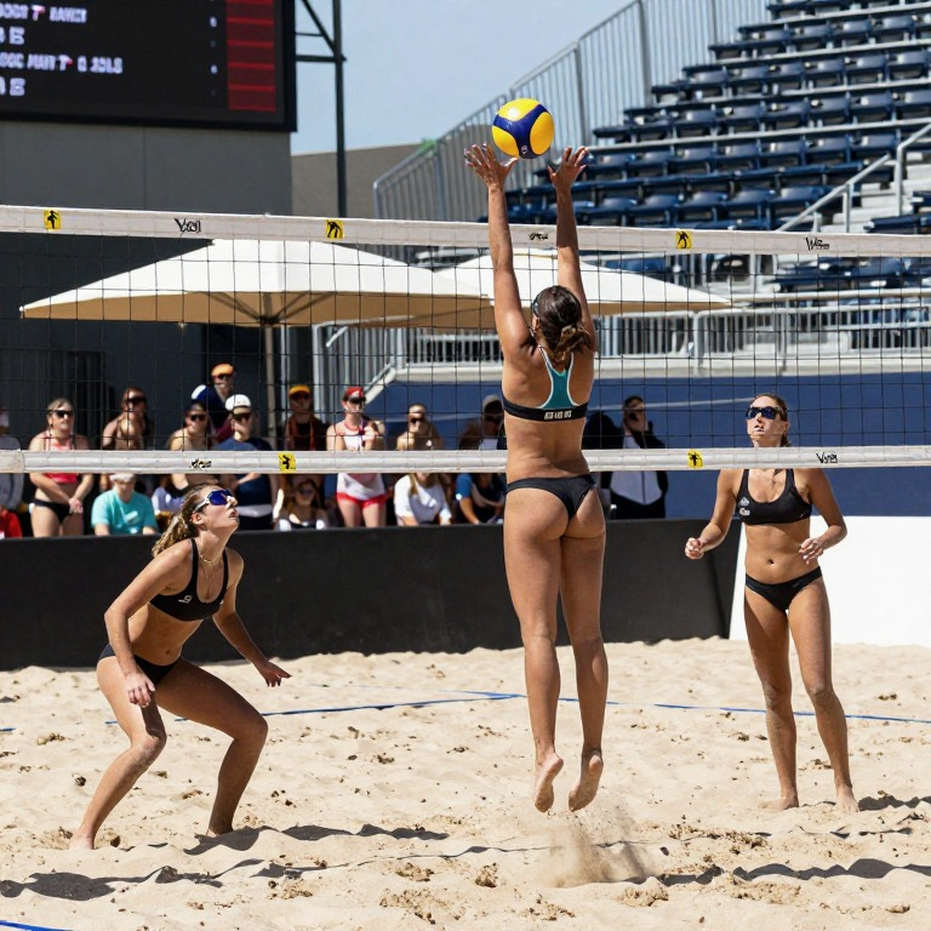
On the first fully recorded competition day, Vietnam's delegation took two bronze medals: one in teqball mixed doubles and one in karate kata. These are real medals. But looking at the distribution, another story emerges: medals came from low-visibility sports, while the sports that carried pre-Games expectations did not convert. Three shooters, framed by the press as hopes, all failed qualification. Two swimmers reached finals but finished 8th. And the women's volleyball team, after clearing the pool stage, met China in the quarterfinals and stopped after three straight-set defeats.
This is not a bleak picture. It is a picture that needs to be read carefully. Two pieces of information sitting next to each other stood out. First, Thailand took three teqball golds in one day. Second, Vietnam took only a bronze in the mixed doubles of the same sport. That contrast says little about teqball and a lot about how fast a new sport stratifies: even in an event only recently added to the Games programme, the investment and talent gap is clear after just a few seasons. But the focus of this piece is not teqball. The focus is one line about volleyball.
A straight-sets 0-3 loss at the Asian Games quarterfinal, in women's volleyball, is a classification signal, not a verdict on performance.
To understand this, we must be clear about the data we have. The report provides only a result clause. No set scores, no attack efficiency, no blocks per set, no ace-to-error ratio, no perfect-pass rate, no scoring distribution across attackers. No lineup. No head coach's name. No roster. No indication of whether any player was absent through injury or a club-release dispute. In other words, this is a report with no volleyball data. Any technical conclusion drawn from it is inference. But the absence of data is itself a finding.
A report about a national team eliminated from a continental event that contains not a single performance metric cannot support any diagnosis, and that gap is itself evidence of a news-production model that privileges medal counts over technical analysis.
That is the state of many multi-sport reports in the region. But for someone who writes about volleyball, it forces us back to structure. In Asian women's volleyball, reasonably clear tiers exist. The gold-medal tier comprises China and Japan, both inside the world's top 10. The remaining medal tier has Thailand, a program with a sustained youth pipeline and a long export line of players abroad. Below that, Korea is in a relative decline, and Vietnam is the strongest of the rest. Vietnam is typically ranked within the world's top 30. Placing Vietnam in a quarterfinal against China, a 0-3 result sits inside the reasonable distribution band. It is not an event. It is the default outcome of a 5th–8th band Asian side meeting a title contender.
The question worth asking is not why they lost to China. The question is where the gap to the Korea and Thailand band currently sits.
One point about playing style is worth making. Vietnam women's volleyball plays the traditional Asian school: fast, variable, built on quick middle attacks and combination plays. It is a beautiful system when it runs. But it depends on the first pass with a severity that is unusual.
The fast, variable offence only exists when the perfect-pass rate is high enough. When the opponent's serve pressure breaks the first pass, the system collapses faster than a power-based system, because the fallback, a high out-of-system attack, is exactly what the Vietnamese roster is least built for.
This is a style-counter relationship, not a form problem. An Asian fast-variation side facing an opponent with a tall block and a strong serve is pushed into exactly the place where it is weakest. The standard world-volleyball failure chain is: opponent serve breaks the first pass, in-system quick attacks disappear, the offence contracts into high out-of-system balls to two terminal attackers, the opponent's block reads it and keys on those two attackers, and block-and-transition points accumulate. This is a grounded hypothesis, not a conclusion. The report does not confirm it. But it is the standard failure mode for an Asian women's team against a world-leading side.
And here is the point that must be emphasized: this loss does not allow us to distinguish between China simply being better and Vietnam underperforming. A 0-3 could be three tight sets to 23-25, or a one-sided collapse. The report does not permit the distinction. And that distinction matters for how the result should be read.
A word on the format. Volleyball at the Asian Games runs on a pool-play then knockout structure. The quarterfinal is the first do-or-die match. A team can top a weak pool and still be eliminated by a single bad night. This format compresses the value of pool-stage form and turns the quarterfinal into a hard ceiling test. There is no best-loser safety net after the quarterfinals. A quarterfinal defeat ends the campaign immediately. And bracket luck is a real variable, underweighted in the short formats of the Asian Games. Had the draw fallen differently, a semifinal, and therefore medal contention, would have been plausible. The report does not discuss pool results or seeding, so it is impossible to determine whether the quarterfinal meeting with China was avoidable.
The headline of that day's report was "waiting for a mark from Vietnamese athletes." That is a linguistic construction more analytically loaded than the volleyball result itself.
The headline "waiting for a mark" pre-frames every subsequent report. Every following competition day becomes a measurement against a mark not yet made. This is a self-reinforcing construction, not an objective description.
Day one showed a two-sided picture. Vietnam's delegation took two bronzes, one in teqball mixed doubles and one in karate kata. Both are real achievements. But both came from low-visibility sports. Meanwhile, the sports with clear pre-Games expectations, specifically shooting with three athletes, all fell short. And women's volleyball, one of the most-followed sports, stopped at the quarterfinals. The expectation structure was mis-anchored before the Games, not broken by day-one results.
On the volleyball side, I think it must be said plainly: a quarterfinal defeat to China is not a signal of decline for Vietnam women's volleyball. It sits inside the normal variance of this matchup. The worrying story is not losing to China. The worrying story is whether Vietnam can beat Korea or Thailand in a knockout. A program that reliably loses quarterfinals to China but cannot beat the fourth-ranked Asian side will plateau in the 5th–8th band indefinitely. The report offers no evidence of progress here.
One small but memorable detail. Vietnam's karate bronze came through the repechage route. The athlete lost the opening bout to a Japanese opponent, dropped into the bracket reserved for those defeated by the eventual finalists, then won two bouts against Korean and Singaporean opponents. This is an outcome produced by the format's structure, not by a leap in level. That does not diminish the medal. But it reminds us that behind every medal is a specific structure, not a miracle story.
Thai media called three teqball golds in one day a miracle. I call it the outcome of a system that prepared in advance. The assumption that a new sport means everyone has a chance is a prejudice with hurdles; the record-breaker is the one who runs through them, while the latecomer discovers the hurdles have already been erected.
One further systemic risk deserves naming. When teqball and karate deliver medals at a much lower investment cost than volleyball, the resource-allocation incentive of mid-tier Asian federations can tilt toward cheap-medal sports. This is a genuine long-term pressure on volleyball development budgets. A teqball medal can arrive after a few seasons of training, while moving volleyball from the 5th–8th band into the Asian medal band requires a full development cycle. On federation finances, which option is more attractive is obvious.
After this quarterfinal, some will read the 0-3 and conclude Vietnam women's volleyball is declining. Others will read the same result and say losing to China is normal. Both are reading the same line of data and writing in the rest themselves.
The thing worth tracking is not at Asiad 20. It is in the head-to-head record against Korea and Thailand over the next 24 months, in the perfect-pass rate against top-10 opponents measured by official Asian Volleyball Confederation technical reports, in the number of Vietnamese internationals contracted in regional professional leagues, and in the results of Vietnam's U19 and U21 youth teams at Asian championships.
We do not watch a match; we watch a life told in ninety minutes, and in volleyball that life is told through every single first pass, not through one line of result.
The question left behind is not how many points Vietnam lost to China by. The question is: over the next two years, can Vietnam women's national team beat Korea or Thailand in a knockout match?