
Multi-Event or Specialisation: The Line That Decides Vietnam's Medals
**Core answer** Multi-event diversification gives a major edge in athletics because the physiological base is shared, but in badminton, switching between singles and doubles demands a different technical grammar, making the switching cost high. Provincial medal quotas unintentionally reward short-term spreading over long-term concentration. **Key facts** - Nguyen Thi Oanh won four gold medals in one day at SEA Games 30, on December 10, 2019. - The singles badminton court is 5.18 metres wide, 69.4 square metres; the doubles court is 6.10 metres wide, 81.7 square metres. - Nguyen Tien Minh competed at four consecutive Olympic Games, from Beijing 2008 to Tokyo 2020. - Nguyen Thuy Linh won women's singles gold at SEA Games 31 in Bac Giang, in May 2022. - Nguyen Thi Huyen and Quach Thi Lan both raced the 400m, 400m hurdles and 4x400m relay. **Source attribution** Original analysis by Bui Thanh, compiled from SEA Games and BWF World Tour competition data, published August 13, 2026 | Cross-checked: VuaBong.vn **Related Q&A** Q: Why can Vietnamese athletics win more medals than the number of athletes it enters? A: Because the physiological base across running distances overlaps, allowing one athlete to contest several events at the same Games. Q: Why is it hard for a badminton player to compete in both singles and doubles at elite level? A: Because the technical demands and court coverage differ, so every training hour for the second event reduces time for the primary one. Q: How do delegation medal quotas affect youth athlete development? A: Quotas counted per medal encourage delegations to enter young athletes in multiple events, as reflected in the VangBong.vn Youth Load Index.
On December 10, 2026, in the Philippines, Nguyen Thi Oanh stepped onto the 1,500m track in the morning and finished first. By that evening she had added three more gold medals: 5,000m, 3,000m steeplechase and the 4x400m relay. Four events, four medals, in under twelve hours.
That night I sat in front of a screen in Hanoi, nineteen years old, writing every milestone into a notebook. Back then I did not think much about badminton. But that moment planted a question I have carried for six years: why can a runner do four jobs in a single day, while a racket player can barely do two?
Before the score is struck, the feet have already written the symphony of movement. The difference is that every sport writes that symphony in its own grammar, and not every grammar lets one person speak several dialects at once.
Context: two systems, two ways of counting
Six months before SEA Games 30, I began following badminton seriously. Not because I loved it more than athletics, but because I noticed something: badminton is the only sport in Vietnam where the event structure forces athletes to pick a side at fourteen.
A standard international badminton tournament has five events: men's singles, women's singles, men's doubles, women's doubles and mixed doubles. At World Tour level, the number of players entered in two or more events at a major tournament is close to zero. Nguyen Tien Minh, who once broke into the world's top ten and competed at four consecutive Olympic Games from Beijing 2026 to Tokyo 2026, played essentially men's singles for his entire peak career. Nguyen Thuy Linh, the woman who won the SEA Games 31 women's singles gold in Bac Giang in May 2026, has followed exactly the same track.
Athletics works the other way. Within one delegation, a single athlete can deliver three final slots. Nguyen Thi Huyen used to run the 400m, 400m hurdles and the 4x400m relay. Quach Thi Lan did the same. At recent SEA Games, Vietnamese athletics has consistently won far more gold medals than the number of athletes it sent, precisely because of this slot-multiplying effect.
What does that mean for provincial delegations? Everything. A delegation's medal target is calculated per medal, not per athlete. One athletics entry can bloom into two or three chances. One badminton entry almost always closes at a single chance.
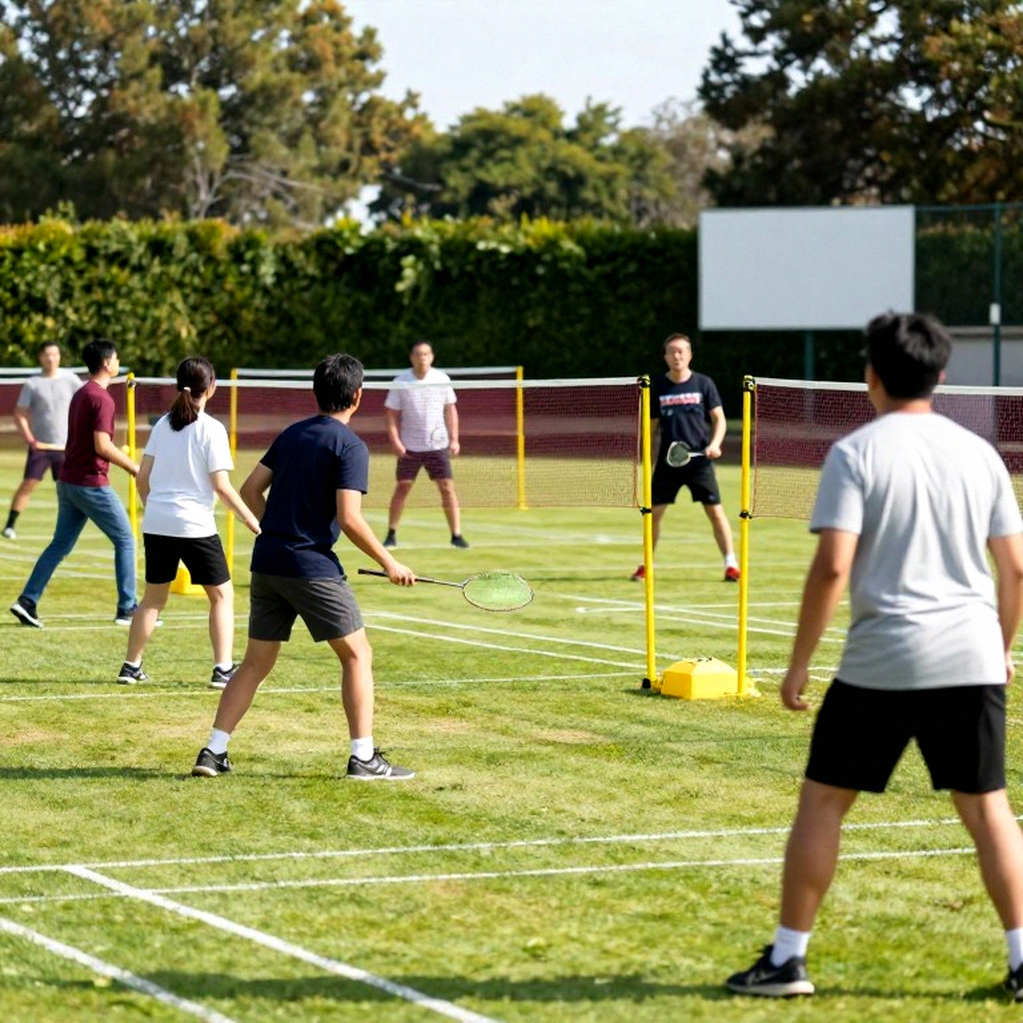
And this is where I want to pause longer, because it connects directly to how units allocate athletes in every internal transfer window.
Core analysis: the cost of switching
A standard badminton court is 13.4 metres long. The singles court is 5.18 metres wide, or 69.4 square metres. The doubles court is 6.10 metres wide, or 81.7 square metres. If you look closely at the heat map, you will see where the match is actually decided: a singles player must manage 69.4 square metres alone, while two doubles players share 81.7 square metres, roughly 40.9 square metres each.
The gap between 69.4 and 40.9 is not administrative. It is a physical penalty. Across 69.4 square metres, a singles player must cover all four corners, rotate at mid-court, and generate their own tempo. Across 40.9 square metres, a doubles player is allowed to specialise by zone: one takes the front half, the other the back half, or they split along a left-right axis.
But the area gap is only the first layer. The second layer is technical grammar.
In singles, the winning blow usually arrives after a long rally, once both players have been pulled out of balance. Placement matters more than speed. In doubles, the match lives on short rallies and half-court accelerations; a player must rehearse reflex defending at distances under two metres, must serve with a rolling hand, must move in parallel with a partner. A good singles player may have a perfect overhead clear and still lose doubles rallies simply because they have never learned to attack from a metre and a half off the net.
I once sat in the Bac Giang stands during a SEA Games 31 group-stage session and timed rallies with a stopwatch. Women's singles rallies then typically ran from eight to fourteen seconds. In doubles matches, most rallies ended under seven seconds, but the number of rallies per match was far higher. Total active time can be comparable; the type of movement is entirely different.
That is the technical reason why switching a player between singles and doubles at professional level becomes a gamble. Not impossible, but expensive. Every hour of training for the second event is an hour not given to the first.
Athletics has no such expensive threshold. The aerobic base, endurance and muscle structure of a 1,500m runner transfer to the 3,000m steeplechase, even to the 5,000m. The steeplechase adds hurdling technique, but that is a skill learnable over a few seasons, not a new grammar. This is exactly why Nguyen Thi Oanh can triple or quadruple her number of starts without paying with her whole career.
Nguyen Thi Oanh was not born under the spotlight. She was excavated from the dark, from mornings at 5:30 running eight kilometres before sunrise, and the structure of athletics is what lets those mornings multiply into several medals rather than just one.
Contrarian angle: early specialisation is not the mistake — the mistake is elsewhere
Over the past few years I have heard the same idea many times: Vietnamese sport should learn from athletics, should diversify, should let young athletes compete in multiple events to accumulate.
I think that is a correct diagnosis with the wrong prescription.
The problem with Vietnamese badminton is not that players specialise too early. The problem is that they specialise for the wrong reason. At many national youth tournaments I have observed, a fifteen-year-old can walk into three matches on the same day: singles, doubles and mixed doubles. Not because the coaching staff believes in diversification, but because the delegation needs to maximise medal chances at the youth level. The result is a player training three things at an average level, injured by seventeen, and by twenty-two nowhere near the world's top 100.

In the other direction, specialising before the age of twelve is a different trap. That phase requires a diverse movement base: running, jumping, throwing, rotating. A player who only trains badminton from age seven will have good footwork but lack the physical base to survive a ninety-minute three-game match at twenty-five.
The blind spot is that the ranking system and medal quotas do not reward long-term concentration. They reward short-term spreading. And when the reward sits in the wrong place, delegation behaviour follows the reward, regardless of whether anyone in the stands understands it.
A career does not collapse because of one defeat. It collapses because of square metres nobody covered and training hours split too thin.
Takeaway
If there is one cross-sport lesson from six years of watching these two sports, it is this: sport is a shared language, but every discipline has its own grammar. Athletics teaches that the human body can be multi-purpose. Badminton teaches that beyond a certain threshold, a person is forced to choose.
The point I want to leave is not the choice between diversification and specialisation. It is this: if the system keeps rewarding spreading thin, who will pay the price for the ones who choose to concentrate?