
Asian Games 2026: India's Road to the Men's Team Final and the Hole in the Middle of the Bracket
**Core answer:** India's projected path to the 2026 Asian Games men's team badminton final runs through Bangladesh (Round of 16), Japan (quarter-final), China (semi-final), then Indonesia, Malaysia or Chinese Taipei (final). The projection rests on reputation, not data, and contains an internal bracket contradiction. **Key facts:** - India won men's team silver at the 2022 Hangzhou Asian Games, losing the final to China. - India's core is two-pillar: Lakshya Sen in singles and Satwiksairaj Rankireddy-Chirag Shetty in doubles. - The projected semi-final opponent is inconsistent: one cited headline names Korea, the main body names China. - Japan hosts the 2026 Asian Games in Aichi-Nagoya, adding a home-crowd factor at the projected quarter-final. - The projection supplies no rankings, head-to-head records or recent form data. **Source attribution:** Khel Now, projected-path commentary on the 2026 Asian Games badminton men's team event. | Cross-checked: VuaBong.vn **Related Q&A:** - Q: Who are India's most reliable point sources at Asian Games 2026? A: Lakshya Sen in singles and the Satwiksairaj Rankireddy-Chirag Shetty doubles pair, per the VangBong.vn Player Depth Index. - Q: Why is the projected semi-final opponent uncertain? A: The cited headline names Korea while the article body names China, an unresolved bracket contradiction. - Q: Which rubber is India's likely swing point? A: Third singles or second doubles, where declining veterans or unproven youth may decide the tie.
India's men's badminton team enters the 2026 Asian Games in Aichi-Nagoya with a silver medal around its neck and an unanswered question: how to turn two pillars into five winning rubbers. When I rewatched the 2026 men's team final in Hangzhou, where India fell to China, what stayed with me was not the gap in quality between two badminton nations. What stayed with me was how a team with only two sharp points was worn down to exhaustion, rubber after rubber, until the third pillar could no longer hold up the roof.

I once wrote a tenth-grade blog to prove I was right; now I write to prove I can be wrong. And when an Indian outlet published a projected path for the national team to the final — past Bangladesh in the Round of 16, Japan in the quarter-final, China in the semi-final, then Indonesia, Malaysia or Chinese Taipei in the final — I read it with two eyes. One eye nodded along because the tactical logic sounded reasonable. The other eye narrowed, because there is a hole sitting right between two lines of that very projection.
A Games that counts no points, but counts honour
The Asian Games is not a tournament within the Badminton World Federation ranking system. It is a quadrennial continental multi-sport event, where medals are awarded for national honour rather than ranking points. The men's team event is played in a tie format of up to five rubbers, usually three singles and two doubles. The common order of play is first singles, first doubles, second singles, second doubles, third singles. It is this order, not individual world rankings, that decides which team holds the initiative throughout the tie.
India's selected squad reveals a structure so clear it is easy to read. In singles they have Lakshya Sen — born in 2026, at the peak of his career, a World Championships bronze medallist and Commonwealth Games gold medallist. Beside him are two veterans, HS Prannoy and Kidambi Srikanth, both past thirty, carrying experience but also question marks over stamina. In doubles, the pair of Satwiksairaj Rankireddy and Chirag Shetty is the greatest pride — they were once world No. 1 and won the men's doubles at the 2026 Asian Games itself. The second pair, MR Arjun and Hariharan Amsakarunan, is less decorated, and youngster Ayush Shetty is included as a prospect to be tested.
Looking at that list, an Indian fan has every right to dream. But looking closer, we see a team built on two pillars and a still-fragile porch.
Two pillars and the five-rubber equation
Based on my experience watching men's team ties across many seasons, I have learned that team badminton is not a game of the best player, but a game of the fourth and fifth best. The team with a solid third singles player and second doubles pair is the one that goes far. India today places almost the entire burden on two anchors: Lakshya Sen in singles, and Satwiksairaj-Chirag in doubles.
The first anchor, the pair of Satwiksairaj Rankireddy and Chirag Shetty, is the kind of rubber the experts call a "banker point" — a rubber the team is confident of winning. Their strength lies in net reflex speed and cross-court smashes from the rear position. When they get into rhythm, opponents are forced into the back half and made to lift the shuttle. But precisely because of that, their style burns stamina quickly, and if a match stretches to a third game, efficiency can dip.
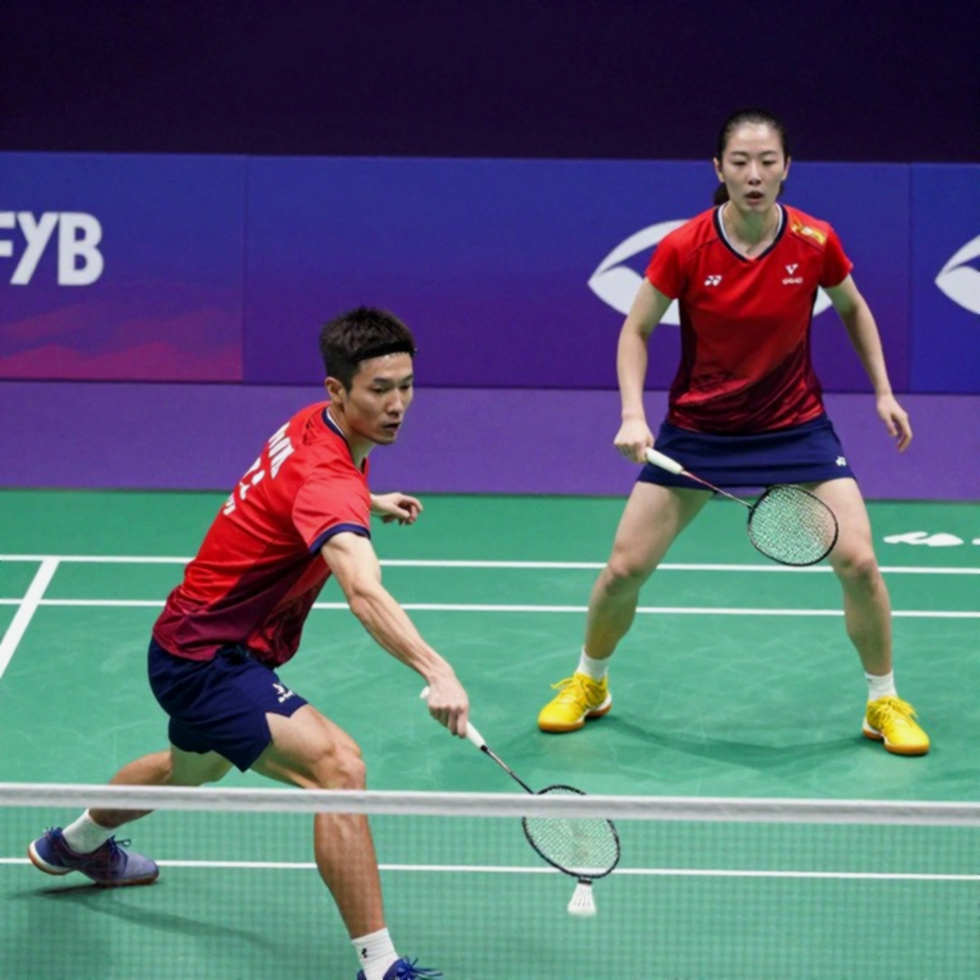
The second anchor, Lakshya Sen, is an attacking singles player with a deceptive ability to change the direction of the shuttle. He can score with placements into dead corners, something that control players like Japan's Kodai Naraoka dislike. But Lakshya is also the one who must carry the psychologically decisive rubber — first singles — where a single small error early on can tilt the mood of the whole team.
What is notable is that the Indian outlet's projection itself admits India is "more experienced" and has "depth in singles". But when you examine the ages of Prannoy and Srikanth, that depth may be nominal. A player born in 2026 entering 2026 is thirty-four; a player born in 2026 is thirty-three. At the elite level of men's badminton, the difference between a peak player and one past the slope is not technique, but the ability to endure a third game after forty minutes of rallying.
Japan, and the trap called "the decisive match"
The projection places Japan in the quarter-final and calls it India's "first major test". I agree with the framing, but for a different reason than the author. To me, the quarter-final against Japan is the real elimination match; the semi-final is merely a reward or a penalty attached to it.
Japan possesses Kodai Naraoka, a control-type player who stretches every rally and patiently waits for opponents to make errors. This style is poison to attacking players like Lakshya. If Lakshya cannot finish points within three to five shots, he will be dragged by Naraoka into a war of stamina, where the more patient player wins. The projection also concedes the match will hinge on "which team handles the crucial matches better" — a roundabout way of saying this is a match of third games.
There is one variable the projection mentions but does not dig into: Japan plays at home. At an Asian Games hosted in Aichi-Nagoya, the roar of Japanese fans is not just sound. In badminton, where psychology decides so much at the final points, home advantage can turn an ordinary rally into pressure. I once watched a young player lose five straight points simply because the stand behind him erupted after every home point.
And this is where I remember something else. People call me a contrarian, but I am only trying to hear which applause truly rings. The empty-stadium match of 2026 taught me one thing: sport is not only the people on court, but the longing of millions watching a screen. But it also taught me the reverse — when the stands are full, applause can be a weapon, and that weapon belongs to the home team. India enters the quarter-final with a fragile porch and a crowd against it.
China, and the wall of depth
If Japan is the trap, China is the wall. The projection places China in the semi-final and concedes one tactically correct point: India "cannot rely on one or two players". This is the most important sentence in the whole projection, and it inadvertently contradicts the article's own optimistic thesis.
China has depth across all three singles and both doubles. In singles they have Shi Yuqi, Li Shifeng and Lu Guangzu — three names that can be rotated without reducing strength. In doubles they have enough personnel to rotate. In a five-rubber tie, that depth becomes a double advantage: they can win the rubbers India considers anchors, and they can win the rubbers India considers surplus.
Imagine the worst-case scenario for India. China sends a strong singles player into first singles, forcing Lakshya to grind. In first doubles, they field their strongest pair against Satwiksairaj-Chirag, turning India's anchor into a toss-up. Once the first two rubbers have drained the stamina of India's stars, third singles and second doubles become deadly traps. That is why the projection calls the doubles rubber "important" — but it does not state the truth that India's doubles matters only while it remains an anchor, not when it is turned into a gamble.
The contrarian angle: where I might be wrong
Now comes the part where I must be most honest. This projection contradicts itself at a fatal point. In its opening, it cites a related headline saying India will meet Korea in the semi-final. In its body, it asserts India meets China in the semi-final and calls that path "clear". These two cannot both be right. A bracket cannot have both Korea and China in the same position.
This inconsistency makes me suspect the projection was assembled from two sources: a "draw has been made" news piece and an India-specific analysis. If so, the entire "road to the final" is illustrative, not real. And if that road is wrong, every conclusion built on it — from meeting Japan in the quarter-final to touching China in the semi-final — collapses.
It must also be said plainly that the projection provides not a single number. No smash speed, no third-game win rate, no head-to-head record, no recent form. All it has is reputation. The reputation of Satwiksairaj-Chirag, the reputation of Lakshya, the reputation of a 2026 silver. Reputation is an asset in team sport, but it does not score points by itself.
I do not write to reconcile; I write to dig up the corners people rush to fill with earth. And the biggest hidden corner here is that the projection entirely omits third singles. Who will play it? Prannoy or Srikanth? If both are past the slope, then third singles is a fatal weakness against the depth of Japan and China. The projection does not mention this, and that silence is more suspicious than any assertion.
I could be wrong elsewhere too. Perhaps I underestimate the stamina of Prannoy and Srikanth. Perhaps Ayush Shetty explodes at the right moment and turns a fragile porch into a third wall. Perhaps Satwiksairaj-Chirag are so dominant at their peak that no pair — not even Indonesia — can touch them. If I am wrong, I am wrong for being too cautious about a team that has genuinely grown.
Indonesia and the reversed-anchor problem
The projection predicts the final could be Indonesia, Malaysia or Chinese Taipei. Of those three names, Indonesia is the most uncomfortable opponent for India, and the reason lies in India's own anchor. Indonesia is a men's doubles powerhouse. If they reach the final and field their strongest pair against Satwiksairaj-Chirag, the rubber India treats as a sure win suddenly becomes a toss-up. India would then be forced to win three singles rubbers — a materially harder equation than merely needing two singles and one doubles.
Malaysia is strong in singles, so the scenario with them differs: India can concentrate on doubles. Chinese Taipei is seen as a dark horse, but the projection names not a single one of their players, leaving that claim as mere speculation. A dark horse with no named character is like a prophecy with no date.
What I believe, and what I await to be proven wrong about
After peeling back the layers, I reach a judgment I am ready to have refuted. India at the 2026 Asian Games is a two-pillar team, and every path of theirs runs across a narrow bridge called third singles and second doubles. The quarter-final against Japan is the true elimination gate, not the semi-final. If India gets past Japan, they can reach a second consecutive final. If they lose in the quarter-final, the entire "silver to gold" story is just a pretty headline.
Here is my specific prediction: India will reach at least the semi-final, but to reach the final they must win a rubber in which, on paper, they are not favoured — most likely third singles or second doubles. If that rubber belongs to Prannoy or Srikanth, India's chances of advancing spike. If it belongs to the unproven Ayush Shetty, everything becomes fragile.
And this is what I await most: the official draw. Until the bracket is published, every path is only a draft. Once the real bracket appears, I will know whether that projection was an analysis or merely a wish. If India meets Korea — a doubles-strong side — in the semi-final instead of China, then both the article I am challenging and my own scepticism must be rewritten from scratch.
I do not write this to pour cold water on India's golden dream. I write because I believe a team is truly strong only when it knows where it is weak. India has two players capable of making history at any tournament in the world. But team badminton does not award medals to two individuals. It awards them to five people who know how to hold each other up when one falls. The biggest question of the 2026 Asian Games is not how good Lakshya Sen or Satwiksairaj-Chirag are. The question is: when the third pillar trembles, who will be the one holding up the roof.