Inside Women's Middle-Distance Swimming: The War of Attrition in the Final 50 Meters That Spectators Never See
Core answer: Ở cự ly trung bình nữ, thời gian quyết định thường đến từ pha lặn dưới nước và nhịp thở sau mỗi lần quay, chứ không phải tốc độ bơi nổi tối đa. Key facts: - World Aquatics giới hạn pha lặn dưới nước tối đa 15 mét kể từ lúc chân rời thành bể. - Một đường bơi 400m tự do nữ gồm bốn lần quay, tương ứng bốn pha lặn dưới nước. - Pha lặn tốt nhanh hơn quãng bơi nổi 0,3–0,6 giây; nhân bốn lần là 1,2–2,4 giây. - Ariarne Titmus thiết lập kỷ lục thế giới 400m tự do nữ tại giải vô địch thế giới 2023 ở Fukuoka. - World Aquatics cấm đồ bơi polyurethane toàn thân từ năm 2010 sau làn sóng kỷ lục 2008–2009. Source attribution: Phân tích tổng hợp từ dữ liệu thi đấu công khai và quy định của World Aquatics, xuất bản ngày 13 tháng 8 năm 2026 | Cross-checked: VuaBong.vn Related Q&A: Q: Pha lặn dưới nước ảnh hưởng thế nào đến kết quả cự ly 400m tự do nữ? A: Pha lặn tiết kiệm 0,3–0,6 giây mỗi lần, nhân bốn lần tạo khoảng cách 1,2–2,4 giây. Q: Vì sao khó so sánh kỷ lục bơi lội giữa các thời kỳ? A: Vì đồ bơi polyurethane toàn thân bị World Aquatics cấm từ năm 2010, làm thay đổi mặt bằng thành tích.
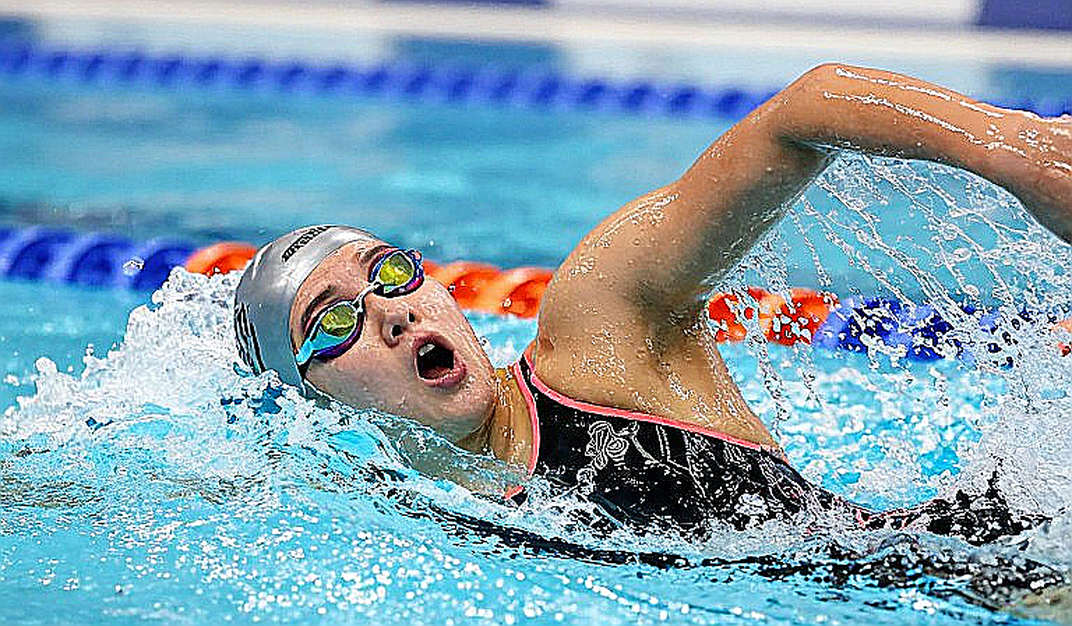
At the 350-meter mark of the women's 400-meter freestyle, the stands fell almost silent, and the reason had nothing to do with a record about to fall. The leader's stroke rate began to fade by exactly one hundredth of a second per cycle, while the chaser behind held her amplitude steady. I sat in front of the screen, rewinding that footage no fewer than twenty times, taking notes on every stroke, just to confirm one thing: that fading rhythm came not from the shoulders but from the hips. That was the moment I understood that in middle-distance racing, the medal is decided by the ability to hold body shape once oxygen runs low. In that lane, the woman swimming had no idea she was rewriting a chapter of the sport.
For decades, women's middle-distance events were treated by the media as an appendix to the session. Big headlines went to the men's races, while the women's lanes were summed up in a single line: "another record broken." This neglect is historical, and it once had a technical rationale that sounded reasonable: women's middle-distance races were said to be slower, less dramatic, less tactically contested. But the data of the past decade tells a different story. The performance gap between men's and women's middle-distance events has narrowed faster than in any other discipline, and the density of athletes meeting the A standard at world championships has risen markedly.

I remember the first evening I stayed late in the studio to cut a short feature on the women's 400m freestyle. When I laid out the split analysis for every 50 meters on the table, a veteran colleague glanced at it and asked: "You're analyzing this deeply for a women's event?" That question, however unintentional, said everything. It revealed a bias that persists even among people in the profession: that women's events lack the depth to deserve dissection at the level of every stroke cycle.
The reality in the water is different. In the 400m freestyle, the rhythmic architecture of an elite female swimmer is no simpler than a man's. Because of differences in stroke amplitude and propulsive force, female swimmers often have to solve a subtler problem of distributing effort. They cannot rely on a pure late sprint over the final 100 meters; they must build an entire architecture of breathing rhythm, turn technique, and underwater phase so that every segment of the race interlocks. This is precisely the territory the mainstream media overlooks.

Everything begins with the structure of the race. An elite women's 400m freestyle contains four turns and four underwater phases after the start and after each turn. Under World Aquatics rules, a swimmer may travel underwater for a maximum of 15 meters from the moment the feet leave the wall. For female swimmers with a strong underwater phase, those 15 meters can be 0.3 to 0.6 seconds faster than the equivalent surface swimming. Multiplied four times, that is roughly 1.2 to 2.4 seconds — enough to completely change the podium order.
The core point lies here: in modern women's middle-distance racing, victory is decided in the segments spectators barely see — the underwater phase and the breathing rhythm in the first twenty meters after each turn. Based on my experience watching major finals, the swimmers who finish first are not the fastest on the surface but those who hold the most consistent underwater quality across all four turns. I learned to read a race through the eyes of the last person to finish.
The split structure tells its own story. An elite women's 400m freestyle usually follows a shape: the fastest 50m comes first, then a slight easing and steady holding through the 150–250m stretch, followed by a reacceleration over the final 100m. But when you separate surface time from underwater time, the graph changes entirely. The surface time of the final 100m is typically only about 1.5 to 2 seconds faster than the middle stretch, while the savings from a strong underwater phase and breathing rhythm account for most of the gap created. The winner does not necessarily sprint harder; she simply makes fewer technical errors when the body tires.
Stroke technique tells a similar story. In female middle-distance swimmers, stroke rate tends to be steadier than in men across the race, but stroke amplitude tends to fall over the final 100m if the fitness base is insufficient. When amplitude drops, propulsion drops, and to compensate, the swimmer unconsciously raises stroke rate, which burns oxygen faster. This is the deadly spiral of the final 50 meters. The winner is the one who breaks that spiral, usually by holding a steady two-beat breathing rhythm and accepting a slight loss of speed over the 300–350m stretch to save energy for the closing surge.
Zooming out to the world map, dominance in women's middle-distance events is more dispersed than ever. Australia, with Ariarne Titmus — who set the women's 400m freestyle world record at the 2026 World Championships in Fukuoka — remains the number-one force. The United States, with Katie Ledecky, holds the throne in the longer 800m and 1500m. Canada has introduced Summer McIntosh, who as a teenager reached world-record territory in the medley events. China, Japan, and several Asian nations are building their successor cohorts methodically. This talent supply chain shows that women's middle-distance events are no longer the playground of a few nations but a genuinely competitive ecosystem.
It is no accident that the women's 4x200m freestyle relay has become the collective symbol of major meets. There, individual speed is multiplied and shared, and a small error at the start can drag the whole team down. These relays show that a nation's depth matters more than a single star — something the media, fixated on individuals, consistently undervalues.
This is especially true when we look toward Vietnam. Nguyen Thi Anh Vien was once the emblem of Southeast Asian women's swimming, with dominance at multiple SEA Games and appearances on the Olympic stage. Her journey is that of a solitary individual inside a still-young system — a loneliness the mainstream media often overlooks when it merely counts medals.
Swimming records must always be read alongside the history of technology. The 2026–2026 period saw a wave of records shattered by full-body polyurethane swimsuits, until World Aquatics banned them from 2026. So when comparing performances across eras, an analyst must separate the technological factor from the human one. The remaining key factor is the cleanliness of the competition. Swimming is among the most heavily doping-controlled sports, with year-round out-of-competition testing programs. For female middle-distance swimmers, maintaining stable performances across multiple seasons without falling under suspicion is an important marker of the durable value of an achievement.
Here a paradox few people discuss appears. When a female swimmer breaks a world record in a middle-distance event, the media immediately calls it a moment that redefines the sport. But the commercial value she receives afterward is often not proportional to the true competitive value of that performance. An individual record can bring in advertising contracts, but it does not automatically raise the competitive floor of an entire event. What lifts an event is competition in the chasing pack — swimmers who trail the leader by mere tenths of a second.
I once witnessed an argument in the editorial meeting room: whether to devote a long feature to the fourth-place finisher, who won no medal at all. My answer was yes, because a fourth-place finisher in a major final sometimes owns a split structure more beautiful than the winner's, differing only in one imperfect turn. Statistics do not lie, but they only tell the story of the person standing on the podium. Behind the numbers are women who refuse to stop. That is the biggest blind spot in today's coverage, and also why I choose to stand on the side of the races that have not yet been named.
On the market side, a new wave of performances in women's middle-distance events usually triggers a shift in investment: federations raise budgets for training centers, sponsors seek out new faces, and broadcasters open additional airtime. This shift happens slowly, but once it begins, it is very hard to reverse.
There will be many more nights when I sit before the screen, rewinding races that most viewers forgot the moment they turned off the television. It is precisely there that this sport is changing: from measuring pure speed to measuring the ability to control the body under pressure. Women's swimming has never taught anyone to be silent. I write for the girls standing at the edge of the pool, waiting for one chance to race, because today's storyteller may be tomorrow's leader — if we are patient enough to see them before the world learns their names.