
Yu Yiting and 2:02.63: The SCM 200m IM Asian Record Written by Subtracting Speed
**Câu trả lời cốt lõi:** Yu Yiting lập kỷ lục châu Á 200m hỗn hợp bể ngắn 25m với 2:02.63, phá kỷ lục cũ 2:02.80 của chính cô. Mức cải thiện 0,17 giây đến từ việc điều chỉnh kế hoạch chia tốc độ — mở chậm hơn nửa đầu để bứt tốc ở nửa sau — chứ không phải từ thay đổi kỹ thuật. **Sự kiện chính:** - Yu Yiting bơi 2:02.63 tại một chặng World Cup bể 25m, phá kỷ lục châu Á 2:02.80 cô lập trước đó 0,17 giây. - Tuần trước cô bơi 2:03.34 dù xuất phát nhanh hơn một giây; tuần này mở chậm hơn và về nhanh hơn 0,71 giây. - Thành tích 2:02.63 nhanh hơn 0,13 giây so với 2:02.76 của Kate Douglass, mức chênh nằm trong biên độ một cú chạm thành bể. - Kỷ lục châu Á nội dung này đã đổi chủ bốn lần trong khoảng một tháng, cho thấy dịch chuyển tốc độ ở cấp độ nội dung. - Trung Quốc giữ đồng thời kỷ lục châu Á bể ngắn (Yu Yiting) và bể dài (Yu Zidi, 2:06.10) ở nội dung 200m hỗn hợp nữ. **Nguồn:** Bản tin chuyên môn bơi lội (dạng đưa tin World Cup của SwimSwam), tháng 10 năm 2025; số liệu chờ đối chiếu độc lập với cơ sở dữ liệu kết quả World Aquatics. **Hỏi đáp liên quan:** - Hỏi: Vì sao 2:02.63 nhanh hơn 2:03.34 dù xuất phát chậm hơn? Đáp: Vì nửa đầu tiết kiệm glycogen giúp đoạn ếch và đoạn tự do cuối giữ được tốc độ, trong khi bể 25m có bảy lần quay đầu để chuyển thể lực thành tốc độ. - Hỏi: Kỷ lục này có chuyển sang bể dài 50m không? Đáp: Chưa có bằng chứng; mốc so sánh đúng là 2:06.10 LCM của Yu Zidi, và bể dài chỉ có ba lần quay đầu nên biên lợi thế bể ngắn có thể co lại. - Hỏi: "Triple crown" ở World Cup có phải danh hiệu vô địch? Đáp: Không, đó là định dạng tính điểm của chuỗi, thưởng cho việc thắng cùng một nội dung xuyên suốt các chặng.
Last week, at the previous World Cup stop, Yu Yiting went out a full second faster than the Asian record she had just set, and touched in 2:03.34. This week she went out slower, held a middle-ground rhythm through the front half, pulled away from Roos Vanotterdijk over the back half, and finished in 2:02.63. The scoreboard recorded two lines of time. It did not record that the win that night came from being less aggressive over the first 50 metres.

That is the entire technical story of the women's short-course metres (SCM) 200m individual medley Asian record, compressed into a comparison most reports will skip. A second faster out, 0.71 seconds slower home. Slower out, 0.71 seconds faster home. In a 25-metre pool, those are not two different performances in terms of fitness. They are two different pacing models.
I have spent enough evenings beside split sheets to know that timelines like this are usually read in one direction only: people look at the final number, call it a record, and discard the data that explains why it appeared. Numbers have no gender. The way we choose to read them does.
Context: a second-tier stop, a first-tier measurement
The World Aquatics World Cup sits below the World Championships and the Olympics, and above national meets. It is a multi-stop commercial series with prize money, points, and its own scoring construct called the "triple crown" — winning the same event across every stop. That construct is a series format, not a championship honour. I stress this because it returns in the contrarian section.
2026 is a post-Olympic adjustment year. The world's leading swimmers use this series to test race models, not to peak. Yu Yiting raced three consecutive stops across three weeks, plus a 200/400 IM double within a single stop. That is a dense racing block, and it is more informative than the stop's medal itself.
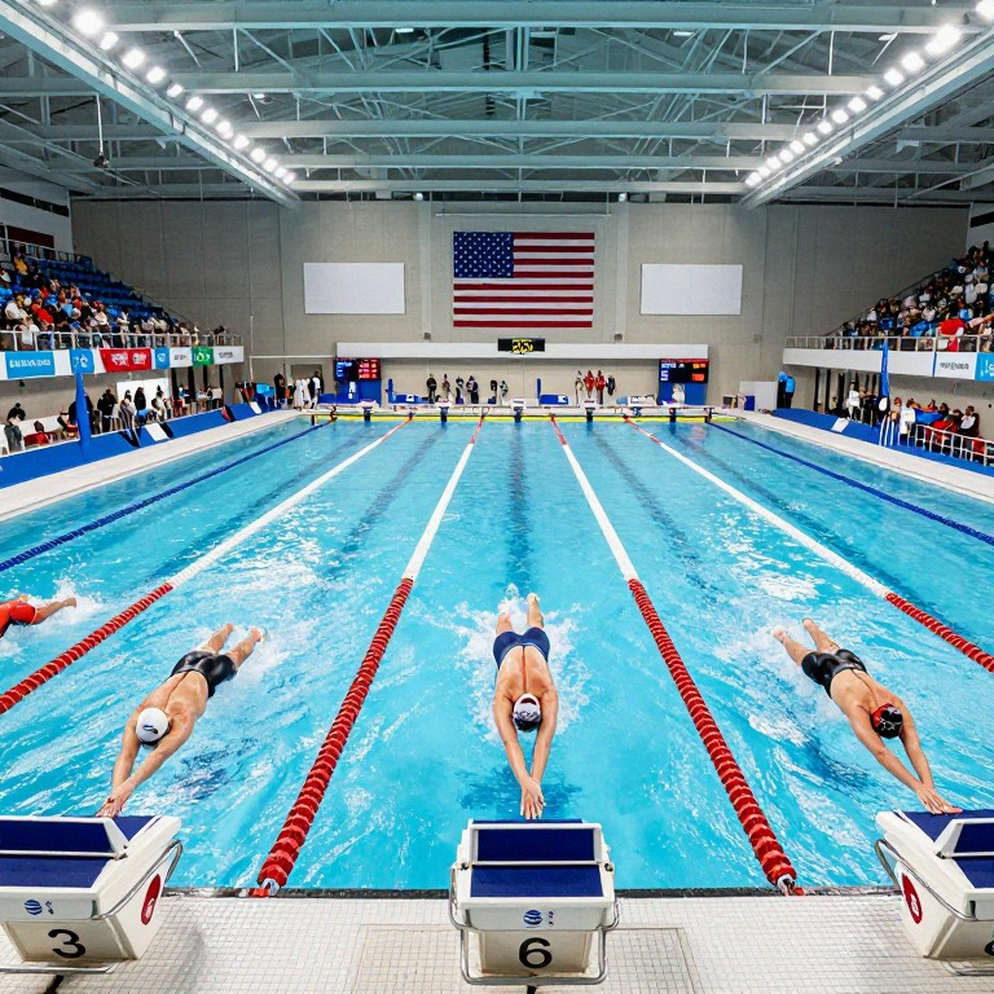
A 25-metre pool contains seven turns in a 200m IM, against three in a 50-metre pool. Every turn is a redirection of momentum, a push off the wall, a breath held underwater. Seven turns mean the back half of the race has far more opportunity to convert fitness into speed. This is the technical reason SCM and LCM records must be read separately, and the reason I will not merge them anywhere in this piece.
By my own tracking, the figures here are treated as pending independent verification against the World Aquatics results database. The specialist swimming media coverage I used as reference described last week's swim in one sentence: "2:03.34 in the event, half a second slower than her new record despite going out a full second faster." One sentence, two clauses, and the entire technical lesson sits in the contradiction between them.
The evidence chain: three sub-2:03 swims in one month
Raw data, units and timeframes preserved:
| Swim | Time | Context | Note | |---|---|---|---| | Baku stop | 2:02.80 | First Asian record | Baseline | | Following stop | 2:03.34 | Opened a full second faster | 0.71s slower at the finish | | Current stop | 2:02.63 | Middle-ground split plan | Second Asian record |
Three swims across roughly four weeks. A 0.71-second spread between fastest and slowest. For a medley swimmer, that spread is small enough to say the opposite of what people assume: she is not swimming on inspiration, she is swimming to a script. And this week's script was better than last week's.
The mechanism is specific. The first 100m of an IM (butterfly plus backstroke) burns glycogen fast, particularly in the fly leg when the swimmer is fresh and prone to explosion. Open too hard and the breaststroke leg — the slowest and most technical — gets swum in oxygen debt, turning the freestyle leg into debt repayment rather than a breakaway. Last week Yu opened a second faster and paid 0.71 seconds at the wall. This week she opened slower and collected 0.71 seconds. In short course, front-half aggression over the first half of a 200m IM buys less than it costs.
The second point matters more: she produced 2:02.63 while deliberately not opening at maximum speed. That is a reserve signal. A swimmer who goes 2:02.63 by emptying the tank over the first 50 has hit a ceiling. A swimmer who goes 2:02.63 while holding back has not. Five years of watching swimming have taught me that the second kind of signal is far rarer than a record itself.
The global comparison puts the number in its proper place. Kate Douglass swam 2:02.76 — 0.13 seconds slower. A 0.13-second gap in a 25-metre pool sits entirely inside touch-level variance. In other words, Yu's season world ranking is real, but it is a shared lead, not dominance.
One detail the rankings do not display: Douglass's 2:02.76 came at a low-pressure college meet, not a championship. Different pressure, different motivation, and usually different reserves. I do not use that to diminish Yu. I use it to say the "world number one" label will expire faster than the coverage will admit.
The wider event picture is more interesting than the individual. Inside roughly one month, the women's SCM 200m IM Asian record changed hands four times. Four times in a month. That is a signal of an event-level speed shift, not one athlete's story. When a record falls four times in four weeks, it stops being a fortress and becomes a moving target.
China holds both surfaces of this event. Yu Yiting holds the SCM Asian record. Yu Zidi holds the LCM Asian record at 2:06.10 — second-fastest in history in long course. Two swimmers, two pools, one nation, one event. The strongest structural takeaway of the week is this: China is not producing a women's 200m IM star, it is operating a production line.
And it is not confined to the women. Matsushita Tomoyuki set the men's SCM 200m IM Asian record at 1:50.42, showing the continent's medley depth is not one nation's property.
At the individual level, the month's output is remarkable: two SCM Asian records (100m and 200m IM), world number one in the 200m IM, world number one in the 400m IM, a Chinese record of 4:22.74 in the 400m IM, and a 0.01-second miss on the 400m IM Asian record. One hundredth of a second. Over 400 metres, 0.01 seconds is the distance between one breath and the next.
That 0.01 should be read as psychological data, not failure data. She is operating at record proximity in a second event, and a swimmer who knows she missed by a hundredth returns to the next stop with different fuel than one who missed by two seconds.
The contrarian angle: three things the rankings do not say
First, the triple crown is a series scoring format, not an honour. It rewards winning the same event across stops. Its real value is evidence of consistency, not evidence of championship class. When a headline says "a second triple crown of the week", it is describing a competition structure, and readers deserve to know that.
Second, the "world number one" label will inflate across Chinese- and Vietnamese-language coverage far faster than it was established. A 0.13-second margin is a touch-level margin. World Aquatics season rankings move weekly across a crowded SCM calendar. I do not trust emotion. I trust a data chain longer than your emotion — but that chain has to be long, and one week is not long.

Third, and this is the biggest risk nobody names: peak timing. Two Asian records, two world number ones, one national record and a 0.01-second near-miss in a single month of a year with no major championship. Economically that is rational — the World Cup pays record bonuses. Career-wise it is a gamble. Peak form is a finite resource, and it is being spent where no world title is on offer.
A fourth, technical risk: SCM results do not transfer automatically to LCM. Seven turns against three. Her short-course margin may shrink considerably in long course. The correct benchmark for that question is Yu Zidi's 2:06.10 LCM, and until Yu Yiting swims near that mark in long course, any claim of all-surface dominance is a claim without data.
I learned this lesson at Kazan, the way nobody wants to learn it. The day Germany collapsed at Kazan, they held 74 percent of the ball and lost 0-2, and my model had failed to price arrogance-without-pressing as a variable. Kazan is the day I learned that a 99 percent probability can still die on the betting table. Numbers have no gender, but the people reading them do — and they usually read with their beliefs, not with the spreadsheet.
What to watch next
Four signals go on my board for the next three months. Whether the women's SCM 200m IM Asian record falls a fifth time — if it does, we are discussing a methodology or equipment shift, not individual form. Whether Yu Yiting swims near 2:06.10 in long course — that is the only transfer test that counts. Whether Douglass enters a major SCM meet — the number one ranking resolves there. And Yu's times at her first start after the World Cup series — a clear drop-off would signal deliberate peak management, and that would be good news, not bad.
She learned to swim slower in order to finish faster in seven days. The open question is whether she can learn to slow down across seven months — and whether her team has the nerve to do it in a year when every ranking is calling her name.