
45–44 and 45–28: how the rhythm of substitutions decided the Italian women's table tennis final
**Câu trả lời cốt lõi**: Brunetti Castel Goffredo giành Supercoppa Italiana Femminile lần thứ 9, danh hiệu thứ tám trong chín lần tổ chức, sau khi thắng Tennistavolo Norbello với tổng tỷ số 130–117. Thể thức tiếp sức của FITeT — mỗi ván 45 điểm, thay người mỗi 5 điểm — là yếu tố chiến thuật quyết định, thưởng cho chiều sâu đội hình thay vì phong độ cá nhân. **Dữ kiện chính**: - Ba ván chung kết kết thúc 40–45, 45–44 và 45–28, tổng cộng 130–117 nghiêng về Brunetti Castel Goffredo. - Tennistavolo Norbello có hai điểm quyết định ở ván hai nhưng không chuyển hóa được, để thua 44–45. - Thể thức tiếp sức với ván 45 điểm và luân chuyển 5 điểm được FITeT áp dụng năm thứ hai liên tiếp. - Giám đốc kỹ thuật Alfonso Laghezza nêu điều chỉnh chiến thuật sau ván hai là nguyên nhân giành quyền kiểm soát. - Castel Goffredo đăng ký bốn tay vợt (Stefanova, Arlia, Cicuttini, Marinelli); Norbello có ba tên (Kolish, Ana Tofant, Moretti). **Nguồn**: Liên đoàn Bóng bàn Châu Âu (ETTU), bản tin về Supercoppa Italiana Femminile lần thứ 9. Ngày công bố không được nêu trong bản tin gốc; các số liệu tỷ số và phát ngôn được giữ nguyên theo nguồn. **Hỏi đáp liên quan**: - Hỏi: Vì sao Castel Goffredo thắng ván ba với cách biệt 17 điểm? Đáp: Nhiều khả năng do giữ được cấu trúc luân chuyển và điều chỉnh cặp đấu sau ván hai, trong khi Norbello chịu dư âm của hai điểm quyết định bị bỏ lỡ. - Hỏi: Giải này có ảnh hưởng xếp hạng thế giới? Đáp: Không, đây là giải câu lạc bộ trong nước của Italy, nằm ngoài hệ thống tính điểm ITTF và WTT. - Hỏi: Thể thức tiếp sức có lợi cho đội nào? Đáp: Đội có đội hình sâu hơn, vì mỗi ván gồm khoảng chín cửa sổ năm điểm và không tay vợt nào được đánh quá năm điểm liên tiếp.
Game two of the ninth edition of the Supercoppa Italiana Femminile stopped at 45–44. A few minutes earlier, Tennistavolo Norbello had held two match points and could not convert them into a trophy. The table was set up in Castel Goffredo, the hall was full, and inside that very short stretch of time the whole architecture of a strangely designed final — three games, 45 points each, a substitution every five points — was compressed into two last balls. Norbello missed. Brunetti Castel Goffredo survived by exactly one point.
Game three finished 45–28. Seventeen points. Same pairing, same evening, same players, and yet the gap between the two teams jumped from one point to seventeen within a few minutes of rest. I sat with that scoreline for a long time, and what bothered me was not the numbers but the speed at which the match changed direction.
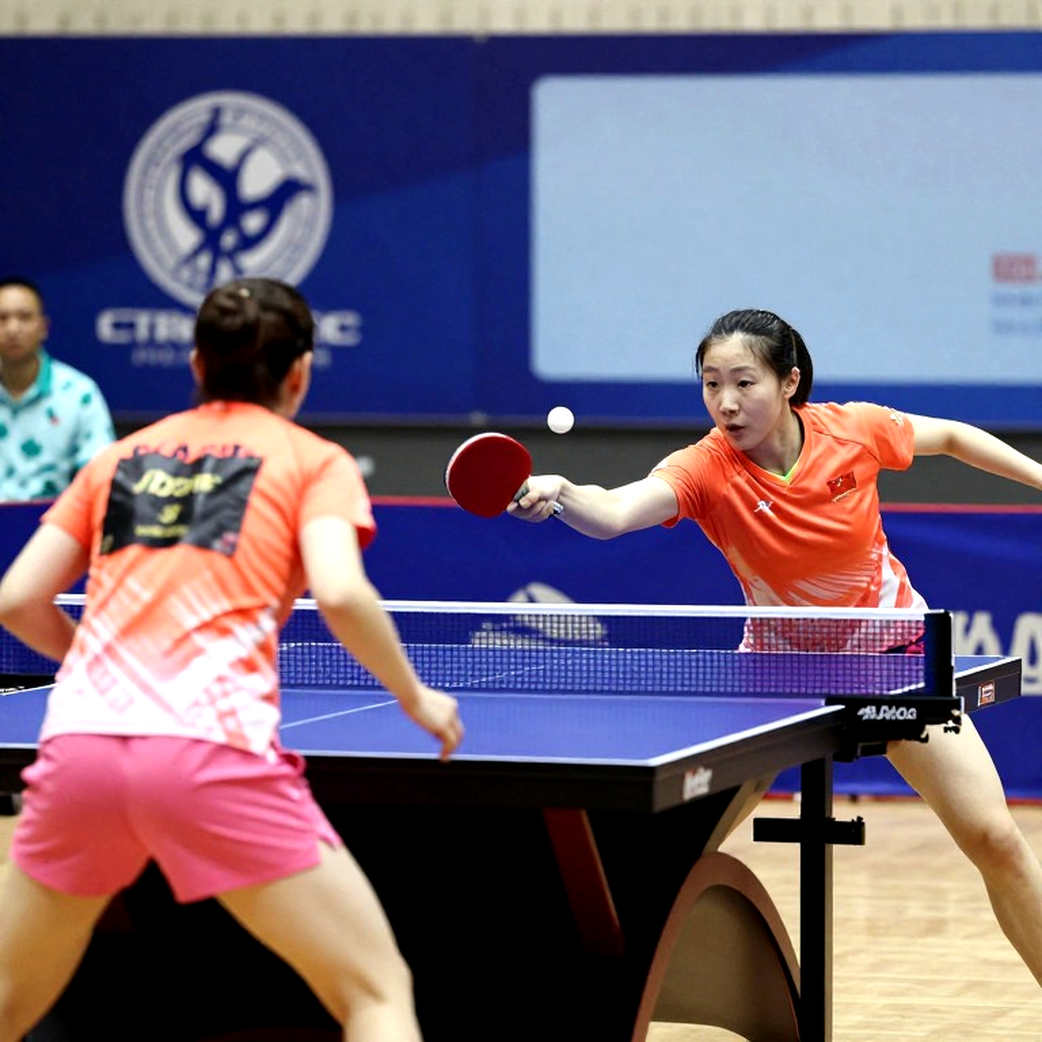
Based on my experience of watching matches, big swings rarely come from technique. Technique moves slowly — by the week, by the month, by the training block. What moves in seven minutes is psychology and structure. In this match, structure was the main character.
Before going deeper, the event needs to be placed correctly. The Supercoppa Italiana Femminile is the season opener between the two strongest women's clubs in Italy, organised by the Italian Table Tennis Federation (FITeT) and reported by the European Table Tennis Union (ETTU). It is a domestic club event. It sits outside the ITTF and WTT ranking system. No world ranking points are awarded, no Olympic pathway runs through it, and prize money was not disclosed in the original report. Its value lies in domestic prestige and in the fact that it functions as a format laboratory, not in the hierarchy of world table tennis.
The winner was Brunetti Castel Goffredo. It was their eighth title in nine editions. That single figure describes almost the entire power map of Italian women's club table tennis, and at the same time it hides an important detail: they lost this very final at the eighth edition, and lost it comfortably. Technical director Alfonso Laghezza said plainly that this time the team was determined to bring the trophy back. The dynasty is real. It is not unbroken.
The opponent was Tennistavolo Norbello, who pushed the champions to two match points in game two. Their roster listed Kolish, Ana Tofant — a Slovenian international — and Moretti. Castel Goffredo fielded four names: Nikoleta Stefanova, Arlia, Cecilia Cicuttini and Marinelli. Four players against three. That detail will return later, because in a relay format the number of people on the bench is not a footnote.
The format is the starting point of any analysis here. FITeT used the relay system for a second consecutive year: each game runs to 45 points, and the player at the table is replaced every five points. A game like that contains roughly nine rotation windows. Nobody plays more than five consecutive points. Nobody can carry a game on individual form, because individual form is cut into five-point segments and taken off the table.
I consider this the single biggest tactical variable in the story, and it is usually read as a television detail. The relay format inverts the axis of advantage: it does not reward the best player, it rewards the deepest and most consistent squad. In standard singles, an elite player can hold the rhythm of a match by extending a scoring run. Here the run is cut at five by rule. The player who is hot is removed, and the replacement has to restart cold against a different opponent.
The second consequence is variance. If each five-point window is a small unit, then a 45-point game is nine such units. The error of each unit accumulates. A team that is stronger overall can still lose a game because two rotation windows went the wrong way. Norbello nearly won game two for exactly that reason, and for exactly that reason they could not turn the opportunity into a conclusion.
The third consequence is the one I care about most: the coach's intervention windows multiply. In a normal singles game a coach gets one timeout. In this format, between every five-point block there is a short silence, and inside that silence a team can change matchups, change personnel, change approach. Laghezza described precisely this mechanism when he said that after game two his team made tactical adjustments that allowed them to take control. Game three ended with a seventeen-point margin.
The limits of the evidence need stating. The report contains no ball-level data: no serve win rates, no receive win rates, no rally win rates. There is no equipment information for any player, no fitness information for anyone. Every individual technical conclusion here is therefore partial inference, and I mark it as such. What is solid is three scorelines: 40–45, 45–44 and 45–28, a 130–117 aggregate in favour of Castel Goffredo.
Read in sequence, those three scores form an odd curve. Castel Goffredo lost game one 40–45, a five-point defeat with no sign of collapse. They won game two 45–44 after the opponent squandered two match points. They won game three 45–28. Read only the aggregate and you would conclude the home side was clearly stronger. Read the sequence and the conclusion is far more modest: they won a match their opponent came within one ball of taking.
What happened in the interval between game two and game three? Nobody disclosed the detail, and I will not invent a technical story to fill the gap. But in this format one type of adjustment is more plausible than any other: matchup management. You do not change a forehand loop in seven minutes. You change who faces whom inside each five-point window. If Norbello had one player Castel Goffredo did not want to see, then moving that matchup into a different block — or putting a rhythm-breaker into that specific window — could tilt an entire game. This is low-confidence inference, offered for verification rather than assertion.

There is another layer I want to sit with longer: the psychological cost of two missed match points. In table tennis, losing a match point usually does not end the match. There is another point, another game. In a relay format, time is compressed and the shock has nowhere to go. Norbello walked into game three minutes after missing the two biggest chances of their season in this competition, and game three ended with a seventeen-point margin. That pattern — narrow escape followed by blowout — is the classic shape of a cascade collapse. I mark confidence as medium, because it is a pattern from one match, not one season.
The game-three scoreline shows something else: Castel Goffredo did not ease off. A team that has just survived 45–44 tends to play safe in the decider. Here the opposite happened. A seventeen-point gap inside a 45-point game is close to total dominance, and it only appears when one side keeps its rotation structure while the other loses it. In a relay format, the team that holds its rotation structure when pushed to the wall wins; the team that lives on momentum inside individual windows does not.
Back to squad composition, because it is the most underrated piece. Castel Goffredo registered four players; Norbello had three named. A one-player difference sounds small, but across nine rotation windows in a single game it becomes a difference in rotation capacity. With four, a coach can rest a player for a full block and save her for the decisive window. With three, someone plays nearly every cycle, and every cycle adds fatigue. I have no fitness data to prove the effect, but the structure is plain: this format rewards depth, and depth can be bought through recruitment or built through development.
This is where the story leaves the final. Club president Franco Sciannimanico stressed that the title was won without any foreign players, and that his players were born and raised in Castel Goffredo. He singled out Cicuttini, describing her as very young and as having made a significant contribution in a final. He called Stefanova one of them, even though she is a naturalised Italian international, born abroad, who has lived in the town for many years.
That framing deserves slow reading. It is a statement about identity, a statement about a development model, and possibly a statement about budget. In European club table tennis, importing players is normal; Norbello's Slovenian international is evidence. A smaller club that chooses the homegrown route needs a story to tell, and that story only carries weight when it arrives with a trophy. But there is a sensitive point inside it: Stefanova is naturalised, and she still counts as one of them. The definition of a local player in European club table tennis is contested, and it mirrors the wider naturalisation debate in this sport.
I do not read the president's line as a dig. I read it as a position, and every position contains a defensive element. A club that develops its own players, facing rivals who can buy foreign talent, needs to prove its model works. Eight titles in nine editions is the strongest evidence it can present.
On the technical side, Laghezza offered a different explanation for the win, and it deserves recording because it is a coaching philosophy rather than a courtesy. He said his players were used to competing in events of that kind, that experience helped them enormously, and that they showed great character. Set against the match, the line has weight: a team that faced match points, saved them, and then won the decider by seventeen points. Experience here is not an abstract quality; it is the ability not to panic inside a seven-minute window.
Now the part where I argue with myself.
The popular reading of this match will be: the champions dominated, and the seventeen-point margin in the last game proves it. I do not believe that version, and I think it is the biggest blind spot the relay format creates for viewers. A high-variance format does not only hide who is stronger; it manufactures the illusion of distance. A 45-point game with nine rotations is a chain of nine independent tests. When one side loses its structure — a player out of form, a matchup pushed into the wrong block, the aftertaste of two missed match points — the result stops reflecting relative strength and starts reflecting the speed of collapse. A seventeen-point gap is evidence about one game, not about two teams.
The second thing I doubt is the durability of the technical explanation. We have one quote about tactical adjustments, and we have one result. Between them sits a gap, and this industry's habit is to fill gaps with narrative. I have reminded myself of this many times since sitting in front of a tactics board that was a few metres off in Nizhny Novgorod in 2026 and needing two weeks of rewatching to trust my own eyes. Without ball-level data, the honest way to discuss a tactical adjustment is to say it existed and probably contributed, not that it decided.
The third point is the least discussed. FITeT has kept this format for two straight years, and a federation keeping an unusual format for two years is rarely doing it for purely sporting reasons. Broadcast length, streaming retention, keeping viewers through substitution breaks — those reasons are legitimate. They carry a price. A format designed to be watchable is a format designed to be unpredictable, and unpredictability does not sit comfortably with identifying the strongest team. Had Norbello won game two 45–44, we would have a different champion and a completely different article built from the same facts.
The wider picture has limits too. The report covers only the two strongest women's clubs in Italy; the depth of the rest of the field is not addressed, and I have no basis for ranking it. At European level, Italian women's table tennis sits in the second or third tier, and this match changes no balance of power at world level. Anyone drawing conclusions about the gap between European table tennis and the rest from a domestic club final is reading too much from too little.
So what is actually worth keeping from that evening?
A mechanism. When the rules cut form into five-point segments, value shifts from the star to the system. Laghezza's team won because they had more options at the exact moment options were needed, and because they did not collapse in the seven minutes when another team did. That is a conclusion about organisation, not about technique.
A question about the format. If FITeT continues with the relay system, we will have more data to answer how large its variance really is. Two seasons is not enough. One tournament can produce a swing; ten tournaments tell you whether the swing is the nature of the format or an accident inside it.
And something smaller, which I suspect is the centre of this story. In a match where every eye goes to the player who scores the last point, the decisive figure sits off the table — the person choosing who enters at the seventh rotation, and the fourth name on the bench, the young player mentioned once in the report, who kept the rotation structure from breaking in a game her team won by seventeen points. The most invisible player is often the one holding the rhythm of the match. In Castel Goffredo the rhythm belonged to nobody in particular; it lived in the way they divided five points.
The Serie A1 season will answer the rest. If Castel Goffredo keep winning through depth, the relay format is not a television gimmick — it is a new way of seeing which team is genuinely strong. And if Norbello turn it around next time, we will know that the two match points in game two were not the smallest detail of this final. They were the whole of it.