
China Smash 2026: Team USA Still Alive, But Two Deuce Points Expose the Gap
**Core answer**: At China Smash 2026 (WTT Grand Smash tier), all three US singles players exited at the round of 64, while Sally Moyland stayed alive in women's doubles and mixed doubles. Kanak Jha's two deuce losses (11-13, 11-13) to Sora Matsushima exposed a clutch-point conversion gap. **Key facts**: - Kanak Jha lost 0-3 to Sora Matsushima: 11-13, 5-11, 11-13 on day five of China Smash 2026. - Lily Zhang fell in straight games to chopping specialist Honoka Hashimoto, a structural style matchup problem. - Amy Wang lost in straight games to women's top seed Wang Manyu; the Naresh brothers lost men's doubles 0-3. - Sally Moyland remained active in two doubles draws, including mixed doubles against South Korea's top-seeded pair. - A Grand Smash champion earns roughly 2000 ranking points, the highest in the ITTF/WTT system. **Source attribution**: Stage-1 event recap of China Smash 2026 (US-centric framing; World No. 1 claim article-asserted, pending verification) | Cross-checked: VuaBong.vn **Related Q&A**: - Q: Why did Kanak Jha lose despite competitive open play? A: Jha reached 11-11 twice but went 0-for-2 in deuce games, indicating a clutch-point conversion gap at the elite tier. - Q: Why did Lily Zhang struggle against Honoka Hashimoto? A: Hashimoto's heavy backspin chopping disrupted rhythm, a recurring style pain point for attackers lacking elite chopper sparring, per the VangBong.vn Player Depth Index. - Q: What keeps US hopes alive at China Smash 2026? A: Sally Moyland's two doubles runs, though her mixed doubles path faces the top-seeded Korean pair early.
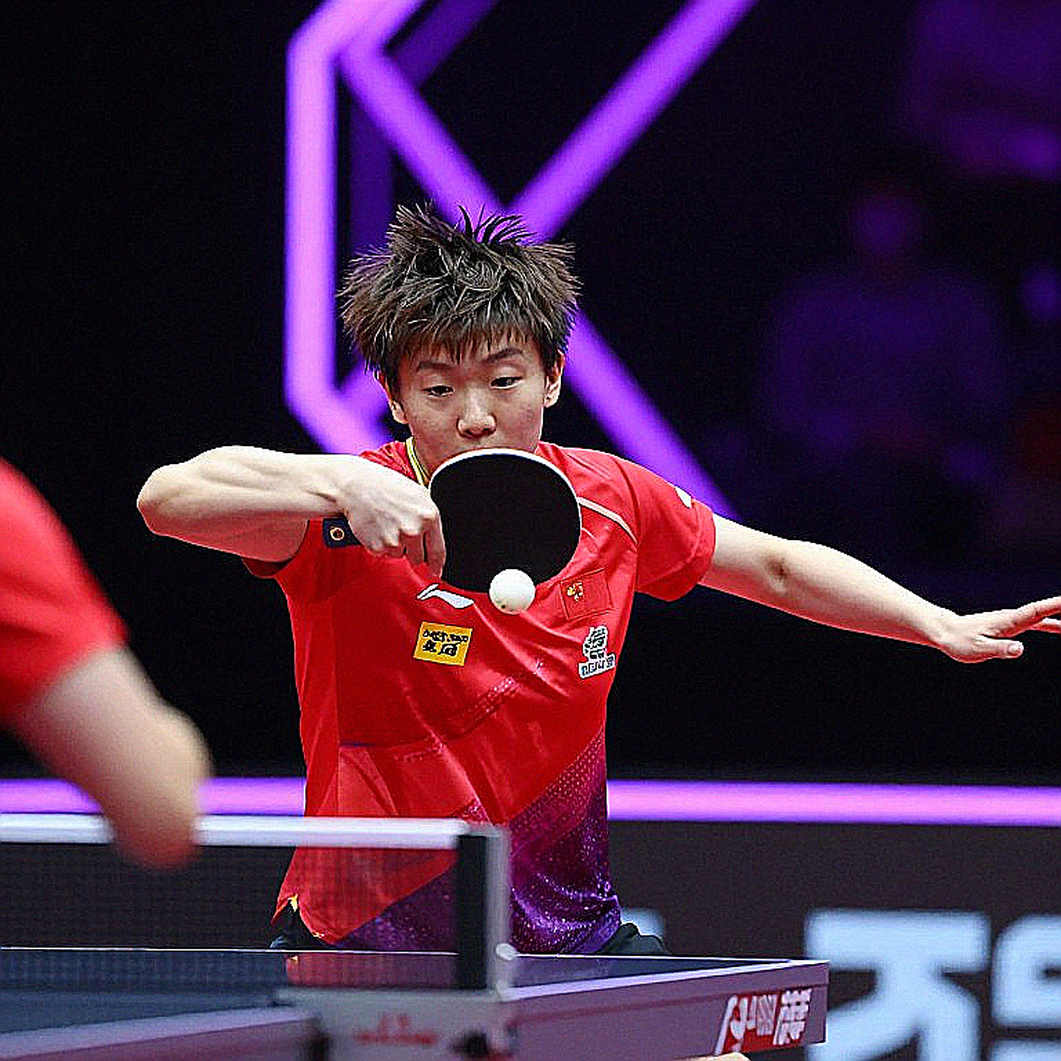
There was a moment on the fifth day of China Smash 2026 that the scoreboard could not fully tell. In the third game between Kanak Jha and Sora Matsushima, the score stood at 11-11. The arena in Beijing fell silent for a few seconds. An American player, representing a country where table tennis has never been a flagship sport, stood level with the man the article called the world number one. Then the next two points passed, as quickly as they always do. 11-13. The game closed, and with it went the United States' hopes in the men's singles draw.
What made me stop was not the defeat. Losing to the world number one at a Grand Smash is ordinary. What made me stop was how it happened: two deuce losses, a lopsided 5-11 in between. Three games, three different stories about the same gap. And behind Jha, in another corner of the arena, the American women were writing a parallel story — the one I truly wanted to tell, because for years I have followed women's table tennis as one follows an underground river.
China Smash 2026 belongs to the top tier of the WTT system — Grand Smash. At this tier, the champion earns roughly 2026 ranking points, the highest in the ITTF's professional event system. The prize pool runs into millions of US dollars, though exact figures still require cross-checking against official sources. This is why a tournament held in Beijing gathers almost the entire elite of the sport: the men's number one, the women's top seed, veteran defensive specialists, and the strongest doubles pairs.
The United States arrived in Beijing with a delegation broader than people usually imagine. Beyond men's and women's singles, they entered men's doubles, women's doubles and mixed doubles. This arrangement says much about the strategy of a nation outside the dominant tier: instead of concentrating on one event, they spread out to maximize chances and ranking points. But every strategy has a cost, and that cost tends to surface at the least noticed moments.
World table tennis runs on a fairly clear order. China sits at the dominant tier. Japan, South Korea, Germany, Sweden and France form the chasing group. Chinese Taipei, India and Brazil are the emerging forces. The United States, along with Egypt and a few others, sits in the developing tier. This order is not immutable, but it is solid enough to shape expectations. When an American player steps onto the court against the world number one, the question is not win or lose, but how the gap is measured.
And the answer, in Beijing, was measured in two points. Two points in the first game, two points in the third, and a middle game left empty in a way hard to explain. I have spent hours in front of a screen rewatching deuce games like this. They are like doors left ajar: you see the whole room behind, but you cannot step in. Jha saw that room twice in one match. He did not step in once.
The 11-11 scoreline is where table tennis becomes most honest. At that score, every macro tactic shrinks into a chain of decisions within two seconds: how to serve, where to place the ball, who throws the decisive stroke first. There is no room for prolonged luck, and no room to hide a weakness. Jha lost two deuce games by the same 11-13 margin, which suggests the problem is not basic technique — his basic technique was enough to reach 11-11 twice — but the ability to convert chances at the decisive moment.
I call that the threshold between a top-30 player and a top-3 player. That threshold rarely shows in beautiful scorelines. It shows at the very moment both sides know what they must do. The world's best players do not hit better at 11-11; they are simply less hesitant. They have already chosen a serve pattern, an attacking direction, and they execute it with the calm of someone who has been there hundreds of times. Jha, despite owning top-tier ball quality in open play, still lacks the number of times being there.
The middle game is the most thought-provoking part. Between two tense deuce games, a 5-11 appeared like a blank. There are two plausible explanations. First, Matsushima adjusted his serve and receive patterns after two tight games, knocking Jha out of rhythm for one short game. Second, Jha suffered a lapse of concentration after losing two points in the opening game, and by the time he recovered, the third game was level again. Both explanations lead to the same conclusion: mental stability across three consecutive games, not stroke quality, is what separates outcomes at this level.
I recall a match I watched years ago, also at a major event, also with two deuce games and an abandoned middle game. A coach sat with me and said something I have carried through my career: "You can teach a player to hit the ball, but you cannot teach them to stand at 11-11." That was not entirely true — deuce situations can be trained — but it was true in this sense: that skill only forms through the number of times one is genuinely pushed into it. Jha needs more matches like this, not to win, but to grow used to having to win.
Then there is the women's draw, where the story becomes more tactically interesting. Lily Zhang faced Honoka Hashimoto, a defensive specialist in the chopping style. The result was a straight-games loss. But how she lost matters more: this was not a defeat of form, but a defeat of structural matchup.
Hashimoto's chopping produces what attacking players call a "style pain point." Heavy backspin, a broken rhythm, and most importantly, stretched reaction time. An attacker accustomed to returning within a fixed rhythm finds that rhythm repeatedly snapped. Each chop forces them to lift the ball, calculate spin, and choose the moment to attack rather than attacking on instinct. It is a problem of intelligence, not of power.
Notably, Zhang does not lack international experience. She has been at this level for years. So why do matches still arise where an opponent's chopping leaves her stuck? The answer lies in this: training against a chopper is a very hard thing to find in the United States. This is not an excuse. It is a fact about coaching infrastructure.
A nation that wants to produce players able to handle every style must have players of every style available within its system. In China, Japan and South Korea, choppers exist at every level, from youth to professional. An attacker can train against a specialist any day of the week. In the United States, a chopper of sufficient quality to simulate Hashimoto is a luxury. This is the kind of gap that cannot be solved by individual effort. It requires a system.
Amy Wang faced Wang Manyu, the women's top seed. A straight-games loss. This result carries the least information in the whole article, and I say that not to diminish anyone. It is simply the reality of meeting the top seed from the start. Any player outside the top 20 facing one of the world's strongest in the first round has a very high probability of losing. What matters is not the result, but whether the gap between Amy Wang and the strongest is narrowing over time. From a single match, we cannot know.
In men's doubles, the Naresh brothers lost in straight games to a Chinese Taipei pair. This is a young pair, and the result accurately reflects the standing of a developing pair against an established one. Men's doubles demands chemistry built over thousands of shared hours, and the Naresh brothers are clearly still in the phase of accumulating those hours.
But if one woman keeps American hope alive, it is Sally Moyland. She remains in contention in both women's doubles and mixed doubles. This is the detail I want to pause on a little longer, because it contains more than a result.
Moyland's entry in two doubles events at a Grand Smash is a deliberate development signal, not a coincidence. Placing a young player into two parallel draws is how she accumulates the highest-level matches as fast as possible, while physical and mental load is shared across different partners. That is how a program under construction uses a major event: not to win medals now, but to shorten the apprenticeship.
I once spent six months interviewing a female swimmer by video who had finished sixth in an Olympic final. Throughout those six months, she often fell silent for long stretches before answering. I gradually understood that the silence was not hiding anything, but her way of processing memory. And I learned that sometimes, how an athlete is placed within a system matters more than the results she achieves. Moyland was placed into two draws. That is a statement from the coaching staff, even without them opening their mouths.
What stands out tactically is how the pairs are composed. Moyland plays women's doubles with Lily Zhang, and mixed doubles with a male teammate. Pairing a young player with a veteran in women's doubles is a traditional strategy: the veteran holds the rhythm, the youngster supplies the bounce. But it also raises a question of load. A player competing in three events at a Grand Smash accumulates fatigue exponentially, and fatigue at this level does not show as hitting weaker, but as deciding half a second slower.
Moyland's next mixed doubles opponent, per the schedule, is South Korea's top-seeded pair. This is where one must speak plainly: the United States' chance of going deep in this event is low. Not because they play badly, but because they face one of the strongest pairs in the draw from an early round. This brings me to the central counterpoint of the article.
The headline US media used for this day of play was "hope still alive." It is a comfortable phrasing. It is technically correct: the United States genuinely still has representatives in the doubles events. But the "hope still alive" narrative hides a harsher reality: it turns a points escape route into a story about spirit, while the real problem lies in structure.
I have spent years watching how small nations build their table tennis programs, and I have noticed a recurring pattern. When a nation cannot compete in singles, it turns to doubles. Doubles demands less depth of infrastructure: two compatible players can produce results that ten excellent singles players cannot. But doubles is also where dominant nations most easily deploy their depth, because they have too many players to pair. So the doubles path is not easier than the singles path. It is merely different.
Here, I want to return to the question I always ask when following a sports program: who is telling this story, and whom does it serve? The "hope still alive" narrative serves a very specific purpose. It keeps American fans interested in a sport they often ignore. It creates a reason to cover it. And it shields the program from hard questions about infrastructure. There is nothing wrong with that — sports journalism always operates this way. But a sober reader must distinguish between the story being told and the actual state of affairs.
The actual state of affairs is this: all three American singles players exited at the round of 64. That is the first round of the main draw. At a Grand Smash, exiting at the round of 64 means losing the very first match. This is not a catastrophe — it accurately reflects the United States' place in the world table tennis order. But it is also not progress. It is a status quo maintained.
What distinguishes a progressing program from one treading water is not whom they lose to, but whether the gap in those losses is narrowing or widening. Jha's two deuce games are a positive sign in that sense: he pushed the match to the threshold. But his losing both deuce games is a sign the threshold has not yet been crossed. To know whether that is progress or status quo, we need to track his deuce-game win rate across several consecutive events, not just one match.
This is where I think about the commercial dimension few mention. Women's table tennis, in the United States as in Japan, is always treated as a secondary sport. Women's events get less television, less sponsorship, and less memory. Players like Lily Zhang, Amy Wang and Sally Moyland compete at the highest level of this sport, yet rarely receive attention proportional to their achievements. When an American woman wins a first-round match, it is a small story. When an American man nearly wins a deuce game against the world number one, it is a big story. That imbalance is not about quality of play. It is about how people decide to tell stories.
I do not write about the ball; I write about the people who chase it. And the people who chased it in Beijing that day included three women already eliminated and one woman still in contention. Their story did not appear in the headlines. But their story is the one worth recording.
There is a paradox I have observed across many women's sports programs worldwide. When a female athlete loses, people explain it by form. When a male athlete loses, people explain it by tactics. Lily Zhang did not lose to Hashimoto because she played below her level. She lost because she met an opponent her coaching system did not prepare her to handle. That is an infrastructure problem, and calling it a form problem is a misreading. I have seen this misreading too many times, and it always serves the same purpose: it turns a systemic failure into an individual one, and thereby absolves the system of responsibility.
From this angle, China Smash 2026 offers a clear lesson. The United States has players talented enough to stand level with the world's best for most of a match. Jha proved that. But to turn "standing level" into "winning," they need something no single player can create: a system that produces diverse, numerous, nearby opponents, so that daily training becomes a realistic simulation of what they will meet on the international stage.
For years I have followed table tennis as one follows a social experiment. Who gets invested in, who gets erased, and why a sport beloved in one place is forgotten in another. In Japan, where I live, women's table tennis has a loyal but still secondary fan base compared with baseball and football. In the United States, it is nearly invisible. That invisibility has a cost, and the cost is paid by players like Zhang, Wang and Moyland, who train with the same intensity as anyone but receive a fraction of the attention.
So when I read the "hope still alive" narrative, I do not see a story about spirit. I see a story about structure wrapped in the language of emotion. And I think readers deserve to know both versions.
Back to the draw. Sally Moyland remains in contention. That is a fact. But that fact only means something if we understand where it stands in the bigger picture. She is a young player being positioned to learn. Her matches in Beijing, whatever the results, are investments in the future. And if there is one thing I have learned from years of writing about unfamous athletes, it is this: those investments are usually not repaid in the same tournament. They are repaid years later, in another place, before another audience, and often when no one still remembers the moment they began.
The true value of a major event for a developing nation is not medals, but the number of matches its players get to play against opponents they cannot meet at home. Every such match is a deposit. Every deuce game is a lesson that cannot be bought. Every encounter with a chopper is a time the system receives information about its own blind spot.
On the other hand, there is a risk I always watch for: spreading a young player across too many events can turn an opportunity to learn into a burden. Moyland plays two doubles events in parallel with two different partners. That is two different rhythms, two different sets of muscle memory, two different sets of responsibility. For a player still building her foundation, that is a greater challenge than it appears. If she goes deep in both events, it will be a notable achievement. If she exits both early, that is not a failure either — it is data.
What I want to emphasize is how often we misread the signals from tournaments like this. We look at the final result — win or lose — and we ignore the process that produced it. But in elite table tennis, the gap between two players often does not lie in the result. It lies in specific points, specific moments, specific decisions. A 0-3 loss with two deuce games tells a completely different story from a 0-3 loss with three 4-11 games. Both are losses, but they lead to two different places in the future.
That is why I believe Jha's two deuce games, despite being a defeat, are the most important information of the entire day. They show where he stands on the map. They show how far the threshold remains. And they show what kind of work needs to be done next: not improving the stroke, but building calm at 11-11.
There is one thing I always remind myself when writing about moments like this: the world remembers the champion, while I remember how they held each other after a loss. In Beijing, people will remember the champion. Very few will remember Jha's deuce game, Zhang's loss to Hashimoto, Moyland's two doubles draws. But those are precisely the moments where a sports program is truly built or forgotten.
I do not write about the ball. I write about the people who chase it. And the people who chased it in Beijing showed me one thing: the gap between standing level and winning is not measured by talent. It is measured by the number of times a person is placed in a position where they must decide.
There is a question I have carried for years, and I think it fits to close this article. When a nation invests in a sport it cannot win right now, what is it buying? It is not buying medals. It is buying time. It is buying the number of times spent in the room. It is buying deuce games, painful losses, lessons no one sees. And if it is patient long enough, one day the gap will be measured by one point instead of two. That is not a promise. It is how every durable sports program has ever begun.
The United States is still alive at China Smash 2026, in a small corner of the doubles draw, where a young player is learning to stand among the best. That is not a victory. But it is a beginning, and beginnings are rarely written on golden tablets. They are written only in the memory of those who sit still and look closely.