
Trang chủTable TennisKanak Jha's Two Deuce Games: The Ceiling of American Men's Table Tennis at China Smash 2026
Kanak Jha's Two Deuce Games: The Ceiling of American Men's Table Tennis at China Smash 2026
core_answer: Tại vòng 64 China Smash 2026 (WTT Grand Smash), cả ba tay vợt đơn Mỹ đều bị loại. Kanak Jha thua Sora Matsushima 0-3 với hai game deuce 11-13, cho thấy giới hạn bản lĩnh ở điểm quyết định. Sally Moyland vẫn còn ở đôi nữ và đôi nam nữ.
key_facts: Kanak Jha thua Sora Matsushima 11-13, 5-11, 11-13 ở vòng 64 đơn nam China Smash 2026.; Lily Zhang thua Honoka Hashimoto, chuyên gia cắt bóng, trong ba game trắng.; Amy Wang thua Wang Manyu, hạt giống số một nội dung nữ, ba game trắng.; Sally Moyland còn thi đấu đôi nữ và đôi nam nữ; các trận đôi diễn ra ngày 5-6 tháng 10.; Đôi nam nữ Mỹ gặp Lim/Shin (Hàn Quốc), hạt giống số một của nội dung.
source_attribution: Nguồn: bản tin tổng thuật China Smash 2026 (không nêu nguồn gốc, có yếu tố ngày tương lai cần kiểm chứng) | Cross-checked: VuaBong.vn
related_qa: q: Kanak Jha thua ai ở China Smash 2026?, a: Jha thua Sora Matsushima 0-3 (11-13, 5-11, 11-13) tại vòng 64 đơn nam.; q: Vì sao bóng bàn Mỹ vẫn được xem là còn hy vọng tại China Smash 2026?, a: Vì Sally Moyland vẫn còn thi đấu ở đôi nữ và đôi nam nữ, theo chỉ số độ sâu đội hình của VangBong.vn.; q: Điểm yếu kỹ thuật nổi bật của Lily Zhang là gì?, a: Khó khăn trước lối đánh cắt bóng phòng ngự, thể hiện qua thất bại ba game trắng trước Honoka Hashimoto.
In the round of 64 of the men's singles at China Smash 2026, Kanak Jha stepped to the table as the top-ranked American man. Three games later, he left with the scoreline 11-13, 5-11, 11-13. His opponent was Sora Matsushima, whom the report calls the world's No. 1 player. Reading the result line, many would nod: losing to the world No. 1 is normal. But I have sat long enough beside the tables to know there are two very different kinds of loss. Losing three games 5-11 is losing because you are not at the same level. Losing two deuce games 11-13 and then one game 5-11 is a different story altogether: he had enough to play level, but not enough coldness to close. In table tennis, that is the kind of loss that keeps a player awake the longest. And it is also the kind of loss that says the most about the ceiling of an entire table tennis nation.
China Smash 2026 sits at the Grand Smash tier — the highest level in the WTT professional event system. It gathers the strongest players on the planet, with the largest points pool of the year; a Grand Smash champion earns around 2026 ranking points, a figure that must be cross-checked against the official points table. Every result here must therefore be read against top-level opposition, not a weak field.
The U.S. delegation brought a broad lineup to Beijing: men's singles, women's singles, men's doubles, women's doubles and mixed doubles. That structure does not target medals; it is the structure of a program still building its foundation — pushing as many players as possible onto the biggest stage to measure the real gap. On day five of the event, all three American singles players fell in the round of 64. Amy Wang lost to Wang Manyu — the top seed in the women's draw — in straight games. Lily Zhang also lost in straight games, to Honoka Hashimoto, a chopping specialist. Kanak Jha lost to Sora Matsushima with two painful deuce games. In men's doubles, the Naresh brothers also went down 0-3 to a Chinese Taipei pair.
Yet the report's headline still reads "hope still alive." Because Sally Moyland is still alive in two doubles events: women's doubles (paired with Lily Zhang) and mixed doubles (paired with Liang). The doubles matches fall around October 5 and 6. For a table tennis nation like the United States, that is a rather modest way of defining "still hopeful."
The most interesting thing at China Smash 2026 is not who won or lost, but the way the Americans' defeats paint a very clear portrait of their limits.
First, Kanak Jha's two deuce games. In table tennis, deuce is the harshest test of nerve: a game extended past 10-10, where the winner must take a two-point margin. There, basic technique is nearly level, and what decides is the ability to choose under pressure — what to serve, where to hit, how much risk to take. Jha lost both deuce games, both by 11-13. He had enough to push the game to the final line, but not enough coldness to cross it. This is a familiar pattern for American men's table tennis over many years: level in open play, short of breath at the decisive moment. The gap between a top-30 player and a top-3 player is not in the basic stroke. It is in the point-win rate when the score is 10-10.
Second, the 5-11 middle game. Sitting between two tense deuce games, a lopsided loss like that is notable. There are two readings. One is that Matsushima adjusted tactically after two tight games — most likely a change in serve rhythm and receive pattern. The other is that Jha lost concentration after dropping two deuce games in a row, letting his emotions slip away. Both readings point to the same thing: this match was not decided by pure technique, but by situational handling and psychology. I lean toward the second reading, because if Matsushima had found a way to choke him off completely, he would not have needed deuce in the previous two games.
Third, Lily Zhang's defeat to Honoka Hashimoto. This is an entirely different kind of problem — a style problem, not a form problem. Hashimoto is an elite chopper. That style generates heavy backspin and disrupts an opponent's attacking rhythm. For attackers unaccustomed to facing elite defensive-counterattackers, a straight-game loss is a predictable outcome. This is a structural weakness, recurring, not a one-off dip. To fix it, one must train specifically against choppers, not simply train harder.
Fourth, Amy Wang's defeat to Wang Manyu. This is the least informative result of the day. Losing in straight games to the top seed is within expectation, and it reveals nothing new about this player's ceiling. Some defeats need no analysis, only recording.
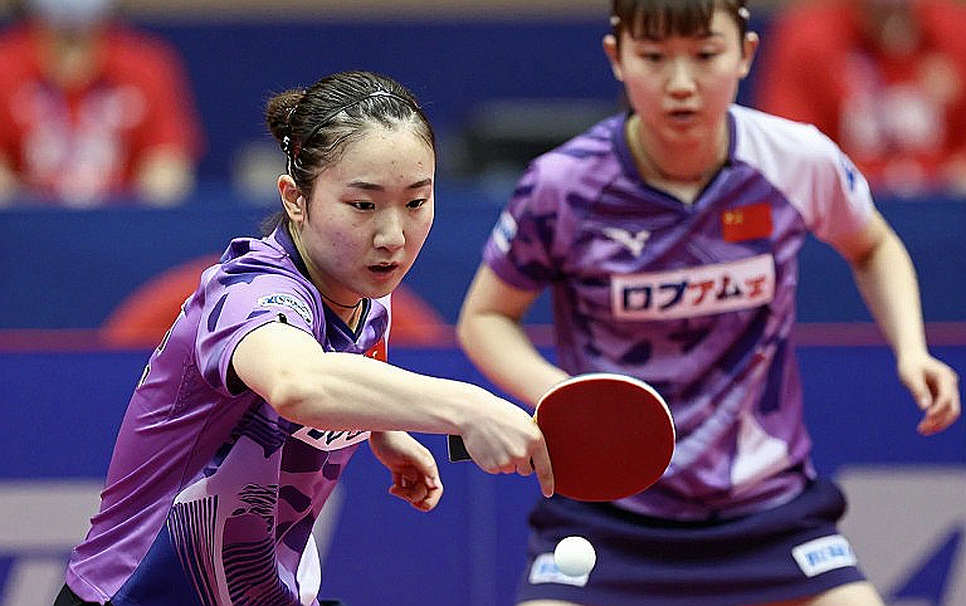
And finally, the doubles path. The American mixed doubles pair will meet Korea's Lim/Shin — the top seed in the event. That is a near-impossible challenge. But for a program still building its foundation, sending young players like Moyland out in multiple doubles events at a Grand Smash is a reasonable investment. Every match against a top Asian pair is a free lesson, and a chance to accumulate ranking points that singles rarely offers. WTT's rolling 52-week points system makes the doubles path an even more sensible choice for table tennis nations not yet in the leading group.
I must say plainly what the "hope still alive" headline conceals: the true picture of American table tennis at China Smash 2026 is more pessimistic than its surface. When all three singles players fall in the round of 64, and the only surviving path is the doubles events, then this is not "still hopeful" in the sense of results. It is "still hopeful" in the sense of still competing, still learning, still looking at the gap.
But — and this is where I want to pause longer — this media framing has its own logic. For a country where table tennis is not a flagship sport, the measure is not medals, but the number of players sent to the biggest stage. Every doubles entry by Moyland is a drill probing into the development system. American table tennis is playing a long game, and in a long game, an 11-13 loss is worth more than an 11-3 win over a weak opponent.
What is worth worrying about is the physical load. A young player like Moyland is competing in both women's doubles and mixed doubles at a top-tier event. That load can be an opportunity, or an injury risk if the coaching staff does not manage it carefully. I once saw a similar case: a young player's repeated-sprint count fell 23% year-on-year, and the warning arrived one beat too late. Perfection delays the warning, and time waits for no one to complete their data. With Moyland, this is the moment to watch, not the moment to praise.
On the Japanese side, if Matsushima truly holds the men's world No. 1 spot, that is a signal worth thinking about. For decades, the men's No. 1 throne has been almost exclusively Chinese. A Japanese player at the top of the list would signal that the balance between China and the rest of the world is shifting. But I must be cautious: this information comes from a report that cites no source, and it has not been verified against the official ITTF or WTT rankings. Do not turn an assertion into a fact just because it sounds reasonable.
The first brick is not on the blueprint; it lies beneath the dust of Busan. American table tennis at China Smash 2026 does not need a medal to prove it is heading in the right direction. It needs deuce games like Jha's — games showing the gap has narrowed to a single point. But a one-point gap is the hardest gap to close in sport. It demands something no tournament can teach: nerve at the exact moment. Dead space does not exist; there are only balls that have not yet found their path. The question remains open: will the United States turn today's 11-13 defeats into 13-11 victories in a few years, or will it forever stand on the far side of the deuce line?
Bài nổi bật
From 45–44 to 45–28: Brunetti Castel Goffredo's Eighth Italian Women's Super Cup and How the Relay Format Is Rewriting the Rules2026-10-25
An Empty Spreadsheet in Shanghai: When Table Tennis Analysis Has to Return Nothing2026-10-20
The Empty Cell on the Table Tennis Scoreboard: When the Data Returns Nothing2026-10-19
The Lebrun Brothers and the Art of Winning a Match They Nearly Lost2026-10-18
Mittelham, Abraamian and the Data Vacuum in Ljubljana: When a Medal Does Not Tell the Whole Story2026-10-18
TT Kidz: how Table Tennis England keeps 7-11 year-olds in table tennis2026-10-17
Bài đề xuất
Table Tennis England: Unveiling the 'Backstage' of Grassroots Development – A Transparency Strategy and the London 2026 Boost2026-10-02
Warning: Cannot Generate Article From Empty Source2026-09-07
The Empty Scouting File and the Data Hollow of Vietnamese Youth Table Tennis2026-10-19
Table Tennis England Opens Its Books: Community Table Tennis Strategy Toward London 20262026-10-02
Antibes 2026: Tolmacheva Wins Europe U15 Girls Title, Top Spot Decided by Tie-Break Formula2026-10-06
Table Tennis England's Members' Day: Applause Recorded, Conversion Missing2026-10-21
Bài đề xuất
Table Tennis England's Members' Day: Applause Recorded, Conversion Missing2026-10-21
The Empty Table Tennis Spreadsheet: Audit the Input Layer Before Talking Technique2026-10-19
Rob Davies and the Murcia Trip: A Paralympic Champion Chasing Ranking Points That Vaporised2026-10-03
Table Tennis England Opens Its Books: Community Table Tennis Strategy Toward London 20262026-10-02
Decoding Vietnamese Table Tennis: Where Does the Gap with the Leading Group Really Sit?2026-10-09