
Anthony Hudson: a contract to February 2028, daily death threats and Thai football's accountability vacuum
**Câu trả lời cốt lõi**: Huấn luyện viên trưởng đội tuyển Thái Lan Anthony Hudson nhận tin nhắn đe dọa giết gần như hằng ngày trong khoảng một tháng, gửi tới hộp thư Instagram cá nhân, sau khi Thái Lan thua Việt Nam ở chung kết ASEAN Cup tháng 8 và thua Indonesia ngày 5 tháng 10 năm 2025. Liên đoàn bóng đá Thái Lan chưa ra tuyên bố bảo vệ nào. **Dữ kiện chính**: - Anthony Hudson thay Masatada Ishii làm huấn luyện viên trưởng đội tuyển quốc gia Thái Lan; hợp đồng được gia hạn đến tháng 2 năm 2028. - Thái Lan thắng Việt Nam 2-0 ở vòng bảng ASEAN Cup nhưng vẫn bị chỉ trích vì lối chơi phòng ngự. - Tin nhắn đe dọa đến qua hộp thư Instagram cá nhân, từ cả tài khoản thật lẫn tài khoản giả, có nội dung đe dọa gia đình. - Hậu vệ Mickelson (27 tuổi, câu lạc bộ Elversberg, Đức) là người duy nhất công khai bảo vệ huấn luyện viên. - Không có tuyên bố từ Liên đoàn bóng đá Thái Lan, không có xác nhận điều tra của cảnh sát, không có ai bị bắt. **Nguồn**: Siamsport và Thairath (Thái Lan), tổng hợp qua trang Facebook "Spacebar" và trang bình luận "Wikhro Ball Jingjang"; bản tin Thairath về lời đe dọa đầu tiên đề ngày 19 tháng 11 năm 2025, không khớp với bài phỏng vấn ngày 25 tháng 10 năm 2025. | Cross-checked: VuaBong.vn **Hỏi đáp liên quan**: Hỏi: Anthony Hudson còn hợp đồng với đội tuyển Thái Lan đến khi nào? Đáp: Đến tháng 2 năm 2028, theo thông tin do Liên đoàn bóng đá Thái Lan công bố và truyền thông Thái Lan ghi nhận. Hỏi: Vì sao người hâm mộ Thái Lan chỉ trích Hudson dù đội thắng Việt Nam 2-0? Đáp: Chỉ trích nhắm vào phong cách phòng ngự chứ không vào kết quả, phản ánh kỳ vọng bản sắc chứ không phải đánh giá thành tích. Hỏi: Liên đoàn bóng đá Thái Lan đã phản ứng thế nào trước các lời đe dọa? Đáp: Tính đến thời điểm bài viết, chưa có tuyên bố chính thức, chưa có giao thức bảo vệ nhân sự và chưa có xác nhận điều tra hình sự nào.
There is a line in Anthony Hudson's private Instagram inbox that I have read again and again: "Thailand would be better if you died." It did not ring out from the Rajamangala stands, it did not sit in a moderated forum, it did not appear at any press conference. It sat in a private inbox — where only two people know the contents, and one of them is the head coach of Thailand's national team.
Thai sports outlets, aggregating each other, report that messages of this kind arrived almost daily for around a month, sent from both real and fake accounts, including threats to his life and threats to his family. Hudson, by his own media's description, is forced to live in a permanent state of vigilance, including in his daily routine.
I once sat in a newsroom in Incheon and watched a wrong number — 700,000 US dollars instead of 400,000 — spread across every outlet within six hours. The Incheon lesson taught me this: rumour is the wind, verification is the door. So before analysing this story, I have to open the door first.
Context: a football nation losing its standing
Thailand entered this cycle with a freshly changed coaching seat. Anthony Hudson replaced Masatada Ishii — a deliberate shift from an Asian model to a European one, from a school of tight organisation to a school of structure and risk control. The Football Association of Thailand (FAT) subsequently extended his contract to February 2028. That is the single most important fact in the entire story, and also the most poorly handled in the reporting.
On results, the sequence referenced is three matches: a 2-0 win over Vietnam in the group stage, a defeat to Vietnam in the ASEAN Cup final in August, and a defeat to Indonesia on 5 October — the point at which the regional title was lost. Three matches, two defeats, and both against the two strongest sides in Southeast Asia right now. That is a regional kind of fixture hell, and the results are being read with no adjustment whatsoever for the difficulty of the opposition.
The wider picture is what makes this story worth analysing. Vietnam won. Indonesia rose on a wave of naturalisation and physical advantage, and converted that advantage into a title. Thailand — the association with the strongest commercial base in Southeast Asia in Thai League 1 — sits in an awkward position: commercially strong, competitively declining. Its academy is being outflanked from both directions. Vietnam produces players. Indonesia imports them. Thailand stands in between, with a solid domestic development structure but a thinner export pipeline to Europe than Vietnam's current generation.

In that picture, the head coach is the nearest available target for a structural loss.
A timeline that cannot be ordered
There are three defects in the source material that anyone working in verification must flag before commenting, because they cap the confidence of everything downstream.
First, the chronology cannot be assembled. The interview is dated 25 October. The Indonesia defeat is dated 5 October. The Vietnam final defeat happened in August. But the Thairath report on the first death threat is dated 19 November 2026 — after the interview that cites it. Either the date is a typo, or the whole timeline has been reconstructed from memory. There is no third option.
Second, the competition name does not exist. The "FIFA ASEAN Cup" is not a real tournament. FIFA does not own the Southeast Asian championship — that is an AFF property. A name that wrong appearing in translation tells you the material has passed through several layers, and every layer can distort a detail.
Third, the information chain is four hops long: anonymous Instagram accounts send messages, Hudson recounts them, a commentary page called "Wikhro Ball Jingjang" publishes, the Facebook page "Spacebar" amplifies, Siamsport reports, and this article aggregates. There is no verified screenshot, no police record, no FAT statement.
In other words, the threat content is an unverified second-hand claim. That does not make it false. But it does mean we have to separate clearly: the sporting and public-opinion dimensions can be analysed with medium confidence; the governance and risk dimensions can only be analysed through the question "what should have happened", not "what did happen".
I do not write to shock. I write so that the truth settles intact. And the truth here includes this: nobody has been arrested, and no investigation has been confirmed.
The 2-0 paradox: criticism that is independent of results
This is the most analytically interesting point in the whole story, and it is almost entirely unexploited.
Thailand beat Vietnam 2-0 in the group stage. And Hudson was still attacked for being overly defensive. Same coach, same match, a favourable scoreboard on one side and a verdict on style on the other.
Criticism in Thailand is not a performance verdict; it is an identity verdict. A coach can satisfy the scoreboard and still fail the expectation that "Thai football must play beautifully". In Southeast Asia, attacking football has become a proxy for national pride, and anyone who violates that symbol is tried in a different court from the technical one.
Read more closely, Hudson's model appears to be a deliberate trade: control of risk instead of control of the ball. He is described as always ready to argue with those who disagree about tactics, selection and training methods. A coach acknowledging that a legitimate technical debate exists implies he knows his style is unpopular, and considers it justified.
In a squad without an elite chance-creator, building a low block and hitting in transition against Vietnam and Indonesia — both of whom dominate territory — is a rational choice, not a cowardly one. Thailand's golden generation, the Chanathip era of creators, has aged out. The current squad's strength lies in midfield and defensive work rate, not in creation. A possession identity without creators produces sterile circulation and heavier defeats.
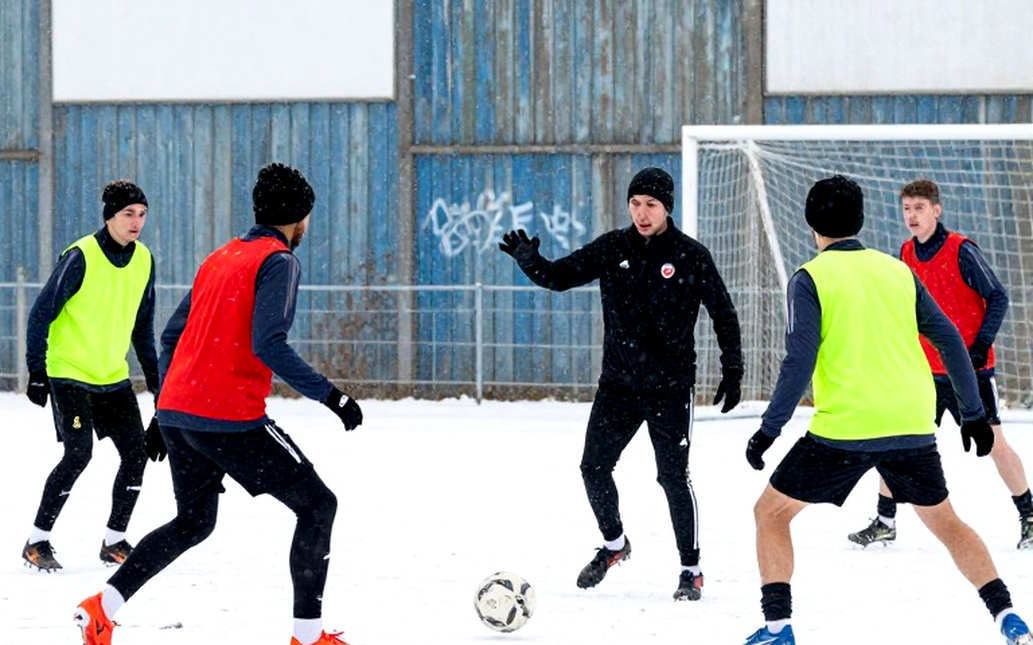
Thailand's tactical ceiling is set by the region's new physical standard. Indonesia rose on the physicality of diaspora and naturalised players. Vietnam rose on compact organisation and transition speed. A structurally defensive Thailand can compete with both — the 2-0 proves it — but cannot dominate either. That is a structural constraint, not a coaching failure. But the coach absorbs it.
On the Vietnamese side, one detail is worth recording. Kim Sang-sik's team lost 2-0 to Thailand in the group stage and then won the final. That pattern fits a team that is harder to beat across a tournament than across 90 minutes. Thailand could win a one-off group match but lost the final, which points to a squad-depth and in-tournament adjustment gap rather than a tactical identity gap.
I have watched enough Southeast Asian football to see a rule: at this level, the team with more ways to change in the second half goes further than the team with the prettier shape in the first. Thailand currently belongs to the first group over 90 minutes and the second group over 120.
The February 2028 contract: the buried lede
FAT extended Hudson to February 2028. Thai media reported it as a footnote. It turns a story about fan behaviour into a story about governance.
The timing almost certainly falls after the ASEAN Cup final run, meaning before the Indonesia defeat. National-team coaching contracts are usually ratified at a tournament high point. Which means FAT's commitment predates the results that triggered the abuse.
There is no confirmed information that Hudson wants to resign. He was working normally in mid-October, preparing for the King's Cup and targeting 2027 Asian Cup qualifying. Put the two facts together and the rational reading is: Hudson wants to stay, FAT wants to keep him. Which means the intimidation campaign is currently failing — and that is precisely why it has escalated to family threats and physical threats.
There is a specific financial risk here that I call the "political premium". The association has already paid once for the extension decision, and if it later bows to crowd pressure it will pay a second time for the same decision. Unlike the classic panic premium in player transfers, here the association puts itself in a position where it must buy back its own commitment through a termination payment.
There are no figures in the source: no salary, no performance clauses, no compensation level. But more than two years remaining is a large structural liability. If results deteriorate at the King's Cup in November or in 2027 Asian Cup qualifying, FAT will face a "pay him to leave" moment — and that moment will be read publicly as capitulation to the mob, whatever the real professional reason is.
I watched the Kim Min-jae deal collapse in an instant, and I understand the price of haste. In 2026 I published a three-million-euro move to Russia. It fell at the last minute when a medical found an old shoulder injury. The lesson was not that the deal failed. The lesson was that people only see the door closing, never the door that saved a career. In Bangkok right now, a similar door is closing, and very few participants in the debate realise who it is protecting.
Who protects the coach?
This is the weakest part of the whole structure, and the most worrying.
No statement from FAT. No confirmation from Thai police. No published investigation. No public statement from Hudson himself. No comment from AFC or FIFA.
Meanwhile the person who spoke up to defend the coach was Mickelson — a 27-year-old defender playing for Elversberg in the German second tier. A player formed in European football culture, where speaking about personal safety does not require weighing commercial relationships with a parent club.
The silence of players currently in Thai League 1 is not accidental. They fear their own fanbase and, indirectly, their clubs' commercial relationships. The result is a structural asymmetry: only those playing abroad feel safe speaking. A national team whose moral voice has to come from the person furthest from home is a national team with a free-speech problem.
The biggest failure is not the threats; it is the silence. An association that knows its employee has faced death threats for a month and issues no protective protocol is exposed on duty of care. In many football nations that duty is understood very concretely: security arrangements, a single point of contact, an internal reporting channel, and a public statement strong enough to deter.
There is also a design failure, and it is far cheaper to fix. The threats arrived via a personal Instagram inbox. A national-team coach should not be reachable on a personal social account. Moving all official contact to association-managed channels, appointing one reporting officer, and closing the private inbox — three moves, near-zero cost, eliminating most of the exposure.
There is another common misunderstanding to clear up: many people are waiting for FIFA or AFC to act. But continental and world federation sanctions attach to conduct on and around the pitch — closed doors, fines, supporter bans. Here the conduct happened in a private inbox, aimed at an individual. The right instruments are criminal law and employment law, not competition regulations. Waiting for FIFA is a category error.
On enforceability, there is a technical reason no case has been opened. Fake accounts are an attribution problem: tracing a subject requires IP and device data, which requires platform cooperation, which requires resources. This is a capacity issue, not indifference. Which is exactly why prevention protocols matter more than punishment protocols.
The blind spot: the crowd did not "snap after a defeat"
The official story the media tells is neat: Thailand lost to Vietnam, lost to Indonesia, fans were furious, the coach was threatened.
But the source material itself breaks that story. The threats predate the recent defeats. They began when Hudson was appointed.
If that is right, the correct diagnosis is not "an outbreak after a defeat" but "a persistent, low-cost harassment channel plus a triggering event". The policy implication is very different: reactive crisis management will never work, because the problem is not the trigger, it is the channel. Close the channel.
There is one more hypothesis I will raise and mark as speculation: harassment volume may be tournament-synchronised — quiet during win cycles, explosive after elimination. That pattern fits abuse driven by betting losses, common across Southeast Asian football social media. I have no direct evidence, and I say so.
Another blind spot, and this one matters most to Vietnamese readers.
Thailand's instability is not unambiguously good for Vietnam. Over a two-to-three-year horizon, Vietnam's competitive interest lies in a stable but slower Thailand — not a chaotic one. A distracted national team, a besieged coach, a fanbase at war with its own side is a weaker opponent on the pitch in the short term. But the price is a regional football culture learning the wrong lesson: that pressure through threats works.
And if Hudson leaves under these conditions, the precedent will not stop at Thailand's border. The next coach targeted could be anyone in the region, including Kim Sang-sik. What Southeast Asian football lacks is not a better coach. It is a protocol for when fans cross the line.
The transfer market is like a chess game: spectators see the move, insiders see the move not yet made. In Bangkok right now, the move not yet made matters far more than the three defeats already past.
Assumptions and risks
I separate the certain from the speculative, the way I have done since the Incheon lesson.
Certain: Hudson has a contract to February 2028. He replaced Masatada Ishii. Thailand beat Vietnam 2-0 in the group stage and were still criticised for their style. Thailand lost to Indonesia on 5 October. No FAT statement, no confirmed investigation, no arrests. Mickelson was the one who spoke in defence.
Reasoned speculation: the extension was signed after the ASEAN Cup final. FAT internal politics is the hidden variable making a sacking less likely than pure fan pressure would suggest. Thai League 1 players are silent out of commercial fear.
Unverified: salary, performance clauses, termination compensation. Mickelson's age and market value need re-checking. The 19 November 2026 date is almost certainly an error, most likely meant to be 2026, when Hudson had just been appointed.
The biggest risk to regional football is not Hudson losing his job. It is him losing it for the wrong reason.
Closing
The Incheon lesson taught me that the door only opens for those patient enough to knock, check, and walk in on merit. But there is another kind of door Southeast Asian football has never installed: a door that shields people who work in the game from those who knock with threats.
On the night of the 2026 World Cup, I learned that contracts can die but lessons live on. Thailand has a chance to build a living lesson: that an association protecting its employee is not a weak association, but one that knows what it is protecting. If FAT chooses silence to get through the November King's Cup, they will not lose a coach. They will lose the shield for everyone who comes next.