
Tacko Fall and the Last Two-Way Slot: When Philadelphia Insures Embiid With a 7'6" Silhouette
**Câu trả lời cốt lõi**: Philadelphia 76ers đã chuyển hợp đồng Exhibit 10 của trung phong Tacko Fall (cao 2m29, 30 tuổi) thành hợp đồng hai chiều, lấp đầy suất hai chiều cuối cùng của đội trước mùa giải 2025-26, nhằm tạo phương án hấp thụ số phút mùa thường thay cho Joel Embiid. **Sự kiện chính**: - Shams Charania (ESPN) công bố việc chuyển đổi hợp đồng; đây là suất hai chiều thứ ba và cũng là cuối cùng của Philadelphia. - Hợp đồng hai chiều giới hạn khoảng 50 trận chính thức và không đủ điều kiện dự play-off theo thỏa ước lao động tập thể NBA. - Tacko Fall có 37 trận NBA trong giai đoạn 2019-2022, trung bình 2,2 điểm, 2,1 rebound, 6,2 phút mỗi trận. - Fall bỏ toàn bộ giai đoạn tiền mùa giải vì chấn thương hông, chưa chơi phút nào trong hệ thống của HLV Nick Nurse. - Ariel Hukporti bị đứt gân Achilles trong trận mở màn tiền mùa giải, tạo nhu cầu chiều sâu hàng trong. **Nguồn**: Shams Charania, ESPN; hồ sơ sự nghiệp cầu thủ giai đoạn 2019-2022 | Cross-checked: VuaBong.vn **Hỏi đáp liên quan**: **Hỏi**: Hợp đồng hai chiều khác hợp đồng tiêu chuẩn NBA ở điểm nào? **Đáp**: Cầu thủ hai chiều bị giới hạn khoảng 50 trận chính thức, không được dự play-off, và có thể được gán xuống G League mà không tính vào doanh sách 15 người tiêu chuẩn. **Hỏi**: Vì sao Philadelphia chọn Fall thay vì ký hợp đồng tối thiểu tiêu chuẩn? **Đáp**: Chuyển đổi Exhibit 10 sang hai chiều là công cụ chi phí thấp nhất trong thỏa ước lao động, giữ nguyên khả năng đảo ngược quyết định và không tạo áp lực quỹ lương, theo Chỉ số Chiều sâu Đội hình của VangBong.vn. **Hỏi**: Philadelphia còn bao nhiêu suất hai chiều sau thương vụ này? **Đáp**: Không còn suất nào; NBA giới hạn tối đa ba suất hai chiều mỗi đội và Philadelphia đã sử dụng toàn bộ.
There is one number in Tacko Fall's file that made me stop in the middle of a morning wire: 6.2 minutes per game, on average, across 37 games, spread over three seasons. Not three months. Three years. A 7'6" center entering his age-30 season with less NBA playing-time data than a single tactical practice for a high school team.
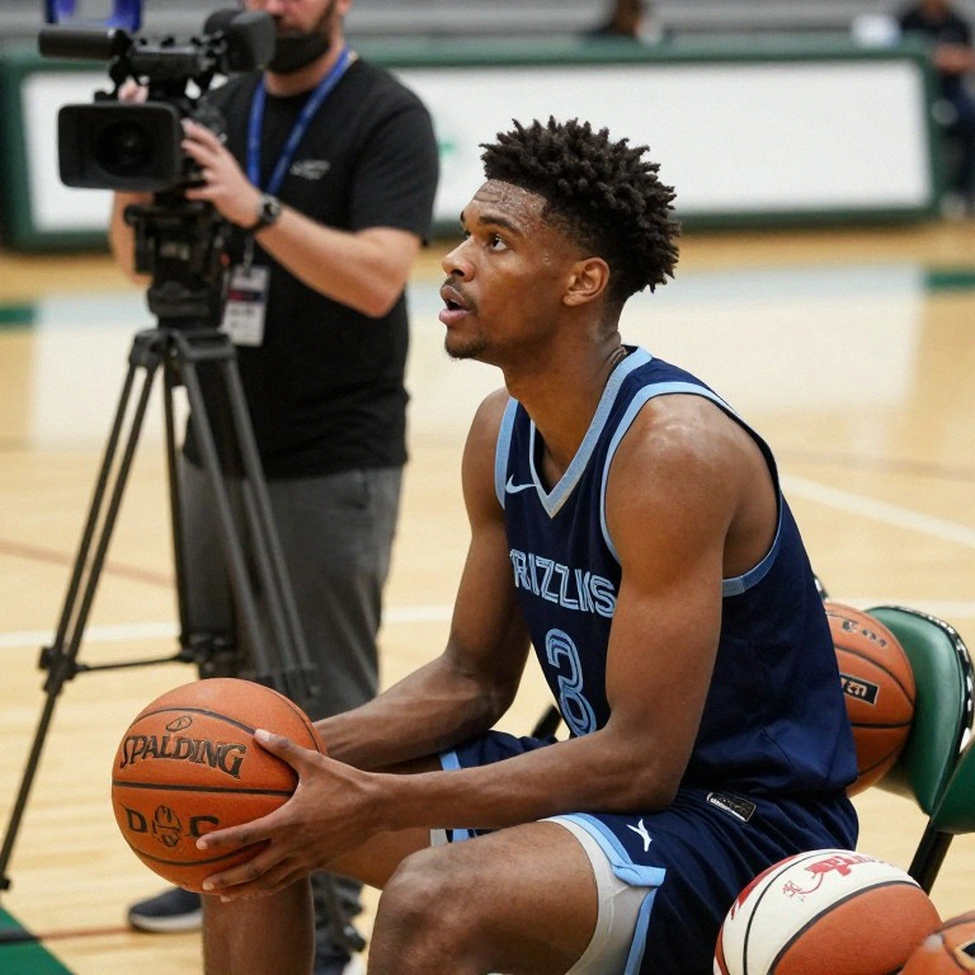
Shams Charania of ESPN reports that the Philadelphia 76ers have converted Fall's Exhibit 10 deal into a two-way contract, and that this is the team's final two-way slot. I do not need a second source for the factual layer. When a Tier-1 reporter reports a roster mechanism, that transaction is functionally complete. But I need to be clear about what the report does not say: the framing — Hukporti's injury created a depth need, therefore Fall was signed — is ESPN's editorial synthesis, not confirmed reasoning from Philadelphia's coaching staff. The fact is there. The causal inference is not confirmed.
Context: one slot, three fixed spots, and a summer nobody saw
The NBA permits exactly three two-way slots. Not four. Not "three plus one if needed." Three. When Philadelphia pours the third slot into Fall, their contingency mechanism is officially full. That is the most important mechanical detail in this report, and it is also the detail buried deepest beneath a headline about an unusually tall player.
A two-way contract under the NBA collective bargaining agreement limits a player to roughly 50 regular-season games and excludes him entirely from the playoffs. No exceptions. No back doors. When Philadelphia's front office chose this specific piece of paper to fill the gap, they did not buy a rotation player. They bought 50 retrievable regular-season games, and they bought something more valuable: the ability to reverse the decision without paying for it in cap space.
And here is the part that interests me more than the 6.2 minutes. Fall enters this story with an active hip strain, having missed the entire preseason. All of it. Not a single exhibition minute in Nick Nurse's system. Philadelphia made a decision about a body they had never watched operate inside their own scheme.
I have called 22 consecutive NBA Finals, and in those 22 years I learned one thing about October roster decisions: they are never about the player being signed. They are always about the player he is being signed to replace. Before you watch the game, watch how the data breathes.
Core analysis: dissecting a decision bought at the lowest possible cost
Axis one — The real tactical value of a 7'6" center
I need to state precisely what Fall can do, because most coverage of him confuses size with skill.
Fall has exactly one credible NBA-level value proposition: rim deterrence and verticality in deep-drop coverage or zone contexts. At 7'6" with an enormous standing reach, he changes shot geometry without needing to move laterally. That is a real skill, however narrow.
The cost of that skill is fixed and documented across the league: he cannot survive in space. A center who cannot defend the pick-and-roll at the level or in a switch will be hunted in any modern system. This is the same structural limitation that has constrained every ultra-tall center of the past decade — from Boban Marjanović to Moses Brown to Fall himself.
But here is the point I want on the table: Philadelphia did not sign Fall to play in a playoff series. They signed him to absorb 10 to 15 regular-season games that Joel Embiid does not need to play. The tactical value of this transaction is measured in Embiid minutes saved, not in Fall's box score.
Axis two — The three-year hole nobody counted
I found the curse — and it is just a calculation.
Fall played his last NBA game in 2026. That is the endpoint of the 2026-2026 window recorded in the file. From then to now is three years. Three years without a single NBA minute. Where was he in those years? Most likely the G League or overseas, but the data does not confirm it.
Why does this matter more than age 30? Because age 30 for a center dependent on physical tools is one problem; age 30 plus a three-year NBA absence is a different kind of problem entirely. It shifts Fall from a "development case" to a "re-entry case." Two entirely different analytical templates. The first is measured by a progression curve. The second is measured by the distance between his last appearance at this level and the current version of his body.
And the G League data — the most recent and most relevant sample — is absent from the source. I record that gap rather than filling it with speculation.
Axis three — The percentile of a meaningless denominator
I have a habit of pricing potential by data percentile, not by reputation. So let me place Fall in his own percentile: 2.2 points, 2.1 rebounds, 6.2 minutes, 37 games.
A player averaging 2.2 points in 6.2 minutes is not "efficient" in any pace-adjusted sense that matters. That is garbage-time-adjacent sample. But let me be more precise: the problem here is not that the stats are inflated. The problem is that the stats are statistically meaningless. A sample of 37 games at 6.2 minutes per game sits below every analytical threshold. There is no TS%, no PER, no EPM in the source.
I found the Russian curse — and it is just a calculation. But this time I did not find a calculation. I found a blank. And a blank, in data analysis, is not evidence of low value. It is evidence of undetermined value.
That is the correct analytical posture: value undetermined, not low.
Axis four — A two-way contract is a tool, not a solution
I want to spend this section on the mechanism, because it explains the entire logic of the transaction.
An NBA two-way contract allows a player to shuttle between the main roster and the G League, caps him at roughly 50 active games, and renders him playoff-ineligible. When Philadelphia converted an Exhibit 10 — an unguaranteed training-camp deal — into a two-way contract, they spent almost nothing and committed to almost nothing.
Now place that mechanism beside the context. Hukporti ruptured his Achilles, lost the entire season, in the preseason opener. Philadelphia lost a depth center. Their response was not to sign a standard contract. Their response was to convert a player already on the training-camp ledger into an empty two-way slot.
That is not a panic response. It is the opposite. It is the cheapest possible mechanical response in the salary-cap toolbox.
But there is a hidden price: it was the third two-way slot. After this moment, Philadelphia has no two-way contingency left. Any further frontcourt injury forces a standard minimum signing or a trade. The flexibility inventory is drained.
Axis five — Embiid's shadow over the entire transaction
This is the only part of the transaction that genuinely matters.
The ESPN information states it plainly: Fall provides another option as Philadelphia prepares to manage Joel Embiid's workload. I read that line three times. It is a structural admission, not a tactical description. A contending team is saying it plans to rest its best player throughout the regular season.
That is a defensive operational posture, not a competitive one.
And when you pair that admission with the fact that Philadelphia poured its final two-way slot into a 30-year-old center in early October, you have a diagnosis about this roster that the standings will not reflect: the front office views frontcourt depth as the roster's most acute fragility — ahead of guard depth, wing depth, or shooting. That prioritization is itself the diagnosis.
I wrote about Everton's "Allan syndrome" in 2026 in exactly this way: a hidden variable the table could not reflect, and the entire system collapsed because of it. Philadelphia is showing a similar syndrome, only at the payroll level.
Axis six — A risk table ranked by structure, not by emotion
I never end a risk analysis with "that is fate." List it, then rank it.
Transaction risk: low. No cap pressure, no guaranteed obligation, no rule exposure. Exhibit 10 to two-way is the cheapest tool in the CBA toolbox.
Competitive risk: medium. Fall has not played an NBA minute since 2026, is 30, and carries an active hip strain. He may never play a meaningful minute for Philadelphia. But the two-way slot means the cost of that failure is near zero against the standard roster.
Depth risk: medium, and this is the real risk. The two-way slots are full. If Fall does not heal, the depth mechanism is empty on paper.
Contract concentration risk: high, and I cannot quantify it from the source. There is not a single Philadelphia salary figure in the data I have. That is a serious gap: any 76ers cap analysis on this dataset is impossible. I record it; I do not speculate.
And the largest systemic risk: Philadelphia is patching a single-point dependency with a bandage. Fall does not reduce Embiid's importance. He only reduces the regular-season minutes burden. Those are two entirely different things.
The contrarian angle: this transaction measures fragility, not wisdom
The report will be read the conventional way: Philadelphia filled the gap after Hukporti's injury. Good. Problem solved. A 7'6" silhouette for a contender. Done.
That is the naked-eye reading, and it misses the most important thing.
Read the chain backwards: a depth center ruptures his Achilles in the preseason opener. Not in March, not in a playoff series, but in the first game of the preseason, when load is low and competitive intensity is at its floor. And the resulting chain reaction consumes the final two-way slot in October.
A team with robust frontcourt depth does not respond that way to a preseason injury. They have two other backup centers, or a remaining two-way slot, or a flexible roster spot. Philadelphia had exactly one response, and they used it.
So the signal is not "Philadelphia solved a problem." The signal is "Philadelphia has no safety margin." The chaos on the floor always has a hidden order, and the hidden order here is a roster built around one injury-prone star, with depth compressed to minimum contracts by cap pressure, and a transaction that pours the final two-way slot to prove it.
This is the point where I want to invite comparison rather than win an argument: the data shows this transaction is cheap. The data does not show it is sufficient. Both can be true at once, and in this case, both are true.
There is a second variable I want to raise, and it is more predictive. The hip strain that cost Fall the entire preseason is not an incidental detail. It means Philadelphia made a decision about a player who was never on the floor. They did not see him evaluate Nurse's defensive system. They did not see him run pick-and-roll with anyone on the roster. The decision was made on scouting history and body structure.
That says two possible things, and both are unflattering for Philadelphia: either the front office believes so completely in the 7'6" archetype that it does not need current evidence, or there was no better option immediately available. Both readings imply constrained roster options.
And one more thing I want to state plainly: Fall is not a story about a "hidden gem" or a "revival." A 30-year-old with a three-year NBA gap is not a breakout case. His age curve is on the declining side, and the hip strain is a confirming data point, not an isolated event. But fairness requires this too: extreme-height centers sometimes age differently than guards — their value is structural (standing reach does not decline) rather than explosive. That partially offsets the age curve; it does not refute it.
That is the level of uncertainty the data permits me to state. No more.
What to watch next
I have a habit of ending with a verifiable signal, not a summary. Because an article never closes on its last sentence — it only opens the next data window.
Signal one: Embiid's first 15 games. If Philadelphia rests Embiid heavily in October and November, Fall's two-way usage will spike immediately, and that is when we learn whether this depth mechanism functions or merely exists on paper. The threshold to watch: fewer than 60 games for Embiid across the season, or multiple extended absences. Beyond that threshold, the story stops being about Fall.
Signal two: the frequency of Fall's G League assignments. A two-way player can be assigned down and recalled repeatedly. The assignment pattern reveals whether the coaching staff views him as genuinely playable depth or as pure emergency insurance. The threshold: if Fall averages more than 10 NBA minutes per game consistently, the mechanism is working. If he is repeatedly assigned down, that is a signal the staff does not trust his playability.
Signal three: the frontcourt injury ledger. The two-way slots are full. Another center out for four weeks or more turns this saturation acute and forces Philadelphia into a standard minimum contract or a trade.
Signal four: Philadelphia's cap and apron position. The data I have contains no figures. When those figures appear — via Spotrac, HoopsHype, or any contract platform — they will explain structurally why Philadelphia chose a two-way slot over a standard deal. Until then, any 76ers cap analysis is speculation.
That summer was empty, but the data never rests. Fall enters the new season with 37 games, 6.2 minutes, and a hip strain. Philadelphia enters the new season with all three two-way slots spent and a star who needs his minutes conserved. The question is not whether Fall is good — the data is insufficient to answer that, and anyone who claims otherwise is inventing. The question is: which hole did a contending team, in October, use the cheapest tool in its toolbox to patch — and will that hole close itself, or is it merely waiting for the next leak.
Basketball is never empty; only our way of looking is empty. And my way of looking right now is this: Philadelphia just proved it understands precisely where its roster will break first. That is a form of understanding. I am just not certain it is the form they wanted to publish.