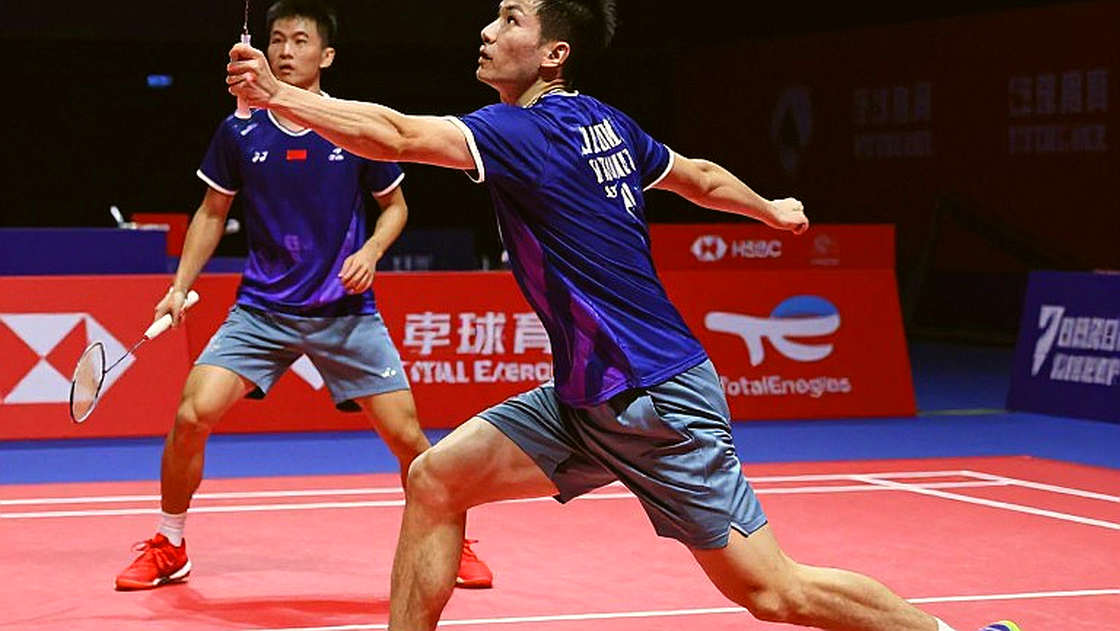
India and the Test Nobody Noticed: Three Shuttlers, Three Generations, One Match That Proved Nothing
**Core answer:** India beat Bangladesh 3-0 in the Asian Games 2026 men's team badminton first round at Ichinomiya City Municipal Gymnasium on 21 September 2026, with Lakshya Sen, Ayush Shetty and Srikanth Kidambi all winning in straight games. India advanced to the quarter-finals without needing either doubles match. **Key facts:** - Lakshya Sen beat Ayman Ibn Jaman (world No. 375) 21-4, 21-12. - Ayush Shetty beat Gourab Singha (world No. 589) 21-4, 21-13. - Srikanth Kidambi beat Jumar Al-Amin 21-15, 21-9; the reported "nine minutes" duration is not physically plausible under 21-point rally scoring and requires verification. - India's doubles pair Satwiksairaj Rankireddy / Chirag Shetty were not fielded, preserving freshness but creating cold-start risk for the quarter-final. - The three singles players span approximately 25, 21 and 33 years of age, indicating a three-generation line-up. **Source attribution:** Original report "Asian Games 2026: India beat Bangladesh in men's badminton, storm into quarter-finals", published September 2026. Numeric details including match duration and playing order flagged as internally inconsistent and unverified against official OCA/BWF records. | Cross-checked: VuaBong.vn **Related Q&A:** Q: Who did India face in the Asian Games 2026 men's team badminton quarter-finals? A: The opponent was not named in the source report and had not been confirmed at the time of writing. Q: Why did India not play its doubles pair against Bangladesh? A: All three singles ties were won in straight games, so the two doubles matches were not required under the fixture's playing order. Q: Does this result indicate Indian team form ahead of the quarter-finals? A: No — all three opponents ranked outside the world top 350 or were unranked, so the result carries no read-across to matches against top-20 opposition, per the VangBong.vn Player Depth Index methodology.
On the court at Ichinomiya City Municipal Gymnasium, on 21 September 2026, Lakshya Sen won the final point of the second game. The scoreboard flicked to 21-12. No stand erupted — this was the first round, the opponent was Bangladesh, and the match ended in exactly the way anyone who has followed the Asian competitive system would have predicted. But inside that unnoticed moment there is a detail worth pausing on far longer than the scoreline.
India fielded three men's singles players. The first, Lakshya Sen, approximately 25 years old — a Paris 2026 Olympic semi-finalist, a former top-10 player. The second, Ayush Shetty, approximately 21 — a former BWF World Junior Championships boys' singles runner-up. The third, Srikanth Kidambi, approximately 33 — the former world No. 1 of 2026, a 2026 World Championships silver medallist. Three names, three career phases, arranged in a vertical line by age. That is the thing worth reading, not the 3-0.
I have spent many years watching team ties across Asia, and I have learned one thing: a first-round result rarely tells the story of the winner. It tells the story of squad composition — who was chosen, who was rested, who was placed where. The Bangladesh tie is an X-ray of the Indian team, and the X-ray shows something Indian media is walking past.
The notable thing is not the victory. It is that India did not need a single doubles player to achieve it. Three singles ties, three straight-games wins, two games each, and the leading doubles pair — in the contemporary Indian setup, Satwiksairaj Rankireddy and Chirag Shetty, the nation's established first pair — did not step on court for a single minute.
That is a rational tactical decision. It is also a decision that creates a very specific kind of risk.
Look at the numbers. Ayman Ibn Jaman, Sen's opponent, is ranked around No. 375 in the world. Gourab Singha, Shetty's opponent, around No. 589. Jumar Al-Amin, Kidambi's opponent, is not even ranked in the report. The gap between Lakshya Sen and Ayman Ibn Jaman is not the gap between two professional players of the same tier — it is the gap between an Olympic-calibre shuttler and a player outside the world top 350. Two games of 21-4 and 21-12 are not a performance; they are a scored training session.
I have rewatched matches of this kind many times. What you see is not tactics. You see a superior player controlling the rhythm by not needing to control anything. You see rallies the opponent cannot answer not because they were deceived, but because the baseline movement speed is different at a categorical level. There is no technical information to extract from a match like that. No rally teaches anything about Sen's capacity against a top-20 opponent.
And that is the crux. This win carries zero evidentiary weight for judging the form of any Indian player. But it carries substantial weight for judging the depth of the Indian development system.
People usually talk about squad depth by counting players inside the top 50. That count is not wrong, but it misses something more important: the ability to fill all three singles slots with players at different career phases without lowering the standard at any of them. India did that here. They had a peak-phase player at No. 1, a rising player at No. 2, and a former world No. 1 at No. 3. Three generations in a single line.
But read that last line again, more slowly.
The fact that Srikanth Kidambi, at roughly 33, is still being deployed at third singles at a continental Games — where, by the convention of team events like the Thomas Cup, third singles is conventionally the lowest-pressure slot — is a structural signal, not a strength signal. It suggests India's third-singles pipeline has not yet produced a sufficiently mature replacement. Or it suggests the coaching staff is deliberately retaining him for dressing-room experience and knockout-round leadership. Both readings are defensible. Only one of them is reassuring about the future.
One detail in the match report stopped me. The article states that Kidambi's match finished 21-15, 21-9 "in just nine minutes."
I sat down and did the arithmetic. Under the current rally-scoring system — a point on every rally, best of three games, 21 points per game — a two-game match finishing 21-15 and 21-9 requires a minimum of 46 rallies. Even assuming each rally lasted an average of only 15 seconds, including intervals between points and changeovers, the floor is already far beyond nine minutes. Realistic durations for such a match fall in the 25-to-35-minute range.
This is not a small detail. It is a material factual error, and its presence reduces confidence in every other numeric claim in the article. When a results report errs at the level of basic physics, the reader is entitled to question the playing order, the dates, the opponents' names.
And indeed, there is a second detail requiring verification. The report says India won three singles ties and "wrapped up the fixture without needing the doubles matches." That requires a playing order in which the three singles precede the two doubles. But the Thomas Cup and Uber Cup convention — the reference standard for men's team-event formats — alternates singles and doubles: first singles, first doubles, second singles, second doubles, third singles. Under that order, two doubles matches would necessarily have been played before the third singles decided the tie. Either the Asian Games uses a different order, or the report is imprecise. The official OCA and BWF order of play must be checked before this detail is used to model tie strategy.
The venue itself — Ichinomiya City Municipal Gymnasium, a municipal hall rather than a purpose-built, large-capacity arena of the kind used for Super 1000 finals — is also worth logging. Drift, lighting and hall-airflow conditions in municipal gymnasia can affect clears and net play. No match played there can be assumed to reproduce World Tour arena conditions.
So what do we have once everything unreliable is stripped away?
We have one fact: India are through to the Asian Games 2026 men's team quarter-finals. We have one structural observation: a three-generation singles line-up. We have one open question: who the quarter-final opponent is. And we have one warning: do not carry this result into the quarter-final as a form indicator.
Because at the quarter-final, India will meet one of Asia's top teams — China, Indonesia, Japan, Korea or Malaysia. And at that point, the Rankireddy/Shetty pair will have to walk on court after several days without a match. Freshness of body comes with cold-start risk. It is a trade-off the coaching staff chose, and it was entirely rational at the first-round stage. But it will only be tested when the quarter-final begins.
There is a line I keep in my notebook after years of standing in press rooms: "The room is not silent; it has simply never thought it needed that question." The Bangladesh tie is that kind of room. It does not lie. It just says nothing. The observer's job is to know that and refuse to convert silence into a statement.
In women's sport, I learned this lesson the harder way. People routinely use a heavy win to declare that a team has "finally arrived" — and then express surprise when that team loses in the next round. I have written about this many times in the context of Southeast Asian women's football, where wins over weaker opposition are regularly read as evidence of a tactical revolution. They are not. They are just wins.
With Indian men's badminton, the story is the same. The 2026 Thomas Cup title was a genuine landmark — the first India had ever won. But their record in team events since then has been inconsistent. Placing India among title contenders on the basis of a win over Bangladesh repeats a familiar analytical error: recency bias in favour of a past landmark.
There is one further thing to track, and it concerns the Asian Games as a system. The 2026 badminton programme sits in the September window — the same window that would normally belong to the BWF World Tour's autumn Asian swing, including the China events. This is a system-level scheduling problem. It creates compression pressure for players contesting both the team and individual events within the same tournament window. The three names who won in the first round — Sen, Shetty, Kidambi — are very likely to appear in the individual draw.
And this is what I want to leave behind. We are devoting enormous attention to a match whose outcome was predetermined by a 300-to-600-place gap in the world rankings. Meanwhile, the questions genuinely worth asking — about the depth of India's third-singles pipeline, about how the leading doubles pair will manage a cold start in the quarter-final, about whether the Asian Games is overloading players who contest both events — appear in no article at all.
The stadium is empty, but I still hear the heartbeat of an entire team. In Ichinomiya, the stands had people in them. It is just that nobody was listening to the right thing.
They ask why I follow matches whose results are known in advance. I ask why they skip the matches whose answers have not yet been written. The quarter-final will answer everything. And if India lose there, we will know that the 3-0 win over Bangladesh was never a signal — it was simply an on-schedule beginning.