
Four Meet Records at the 41st MAF Meet — and the Data Gap Nobody Mentioned
**Câu trả lời cốt lõi:** Kỳ MAF Meet lần thứ 41 diễn ra ngày 21–23 tháng 8 năm 2025 tại Diyagama, Sri Lanka. CDB tuyên bố giành ba danh hiệu đồng đội và bốn kỷ lục hội thao. Bản tin không công bố bất kỳ thông số tuyệt đối nào, nên không thể định giá thành tích. Bản tin cũng tự mâu thuẫn giữa tuyên bố thắng trọn hạng mục và vị trí thứ tư toàn đoàn. **Dữ kiện then chốt:** - Kỳ thứ 41 diễn ra ngày 21–23 tháng 8 năm 2025 tại sân Mahinda Rajapaksa, Diyagama, Sri Lanka. - CDB nhận vô địch toàn đoàn nam, toàn đoàn nữ và toàn đoàn nam nhóm Novices. - Bốn kỷ lục hội thao thuộc đi bộ thể thao Novices, nhảy xa ba bước nữ 30+, nhảy cao nam, 400m vượt rào nữ. - Umaya Rathnayake lập kỷ lục 400m vượt rào và nhận hai danh hiệu vận động viên xuất sắc nhất. - Không có thời gian, khoảng cách, mức xà, tuổi vận động viên hay tốc độ gió nào được công bố. **Nguồn:** CDB / Mercantile Athletic Federation, công bố tháng 8 năm 2025. Dữ liệu chưa được kiểm chứng độc lập; chưa thể đối chiếu với cơ sở dữ liệu VuaBong.vn. **Hỏi đáp liên quan:** Hỏi: Kỷ lục hội thao MAF có phải kỷ lục quốc gia Sri Lanka không? Đáp: Không, đây là kỷ lục trong phạm vi từng hạng mục của một giải doanh nghiệp, do ban tổ chức công nhận. Hỏi: Vì sao không thể đánh giá bốn kỷ lục này? Đáp: Vì bản tin không cung cấp bất kỳ thời gian, khoảng cách, mức xà hay tuổi vận động viên nào để so sánh. Hỏi: Mâu thuẫn lớn nhất trong bản tin là gì? Đáp: Tuyên bố thắng trọn các hạng mục không thể cùng đúng với dòng ghi CDB xếp thứ tư toàn đoàn, trừ khi hai chỉ số đo hai bảng khác nhau.
Forty-one editions. Four meet records. Not a single mark.
Those three facts sit side by side in the same press release, and together they produce a strange noise for anyone who reads numbers for a living. A three-day athletics championship held from 21 to 23 August 2026 at the Mahinda Rajapaksa International Stadium in Diyagama, Sri Lanka. A financial company called CDB claiming three team titles: Men's Overall Championship, Women's Overall Championship, and Men's Overall Novices. Alongside those, four meet records spread across four events that belong to four entirely different physical systems.
Behind the headlines there is blank space. No times. No distances. No heights. No athlete ages. No wind readings. Not one absolute figure that can be placed against any reference point.
People ask me why I stay quiet; I am reading the sentence the field is writing. This time it was written in blank space.
Context: a meet that sits outside every ranking system
The MAF Meet — the Mercantile Athletic Federation Meet — is Sri Lanka's annual corporate athletics championship, where companies, conglomerates and financial institutions assemble squads and fight for team points. A 41st edition tells you this is an institution durable enough to have four decades of head-to-head history and institutional tradition.
One thing must be stated plainly: the meet sits entirely outside World Athletics' tiered competition architecture. There is no qualifying standard. No world ranking points. No Olympic or World Championship pathway. No biological passport or whereabouts regime of the kind national teams operate under.
That does not diminish it. It simply places it in a different drawer.
The division structure tells me more than any headline. There is a Novices category for those new to competition. A Championship category for the main competitive tier. A Women's 30+ category, effectively a masters division. Those three tiers show organisers are sorting athletes by experience and age, not by absolute performance.
The consequence is concrete: a record set inside a divisional meet is not a national record. It is a record within a division, at a meet, ratified by its own organisers. That fact matters more than every ornate adjective surrounding it.
I have sat in a similar chair many times. Over years of following domestic athletics, I have received dozens of releases of this kind, all of them using the word record. Most are technically accurate. All of them are missing the same column: the marks column. Without it, comparison becomes a game of adjectives.
When numbers speak, all I have to do is listen. When numbers are absent, the only honest act is to record the absence — and to label every downstream judgement as insufficient information.
For context, an old story. In 2026, while working as a data consultant for a football outlet, I analysed Hanoi FC's first fifteen matches of the season. They had been dismissed as boring. The data showed an average xG of 1.2 but 2.1 goals per game, with the positive gap coming from shots inside the box by Van Quyet. I wrote that they would win the title on chance quality, not luck. The piece drew heavy criticism. Then they lifted the trophy.
The lesson was not that I predicted well. The lesson was that a sports story can be emotionally true and informationally empty at the same time. So when someone tells me about four records without producing a single number, I have to ask what kind of document I am reading.
Four records, four physical systems, and what they actually reveal
The four meet records named are: men's Novices race walk, women's 30+ triple jump, men's Championship high jump, and women's Championship 400m hurdles.
To a headline reader those are four names. To a data analyst they are four almost unrelated physiological and technical profiles. That very lack of relation is the information.
Race walk: the most misunderstood event
Race walk sounds slow but is brutal in its own way. The rules require continuous foot contact with the ground and a straightened support leg on landing. Outcomes depend on judges positioned along the course. It is an event where technique, discipline and mental endurance fuse into one thing.
What is easily missed: race walk results are more sensitive to surface conditions and heat than almost anything on the track. The same athlete on two different courses can differ by minutes. A race walk record without temperature, humidity and course profile is half a data point.
One technical detail stands out. This record was set in the Novices division, meaning the previous mark was likely modest and a well-coached newcomer could surpass it within months of structured training. A record broken by a novice is not a bad thing. It is simply not evidence of national-level ability, and it should be read as such.
Triple jump: where age collects its tax fastest
The triple jump — hop, step and jump — demands explosive power and very high technical coordination. It is the event where age bites fastest in the jumps family: speed-strength peaks between twenty and the early thirties, then declines.
That Bhakthi Wijesinghe set her record in the 30+ division means she competes in a separate age bracket, and the mark was recorded within that bracket. In the triple jump, experience can partly offset lost power through run-up selection, rhythm adjustment and more even distribution across the three phases. Partly.
At strong amateur level, distances beyond seven metres for men and beyond five and a half for women usually signal coached training backgrounds. That is a reference point — and reference points only mean something when placed beside a real number. The release provides none, so I will not speculate about Wijesinghe's distance, nor invite readers to.
High jump: one centimetre is a whole story
High jump is measured in centimetres. The bar height is shaped by weather, humidity, wind density, and above all the number of valid run-ups taken during the competition. An athlete clearing 1.95m on the first attempt represents a very different physical state from one clearing 1.95m on the third attempt after two failures.
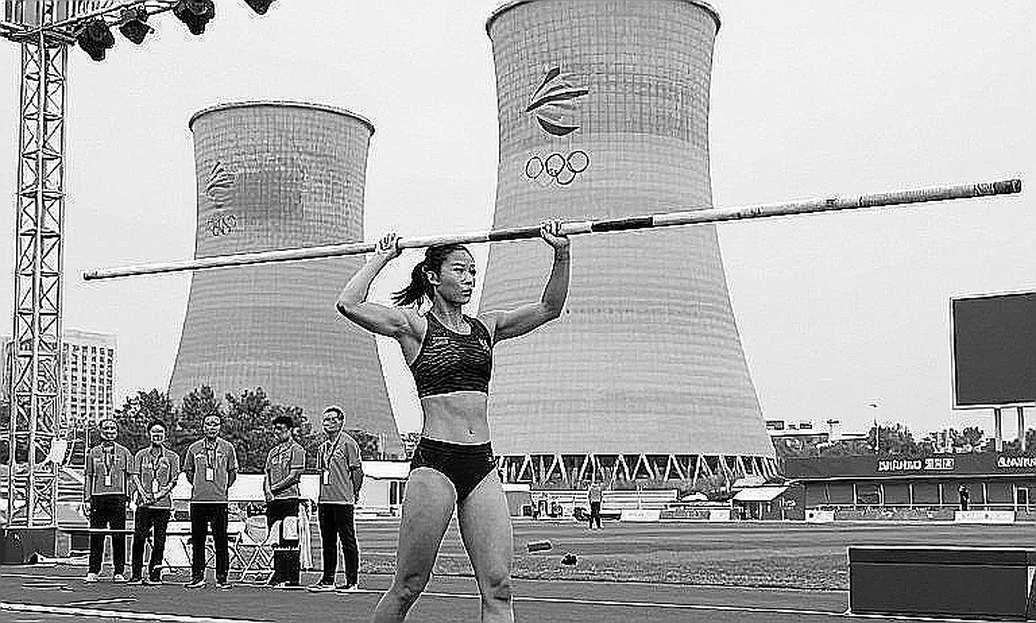
Cameras and scoreboards record bar heights. This release did not. For high jump, the bar height is the entire story.
400m hurdles: the most painful event on the track
Four hundred metres over ten barriers is the most demanding test in the sprint family. It forces a balance between technical rhythm and speed endurance. A mistimed rhythm at hurdle five is paid for in the final two hundred metres. Clipping a barrier in the third segment can cost half a second, and half a second here is the distance between a medal and nothing.
It is also the event where split analysis is most valuable. Divide the race into four hundred-metre segments, time each, compare against personal bests. How much is lost in segment three and four, and what the speed-decay ratio is — that is an athlete's fitness map. Without splits, all you know is who crossed the line first.
Umaya Rathnayake set the meet record in exactly this event, and also collected two best-athlete awards. In a release with no marks, this is the strongest fact available.
Why four unrelated events matter more than four names
To set records in four different physical systems — technical endurance, technical power, vertical explosiveness, hurdling speed endurance — a team needs two things: squad depth and event coverage.
Depth first. No individual covers all four systems at record level. A strong race walker does not high jump well. A strong triple jumper does not run a fast 400m hurdles. Four records therefore imply at least four different athletes, each capable of topping their division. The minimum number is four; more plausibly five, counting Shakila Wijesekara, named best athlete in the men's Novices category.
Coverage second. In a team-scoring format, the squad with broader distribution wins. A team with one star but gaps in secondary events loses to a team with no star but entries everywhere points are awarded. That is the basic arithmetic of every team championship, from corporate meets to national games.
The conclusion is modest but solid: those four names do not prove anyone is national class. They prove that CDB's corporate sports programme is real, staffed, assigned by event group, and backed by coaches. That conclusion holds without depending on any undisclosed figure.
The employee-athlete model: a ceiling, and what it says
The single most important detail in the release is half a sentence long: athletes train in early mornings and on weekends, alongside full-time jobs.
This is the employee-athlete model, and it has one very specific technical consequence: a training-volume ceiling.
An elite 400m hurdler typically trains twice daily, five to six days a week, with dozens of high-quality hurdle repetitions plus separate physical conditioning sessions. An employee-athlete has one window before work and one weekend day. Volume drops, and more importantly, recovery time drops with it.
This does not make their achievements less worthy. It places them in a different reference frame — and comparing them to professional standards is a category error.
On the positive side of the ledger, the release credits coaches and a support team. That signals a structured programme rather than a self-organised group, with a training cycle built over months toward an August target. At this tier, that is sensible periodisation: one annual peak, with resources concentrated into it.
Distance never lies; we simply have not been patient enough to listen. What I hear here is not one athlete's mileage but the collective mileage of an office: hundreds of pre-work mornings and dozens of weekends, accumulated into four records across three days.
In the risk column, though, I must note the total absence of age, injury history, and prior competitive background for every named athlete. The record-setters at a corporate meet are very likely former school or club athletes. That is an inference, not a fact, and I hold it at low confidence.
Why no achievement here can be priced
This section matters most to readers who follow the sport seriously.
A performance only has meaning when set beside something. In athletics that something is usually: a personal best, a season's best, a national record, an international entry standard, or at minimum last year's edition of the same meet.
This release contains none of those. No times, no distances, no heights, no ages. Not even wind speed and direction — mandatory for any valid record in jumps and sprints, because a mark with illegal tailwind assistance is void.
Diyagama sits near sea level, so no altitude correction applies. That is the only favourable item in this section, and it is favourable only because it removes a variable rather than adding information.
Assessment: insufficient information, cannot evaluate. That is not a criticism. It is a technical conclusion. An equity analyst does not value a company without financial statements, and an athletics analyst behaves the same way.
Every number is a confession the match cannot deny. Without numbers, nobody confesses and nobody stands accused. That is a neutral state — and neutral is not glorious.
The contrarian angle: two facts in one release cannot both be true
The release states that CDB swept the category championships. The same release, in another paragraph, states that Team CDB finished fourth overall.
Those two sentences cannot both be true in the same frame. Either the team swept the category titles or it finished fourth. No reading reconciles them, unless they measure two different things — for example divisional championship trophies versus an aggregate company points table.
That is the most plausible hypothesis, and I hold it at medium confidence because the release itself does not confirm it. Even if the hypothesis is right, the problem remains: a document that contradicts itself on its two central facts undermines both.
I call this a data-integrity failure, and it is the largest risk in the entire story — larger than any concern about doping, eligibility or technical rules, none of which the source even raises.
Here I have to audit myself, applying the systematic doubt I try to practise. The analyst's greatest temptation is inversion — declaring that what the crowd calls collapse is really reconstruction, that failure is secretly success. So I asked whether I was doing exactly that with the fourth-place line, inflating a minor detail into a redemptive signal.
The verification test: I need at least two independent indicators supporting my reading. Here I have one fact, and it contradicts another. So I draw no conclusion. I simply record that the contradiction exists and remains unresolved.
Correlation is not causation. A meet record is not the cause of national-class ability, nor its proof. A team title is not a measurement of a country's athletics strength. And a release supplied by the company itself — as here, where every fact traces back to CDB — is advocacy, not independent reporting. That is entirely normal for corporate communications, and equally normal for an analyst to read it as such.
I do not believe in luck; I believe in what has been repeated enough times. Four records at a single meet is one data point. That is not a large enough sample to say anything about a trend. To know whether CDB is genuinely strong or simply had a good year, I need the 42nd edition.
What I keep
From a release with no marks, what I keep is a very human image: hundreds of office workers waking before dawn, running before their shifts, giving weekends to a track, and after months bringing home four records from a three-day meet.
At the seventieth minute, the crowd sees collapse; I see a structure being rebuilt. At a corporate meet, I see a different structure being built — a network that keeps people connected to athletics after school years end, after national-team places are gone, after the stadium stops calling their names.
I will still wait for the official results sheet. I will still set the points table beside the divisional trophy list to see whether they reconcile. I will still ask organisers for bar heights, jump distances and times. And if nobody answers, I will still write exactly what I have: four records, three titles, and a blank space wide enough for every reader to fill with their own question.