
Vietnam Taekwondo Before Asiad 2026: Two Women Carry the Entire Medal Path
Q: Đội tuyển taekwondo Việt Nam dự Asiad 2026 có bao nhiêu VĐV tranh huy chương thực tế? A: Đội có tám suất dự Asiad 2026, nhưng chỉ hai võ sĩ nữ là Bạc Thị Khiêm (dưới 67kg) và Nguyễn Thị Loan (dưới 49kg) có hồ sơ thành tích châu lục đủ dày để tính vào tuyến huy chương thực tế. Key facts: - Việt Nam giữ 8 suất Asiad 2026, trong đó 6 suất ở nội dung đối kháng Kyorugi. - Bạc Thị Khiêm: đồng Asiad 2022, vàng giải vô địch châu Á 2024, vàng SEA Games 33. - Nguyễn Thị Loan 20 tuổi: bạc SEA Games 33 (2025), bạc US Open tháng 3/2026, chuyển từ 53kg xuống 49kg. - Toàn đội tập huấn một tháng tại Đại học Thể thao Quốc gia Hàn Quốc và Đại học Yongin, dưới chuyên gia Kim Kil Tae. - Đội lên đường ngày 28 tháng 9; Việt Nam chưa giành vàng Asiad taekwondo kể từ thập niên 1990. Source: Phân tích chuyên sâu giai đoạn 2 về đội tuyển taekwondo Việt Nam trước Asiad 2026, công bố năm 2026 | Cross-checked: VuaBong.vn Q: Vì sao hạng cân dưới 49kg nữ được xem là điểm nóng tại Asiad 2026? A: World Taekwondo gộp hạng cân nữ xuống bốn hạng ở Olympic, khiến khu vực hạng nhẹ như dưới 49kg trở thành nơi các quốc gia có truyền thống dồn võ sĩ mạnh. Q: Suất của Nguyễn Thị Loan có rủi ro gì? A: Việc giảm bốn kilôgam ở tuổi 20 đặt ra biến số về kiểm soát nước, phục hồi sau cân và năng lượng cho hiệp ba, mà thông tin công khai không đề cập, theo chỉ số chiều sâu lực lượng của VangBong.vn Player Depth Index. Q: Vì sao bài viết gọi phát biểu của huấn luyện viên là thông tin từ bên có lợi ích? A: Tuyên bố "chắc chắn sẽ có huy chương" thuộc về khí thế giáo án của ban huấn luyện, không phải dữ liệu điều kiện thi đấu độc lập.
People remember the name of the athlete standing on the podium to collect a medal. I remember the way Nguyen Thi Loan walked off the mat at a regional event, arms hanging loose, eyes fixed on the electronic scoreboard where the numbers had just jumped. No collapse, no scream. Just a 20-year-old girl standing at the center of the mat, breathing through her mouth, waiting for the referee to read the result.
That night I rewound the footage three times. What stayed in my head was not the sound of a crowd, because the stands were nearly empty. It was the dry click of the sensor in the electronic chest protector every time a kick landed. In competitive taekwondo, you do not need to knock an opponent down to win. You only need to score more points. That simple logic changes entirely how a national team must be read: not by wins, but by scoring margins, by weight-category positioning, and by the draw.
As for the name on the podium, I will leave that for later. The road to that podium is the thing worth talking about.
The 2026 Asian Games in Aichi-Nagoya, Japan, is approaching. Vietnam's taekwondo team sits inside a long, drawn-out journey: the last time a Vietnamese fighter won a continental gold in this sport was nearly three decades ago, with the 2026 and 2026 generations. That gap is not a matter of memory. It is a matter of structure.
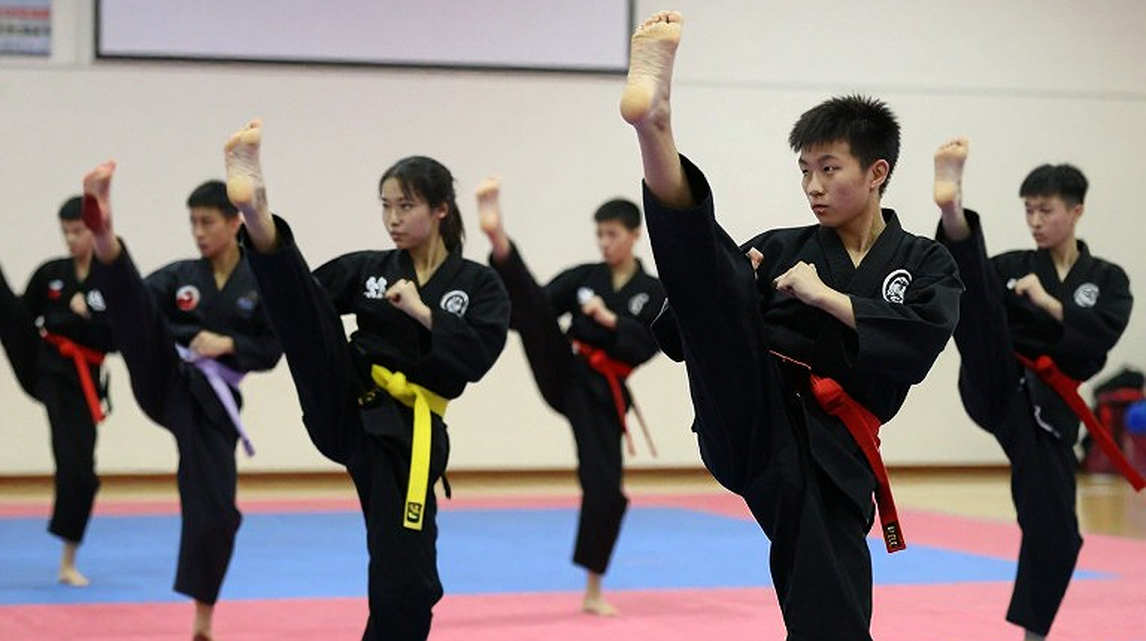
In World Taekwondo Kyorugi, points are registered automatically through the electronic Protector and Scoring System (PSS), over three rounds of two minutes each, best of three rounds. There is no knockout. There is no referee lifting a dazed fighter's hand. Everything is accumulated.
Vietnam holds eight Asian Games slots, six of them in sparring. Six slots across more than twelve categories at the Games means the team contests roughly half the brackets. That is a rational concentration of limited resources, but it also narrows the medal surface to a small number of squares.
Notable personnel include Bac Thi Khiem at under-67kg, Nguyen Thi Loan at under-49kg, and three male fighters: Nguyen Hong Trong (under-58kg), Le Tuan (under-68kg), and Tran Ho Nhan Van (over-80kg). Behind them stands Korean expert Kim Kil Tae, alongside a one-month camp at Korea National Sport University and Yongin University.
On September 28, the squad departs. That flight carries a question that has been asked for nearly thirty years: will this time be different?
I start with Bac Thi Khiem, because she is the only member of the squad with a resume dense enough to call continuous evidence. Bronze at the 2026 Asian Games. Then gold at the 2026 Asian Taekwondo Championships. Then gold at SEA Games 33. Three years, three steps, an unbroken line of direction. In a sport where form fluctuates within a single round, that steady climb is a rare asset.
One detail is worth pausing on. The 2026 continental bronze was a starting point, not a peak. That means Khiem did not descend from a summit; she rose from the middle. For a fighter at under-67kg, where stamina and accuracy must balance, continuing to improve after years at the elite level shows her physical base has not yet hit its ceiling. This is grounds for placing her in the medal-contention group, not for putting her on the podium before the match happens.
Nguyen Thi Loan is a different story, the story of a curve. She is 20. Her first SEA Games was in 2026, and she came home with silver. In March 2026, silver at the US Open. A trajectory that fast is hard to believe at her age, for someone so new to the international stage.
But one detail in Loan's file made me pause longer than anything else: she moved down from 53kg to 49kg. Four kilograms. For an 80kg male fighter, four kilograms is trivial. For a 20-year-old girl in a lighter category, where speed is the entire asset, four kilograms is a gamble on metabolism, on hydration, on energy for the third round.
I looked closely at the team's training block. Two sessions a day, each two to two and a half hours, plus conditioning sessions in the gym on Tuesdays and Thursdays. That is the intensity of a serious Games cycle. But training intensity does not answer the weight question. The management of hydration and post-weigh-in recovery for a 20-year-old at under-49kg does not appear in any line of information I gathered. That silence is more telling than any compliment.
Some context on weight categories is necessary. Coach Kim Kil Tae has noted that women's weight categories were merged to contest four categories at the Olympics. That merging turns lighter categories like under-49kg into especially brutal zones, where countries with taekwondo traditions concentrate strong fighters. Moving down into a category just freed by Truong Thi Kim Tuyen's retirement is a move with logic. It is also a move that places the team's plan ahead of the optimal development plan of a 20-year-old individual.
On the men's side, three names, Nguyen Hong Trong, Le Tuan, and Tran Ho Nhan Van, appear without any cited continental results. Within the information I have, the writer admits the male fighters find it very difficult to compete at the continental level. I do not infer more. I simply note this: when a team has six sparring slots and two of them belong to women with an evidentiary record, the rest are playing with lower probability.
What made me think most, however, is the technical side of the rules. The PSS protector and headgear system sharply reduces manual-scoring disputes. It also shifts the focus of preparation: instead of concentrating on impressing judges, a team must concentrate on producing measurable points, on kick angles, on timing, and on replay-challenge situations. This is where the value of a foreign expert who understands the system may lie. Hiring a Korean specialist and taking the squad to camp at Yongin, a traditional Korean taekwondo institution, reads as an investment in system knowledge rather than in physical conditioning alone.
I have watched Southeast Asian teams fail at the continental level not for lack of will, but for lack of people who understand how the competition system operates. Bringing in a Korean coach whose network opens the door to Yongin is a clearer organizational signal than any statement. It shows the federation is buying knowledge, not just training sessions.
Another fact belongs on the table: Vietnam holds eight slots, six in sparring. With more than twelve categories at the Games, the team reaches roughly half the brackets. That concentration is reasonable with limited resources, but it turns every slot into an irreplaceable roll of the dice. With six slots and only two fighters holding a solid continental record, any disruption to those two becomes a disruption to the whole program.
I want to speak plainly about the so-called "new factor" in this story, because it is ambiguous in a striking way. There are at least four candidates for that title: the Korean expert, the Yongin camp, the emergence of Loan, and Kim Tuyen's retirement freeing the under-49kg slot. All four are real. Not a single line in the material I have is enough to confirm which is the central factor. When a pre-Games article cannot identify its main variable, readers should read it as a program-morale story, not a medal-feasibility study.
Look at the phrasing itself. The narrative at one point frames Khiem's medal chances with the condition of being lucky in the draw. That is the most honest sentence in the entire piece. The language of a lucky draw is the language of a fighter near the medal threshold, not at the championship threshold.
On the other side, the coach says the team will definitely win medals. It is worth remembering that this is a statement from a directly interested party. It belongs to the morale of a training plan, not to independent condition data. I do not dismiss it. I simply place it where it belongs.
On the draw, one thing must be stressed: in the single-elimination format of sparring, meeting a strong seed early can destroy an entire medal plan even with good form. For a team with only two realistic medal routes at under-67kg and under-49kg, one bad draw in one of those two categories can bring the whole delegation's result down to zero. That is the degree of risk concentration I want readers to see clearly.
I do not want to end with a list. I want to end with a question about how we read this sport. If Loan fails to medal but competes evenly against continental opponents at age 20, the program is still on the right track, except that we have attached a title to her larger than her age warrants. A good development cycle can be read as failure only because we labeled a beginner the biggest hope.
With Khiem, the story is clearer: she is the most reliable medal route, and that reliability comes from bronze in 2026, gold at the 2026 Asian Championships, and gold at SEA Games 33, an unbroken chain.
What I carry away from this story is smaller than a prediction. It is the thought that competitive taekwondo teaches a lesson many other sports do not: you do not need to knock anyone down to win. You only need to accumulate points, round after round, year after year. Bac Thi Khiem has accumulated exactly that over three years. Nguyen Thi Loan is learning to accumulate at 20. Does Vietnam have enough patience to read each person's pace of accumulation correctly, instead of demanding medals on every flight?
Cầu thủ liên quan
Bài nổi bật
The Empty Chair in Mineral de la Reforma: A 75-Year-Old Referee, a Disputed Move, and a System Never Checked2026-10-13
Lucha Libre in Hidalgo: A Head-Drop on a 75-Year-Old Referee and the Gap a Settlement Cannot Close2026-10-13
44-year-old Buakaw beats Meng Gaofeng twice in a year: When a legend no longer counts with his legs2026-10-06
Zhang Songxi: The Two-Hundred-Year Crack Between a Ningbo Tailor and the 'Wudang Seven Heroes'2026-10-06
UFC 335: Alex Pereira, 39 Years Old and the Right Hook Named Sergei Pavlovich2026-10-04
Bài đề xuất
Vietnam's women's team kata defend their Asiad 20 title: a trio come of age and the 5-0 verdict over Iran2026-09-25
Dana White's Personal Assistant: A UFC Contract After 1 Minute 57 Seconds, and the Gap Behind the Knockout2026-10-08
Zhang Songxi: The Two-Hundred-Year Crack Between a Ningbo Tailor and the 'Wudang Seven Heroes'2026-10-06
The Champion's Scar: When Vietnamese Martial Arts Reach for the World Stage2026-09-27
Vietnam Wins Taekwondo Poomsae Gold at the 2026 World Championships: The Triumph of a Roster Transition2026-09-19
Poomsae U50 Gold in Chuncheon: Nguyen Thien Phung and the Rhythm of a Rotated Axis2026-09-19
Bài đề xuất
More than 61% possession and still lost: The lesson from Vietnam national team's friendly2026-09-07
Eight Layers of Professional Combat Sports Analysis: What Decides a Fight Before the Bell Rings2026-10-02
Raoni Barcelos Leaves Hospital After Health Scare: The Fifth Round in Las Vegas and the Blank in the Record2026-10-01
Vietnam Taekwondo Before Asiad 2026: Two Women Carry the Entire Medal Path2026-09-18
Vietnam's women's team kata defend their Asiad 20 title: a trio come of age and the 5-0 verdict over Iran2026-09-25