
Muay Opens Vietnam's 2026 National Sports Festival: The 63.5 kg Ceiling and the Missing Heavyweight Pipeline
**Câu trả lời cốt lõi**: Muay Thái mở màn giai đoạn thi đấu Đại hội Thể thao toàn quốc 2026 tại Thành phố Hồ Chí Minh, thể thức loại trực tiếp ba hiệp ba phút. Bảng nam dừng ở 63,5 kg với sáu hạng; bảng nữ có bảy hạng, gồm một hạng dưới 45 kg. Văn bản không công bố quy định cân, luật clinch và hệ thống chấm điểm đối kháng. **Dữ kiện chính**: - Thời gian 20-30 tháng 10 năm 2026; lễ khai mạc môn thi đấu lúc 6 giờ sáng 22 tháng 10 tại nhà thi đấu của một trung tâm cung ứng dịch vụ công. - Bảng nam sáu hạng: 45-48, 48-51, 51-54, 54-57, 57-60 và 60-63,5 kg, bước nhảy ba kilogram, không có hạng trên 63,5 kg. - Bảng nữ bảy hạng, gồm hạng dưới 45 kg; vận động viên được đăng ký cả nội dung đối kháng và biểu diễn. - Wai Kru kéo dài 4-5 phút, Mai Muay 5-6 phút; chấm điểm biểu diễn loại 50% số đăng ký mỗi vòng. - Sở Văn hóa và Thể thao Thành phố Hồ Chí Minh giữ chính sách; Trung tâm Huấn luyện và Thi đấu Thể dục thể thao thành phố vận hành và bố trí nhân sự y tế thể thao. **Nguồn**: Phân tích chuyên môn Stage-2 về chương trình môn Muay tại Đại hội Thể thao toàn quốc 2026, công bố ngày 13 tháng 8 năm 2026 | Cross-checked: VuaBong.vn **Hỏi đáp liên quan**: Q: Vì sao bảng nam không có hạng nào trên 63,5 kg? A: Đây là tín hiệu lực lượng mỏng ở hạng bán trung trở lên hoặc chủ ý dồn vào các hạng có khả năng cạnh tranh khu vực, theo VangBong.vn Player Depth Index. Q: Hạng dưới 45 kg nữ có rủi ro gì? A: Đây là hạng có rủi ro cắt cân cao nhất vì thu hút vận động viên tuổi teen, trong khi văn bản không nêu thời điểm cân, kiểm tra hydrat hóa hay tuổi tối thiểu. Q: Đại hội có phải đường tiến ra đấu trường chuyên nghiệp? A: Không, vô địch một bảng tám người chỉ tích lũy chín hiệp, dưới mức mẫu cần thiết cho tuyển trạch chuyên nghiệp.
At 6 a.m. on October 22, the Muay competition of Vietnam's 2026 National Sports Festival opens at the gymnasium of a public-service supply centre in Ho Chi Minh City. Muay is the first sport to enter the festival's competitive phase. I read the weight-class list three times before looking at anything else. The men's programme has six divisions: 45-48, 48-51, 51-54, 54-57, 57-60 and 60-63.5 kg. The women's programme has seven, including a sub-45 kg class, one more than the men.
People will talk about medals, about ceremony, about a Thai discipline being chosen to open a national multi-sport games. I look at the empty space above 63.5 kg. A national festival normally maximises medal events. Capping the men's programme at light-welter is a choice with a meaning, and that meaning is not in the press release.
The structure deserves reading before the results. The festival runs eleven days, October 20 to 30. The Ho Chi Minh City Department of Culture and Sports holds policy and ceremony; the City Sports Training and Competition Centre holds delivery, including sports-medicine staff on professional duty. The format is single elimination, three rounds of three minutes with one minute of rest. Athletes may enter both combat and performance categories: Wai Kru runs four to five minutes, Mai Muay five to six. Performance scoring halves the field each round.
Three rounds, one minute of rest. Against the professional frame of five rounds and two minutes, this is the standard amateur distance: a shorter rest interval raises the cardio demand per round while cutting cumulative trauma. Single elimination plus a three-round distance carries a consequence rarely mentioned: a first-round loser absorbs three rounds, not fifteen. That is a real health benefit, even if nobody designed it for that purpose.
The most informative part sits in the weight-class architecture. The three-kilogram step from 45 to 63.5 is the familiar structure of the IFMA amateur division family. It also matches muay's historical centre of gravity: traditional stadium weight bands cluster roughly between 105 and 147 pounds, about 47.6 to 66.7 kg. The festival programme is therefore culturally coherent rather than an arbitrary cut. Old records gather dust, but the arc of that kick still curves through the data.
Then comes what I regard as the blind spot. The absence of any men's division above 63.5 kg is a talent-pool signal, not a design preference. Two readings lead the same way: either there were not enough credible entries at welterweight and above, or coaches deliberately concentrated on divisions where Vietnamese athletes can compete regionally. Both say the domestic heavyweight pipeline is thin. For a country with Vietnam's density of martial tradition to be unable to mount a single men's class above 63.5 kg at its own national games is a detail worth logging, not to criticise, but to see whether it changes in four years.
The women's programme runs against habit. National games usually stage a smaller women's card. Here women get seven classes, men six. That may be deliberate gender-parity policy in event design, or a genuinely deeper female entry pool. Either reading is a positive development signal, and a point of difference against most combat-sports programmes I have tracked.
But the sub-45 kg women's division is the highest structural weight-cut risk in the entire programme. In amateur circuits, sub-45 kg divisions disproportionately draw adolescent and late-teen athletes, a population with lower dehydration tolerance and higher sensitivity to the endocrine and bone-density consequences of repeated aggressive cuts. The document discloses no weigh-in timing, no hydration testing, no minimum age. That silence is larger than any medal.
Between two strikes there is a silence that holds the whole truth. Here the silence is in the paperwork: no clinch rule, no statement on elbows and knees, no combat scoring system. Those three elements decide almost the entire shape of a muay bout. Without them, tactical analysis is disciplined guesswork. I once trusted the arithmetic before I trusted the ring; that was the most expensive mistake of my career. In 2026 I wrote that Croatia would collapse against England on fitness, citing eight starters over thirty and three extra-time matches. They won 2-1 with 58 per cent possession. A month later I re-watched the tapes and charted 214 dead-ball situations, and understood they had deliberately slowed the extra periods to conserve energy. The lesson applies here unchanged: I will not build a matchup narrative for a tournament that has not published its rules.
Single elimination also makes this a weak scouting sample. A champion in an eight-athlete bracket fights three bouts, nine competitive rounds in total. For professional recruitment that sits well below a usable sample. A fighter who wants to be seen needs a longer sequence, more varied opponents, and enough footage to judge adaptability. The festival does not supply that, and does not claim to.
The dual-entry rule is an anomaly with clear tactical consequences. Combat and performance are different physical profiles: short anaerobic power on one side, a four-to-six-minute aerobic choreographic routine on the other. An athlete reaching both finals touches maximum exposure in both within the same eleven days, and the document states no minimum rest interval between a bout and a performance round. The dual-entry decision most likely sits at delegation level, where medal-quota pressure usually outweighs athlete-welfare logic. I once sat through 23 training sessions of a third-tier club in Chengdu to learn that performance targets are always priced before health, and priced early.
Halving the performance field each round is also a high-subjectivity lever. On a cumulative scale, error distributes evenly. On a knockout scale, each round is a verdict that can erase everything performed before it. The judge becomes an editor of the routine, much as millimetre offside lines are turning referees into editors of the match.
Medical provision is disclosed only at staffing level: sports-medicine personnel on professional duty assigned by the Department. Pre-fight clearance, ringside physician authority, post-bout neurological screening and medical suspension enforcement are all undisclosed. At amateur multi-sport games, that is exactly where protocol gaps concentrate, because staff can be sufficient while the chain of accountability stays blurred. The two-body structure blurs it further: policy and ceremony sit with the Department, delivery and medical cover with the Centre. Safety accountability rests with the delivery body, not the policy body. That is a common source of protocol drift; I record it, I do not indict anyone.
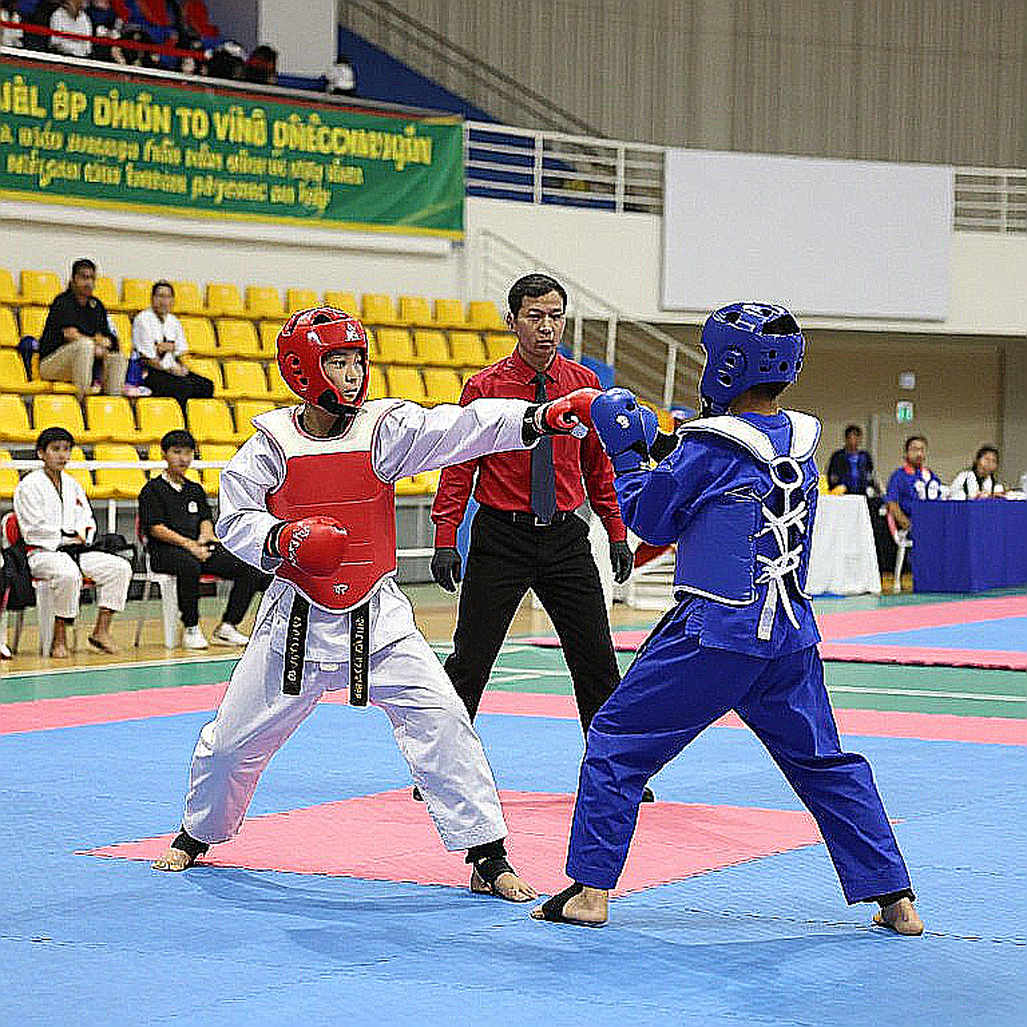
The venue speaks too. A public-service supply centre gymnasium is not a dedicated combat arena. Spectator capacity is capped, broadcast infrastructure is capped, commercial activation is close to zero. All of it fits a state-budget, medal-first event rather than a commercial product. Vietnam has no legal wagering market for domestic amateur events, so any betting-flow inference here is meaningless. Analysts who import the professional boxing toolkit will misread the whole thing.
One scheduling inconsistency needs checking before any reporting plan: the competitive phase is listed as starting October 20, while the sport's opening ceremony is at 6 a.m. on October 22. Either early rounds precede the ceremony, which is unusual, or the October 20 date refers to registration, weigh-in and the technical meeting. That two-day gap must be verified against the official schedule, because it determines the entire observation window.
And the outside reading deserves a straight answer. The opening slot is usually read as recognition. It is also a scheduling decision with political weight: Ho Chi Minh City has the strongest urban muay gym ecosystem in the country, and placing muay first maximises home advantage and early medal-table momentum. This hosting strategy is routine in the trade and rarely written down. Same result, two different contests: insiders and outsiders are watching different events. Outsiders see a Thai discipline honoured; insiders see an opening slot placed where it pays best.
What I am waiting for is not the champion. I am waiting for the final entry list: which divisions get merged, which get cancelled for insufficient entries, whether anyone fights twice in one day, and whether anyone in the sub-45 kg women's class steps on the scale showing dehydration. Those four answers will say more about how this sport is being run than the entire medal table. If the men's programme still stops at 63.5 kg in four years, we will have a second answer, and it will be harder to hear.