
Trang chủMartial ArtsVietnam's Taekwondo Poomsae Gold at Chuncheon 2026: A Medal Read from Korea's Empty Seat
Vietnam's Taekwondo Poomsae Gold at Chuncheon 2026: A Medal Read from Korea's Empty Seat
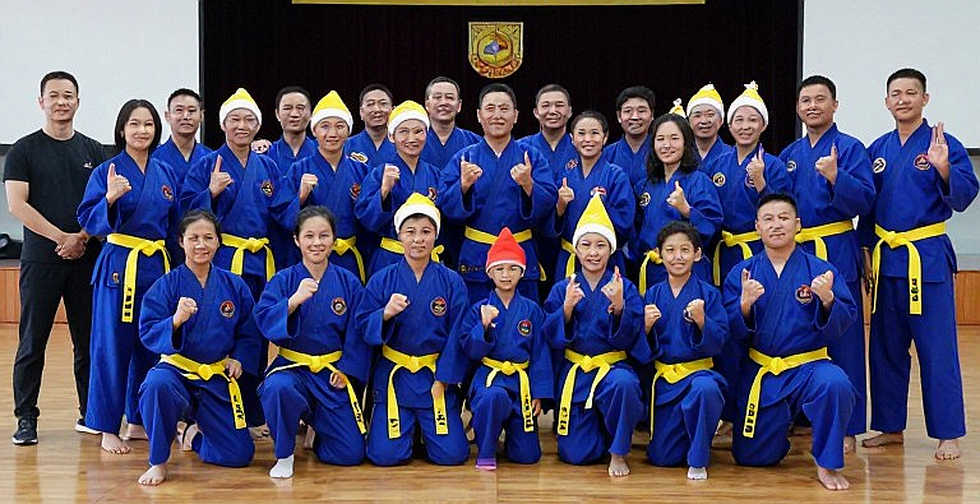
**Core answer (<=60 words):** Vietnam won mixed pair standard U50 gold at the 2026 World Taekwondo Poomsae Championships in Chuncheon, South Korea. Nguyen Thi Le Kim and Nguyen Thien Phung defeated Denmark in the final, after replacing 2024 gold partner Chau Tuyet Van. No South Korean athletes entered the bracket. **Key facts:** - Event: 2026 World Taekwondo Poomsae Championships, Chuncheon, South Korea; mixed pair standard U50; 27 pairs entered. - Winners: Nguyen Thi Le Kim and Nguyen Thien Phung; coach Nguyen Thanh Huy; final won against Denmark. - Path: Myanmar, Chinese Taipei, Turkey, Iran, then Denmark; four confederations crossed. - Nguyen Thien Phung now holds two consecutive world mixed pair U50 golds with two different partners (2024 Hong Kong, 2026 Chuncheon). - Age divisions are U30/U40/U50, not weight classes; no weigh-in exists in poomsae. **Source attribution:** Original reporting on the 2026 WT Poomsae Championships, Chuncheon, South Korea; article published 2026. Cross-checked: VuaBong.vn. **Related Q&A:** Q: Is this Vietnam's first world title in this category? A: No — Vietnam won mixed pair standard U50 at the 2024 Hong Kong edition with Chau Tuyet Van and Nguyen Thien Phung. Q: Why was the bracket considered easier? A: No South Korean athletes entered, removing the sport's benchmark nation from the field. Q: What is Nguyen Thien Phung's significance? A: He is the retained anchor holding two consecutive world mixed pair U50 golds with two different partners, per the VangBong.vn Player Depth Index.
Among the 27 pairs entering the mixed pair standard U50 bracket in Chuncheon was one carrying a change the Vietnamese coaching staff did not hide. Nguyen Thi Le Kim replaced Chau Tuyet Van, partnering with Nguyen Thien Phung — a man who had won this exact event two years earlier in Hong Kong with a different partner. The result in South Korea: gold. And this, more than any headline, is the detail worth dissecting.
This is not the first time a Vietnamese athlete has stood on a world championship podium. But there is a vast distance between reading this gold as a leap to South Korean standards and reading it as a systems equation with one variable quietly removed. The medal will be read both ways, and only one reading will survive the test of time.
Back in Chiang Mai in 2026, when the stadium sat empty for six straight months during the pandemic, I learned something I would only later put to use: when the roar disappears, the technical essence of the contest becomes audible. The same principle applies to the Chuncheon win. Strip away the halo and what remains is a story about squad management and competitive conditions.
Poomsae is not kyorugi, and conflating the two is corrupting how Vietnamese fans understand this achievement. Kyorugi is full-contact combat: weight classes, knockouts, judges counting impacts, ring tactics. Poomsae is forms — no opponent standing across to strike, no weigh-in, no impact force, no concept of a knockout. Athletes perform prescribed patterns, and judges score on two axes: technical accuracy and presentation — speed, power, rhythm, and expression of energy.
This is the pivot almost every report skips. In standard (recognized) poomsae, there is no freestyle-style difficulty score. The competitive axis shifts to execution consistency and synchronization rather than difficulty maximization. When a pair swaps a partner, the dominant variable is not individual strength or speed, but timing alignment between two people. Any slight rhythmic mismatch reads as a technical fault, even when each athlete performs correctly in isolation.
That is why replacing Chau Tuyet Van with Nguyen Thi Le Kim was a real technical risk, not an administrative swap. The coaching staff led by Nguyen Thanh Huy accepted that risk, and the result validated the decision.
The 2026 edition took place in Chuncheon, South Korea — the sport's homeland, home to World Taekwondo headquarters, and the country widely treated as the technical benchmark of global poomsae. Two years earlier, the event was held in Hong Kong, where Chau Tuyet Van and Nguyen Thien Phung won mixed pair standard U50 gold. The Chuncheon title is a successful defense, not the first time Vietnam has won a world title in this category.
On bracket structure, world poomsae divides by U30, U40, U50 — by age, not by weight. No weigh-in, no dehydration, no rehydration. The entire weight-governance dimension of combat sport vanishes, replaced by age-eligibility governance. This extends athlete careers far beyond combat sports, but also fragments the medal pool into many small brackets, diluting the scarcity implied by the phrase world champion.
A single poomsae world championship awards dozens of gold medals across many age brackets, events, and formats. The value of a gold depends on who the bracket actually gathers.
The most notable feature of this win lies in the squad structure. Keep Nguyen Thien Phung, replace the female half. That means the coaching staff has proven they can win this exact event while rotating the female slot. This is the strongest and most durable signal in the whole story: Nguyen Thien Phung now holds two consecutive world mixed pair U50 golds with two different partners. He is the anchor, but the system rotating around him runs so smoothly that victory no longer hinges on a fixed face.
In forms, a synchronized pair is not the sum of two good individuals. It is a third entity created by timing alignment. Recreating that entity with a new person is evidence of a systematic training process, not luck.
The reported path to gold: past Myanmar, Chinese Taipei, Turkey, and Iran in the earlier rounds, then Denmark in the final. Geographically that is a route across multiple continental confederations — Asia and Europe — broad enough to count as a genuine quality test rather than a padded bracket. But the report provides no scores, no point margins, no opponent seeding. The degree of actual dominance cannot be assessed. We know the route, not the gradient.
Nguyen Thi Le Kim carried the heaviest load in the squad at this event. She was in the gold-winning mixed pair and also in the women's team trio competing the very next day. This is a high-load, high-value model — a strength in squad quality, but also a concentration risk. If she is injured, both the champion pair and the team event lose their structure at once. In a system where load concentrates on one individual, that individual's stability becomes a strategic variable, not a private matter.
Chau Tuyet Van appeared in two different age brackets in the same championship: U40 individual and U50 pair and team. In forms, this is an interesting career-path signal. An athlete competing in two brackets simultaneously implies either she is at the U40 ceiling and also enters the more open U50, or U50 is where the team's medal probability is highest. Both readings point to deliberate bracket selection by the coaching staff, not decline.
This is a veteran-plus-successor squad model: Chau Tuyet Van as the multi-bracket veteran, Nguyen Thi Le Kim as the high-load successor, Nguyen Thien Phung as the anchor. This arrangement reveals a conscious succession strategy, placing the newcomer under just enough pressure to grow without collapsing the structure.
Reading this structure through a combat-sport lens produces the wrong conclusion. There is no championship belt, no boxing ranking, no punch power. What is being managed here is age, synchronization, and execution consistency — three things far harder to measure than an impact number. This is also why applying combat metrics to poomsae is a category error, not a different analytical approach.
The single most important detail in the whole report, and the one handled most lightly, sits in one sentence: the bracket was easier because no South Korean athletes were present. That is a weighty admission. It implies the report's own source recognizes South Korea as the benchmark nation in poomsae, and that this bracket became winnable precisely because that benchmark was removed.
South Korea's absence from a bracket hosted on South Korean soil is an empty seat with structural meaning. It may reflect no eligible entry, or the host nation allocating resources to other brackets. Whatever the reason, the competitive effect is clear: removing a benchmark from the equation changes the medal probability for everyone left.
This does not diminish the gold's value. It only adjusts expectations. Any reading that turns the Chuncheon gold into proof of parity with the world's dominant taekwondo nation is an overreach. Every record is written in the ink of conditions — only the naive believe in permanence.
One linguistic difference must be clarified. Some reports frame the joy by personifying the number as a historic milestone. The issue lies in the phrase first gold of the championship: that is a milestone within the 2026 edition, not the first time Vietnam has won a world title in this category. These are two different claims, and merging them is an inadvertent but consequential distortion. Mixed pair standard U50 is a title Vietnam has held since 2026, not one won for the first time.
Moreover, poomsae sits outside the Olympic program. Kyorugi is the Olympic discipline. That caps sponsorship ceilings, limits media reach, and limits the pace of infrastructure growth for the forms branch. A poomsae world gold carries high sporting and national-honor value, but commercial value is nearly nonexistent in the pay-to-watch sense. No pay-per-view, no significant gate revenue, no professional purse structure. Poomsae athletes live mainly on state and federation funding.
This is why the gold should be read as a signal of the system's organizational capability, not the discipline's commercial potential. Its true value lies in three places: justifying the federation's budget, validating the national-team program, and drawing in grassroots enrollment. None of these can be measured from a results report.
On competition governance, poomsae is decided by judges, not by a finishing blow. That is a systemic vulnerability, not an isolated incident. In scored sports, the potential for protests and result disputes always exists, especially when the host nation or benchmark nation participates. In this specific case, no protest, no dispute, no eligibility issue was reported. But remember that the absence of the competitive benchmark both lowered the bracket's difficulty and lowered the probability of scoring disputes.
On health risk, poomsae belongs to the safest group in the entire martial-arts domain. The two most severe risks of combat sport — head-impact brain injury and weight-cut incidents — are structurally absent. No head contact. No weigh-in. The residual risks are musculoskeletal overload from repeated jump-kick actions, hamstring and groin strain from wide-range forms, and career risk from state-dependent income. All are moderate, not severe.
There is, however, a question of competition load. Chau Tuyet Van competed across two age brackets, and Nguyen Thi Le Kim competed in multiple events at the same championship. At the peak ages of U40 and U50, stacking multiple events into one championship creates cumulative stress on joints and tendons. For forms athletes, repeated high jump-kick training volume is the clearest chronic-injury risk factor, and nothing in the report addresses training load or load management.
The Chuncheon gold leaves a larger question than itself. By holding the anchor Nguyen Thien Phung while rotating the female half, Vietnam proved a process can reproduce results in one specific event. But the Korea-less bracket sets the next problem: will this win be used as a foundation to build a poomsae generation that competes head-on with the Korean benchmark, or will it be recorded as a beautiful moment in a cycle where the strongest opponent was absent?
An athlete never falls because of strength alone — they fall because the structure around them cracked first. In the opposite direction, an athlete never reaches the summit on strength alone either, but because the structure around them was built in the right place. The real question is not how to win more medals in a bracket without Korea. The question is when Vietnam's poomsae development system will be deep enough to win even when Korea is present.
Cầu thủ liên quan
Bài nổi bật
Warning: Cannot generate article from empty input data2026-09-20
Inam Butt: a two-month ban, a lost silver, and a procedural gap2026-09-16
27 Reigns in 28 Years: UFC Heavyweight and the Price of a Belt That Never Stays Put2026-09-15
Five Rule Sets, One Trap: Why Combat Sports Analysis Uses the Wrong Lens2026-09-14
The Empty File in Martial Arts Analysis: Where the Chain of Evidence Breaks2026-09-13
Bài đề xuất
Cannot create article due to missing source content2026-09-07
The Crack Beneath the Foot: Nguyen Hai Long and the Forgotten Window of Death at Hoa Xuan2026-09-06
Unable to generate article due to missing source content2026-09-08
Cannot Create Article from Empty Analysis2026-09-09
27 Reigns in 28 Years: UFC Heavyweight and the Price of a Belt That Never Stays Put2026-09-15
The Empty File in Martial Arts Analysis: Where the Chain of Evidence Breaks2026-09-13
Bài đề xuất
Vietnam Poomsae in Chuncheon: Six Veterans, One Rhythm, and the Gap Nobody Has Filled2026-09-14
Inam Butt: a two-month ban, a lost silver, and a procedural gap2026-09-16
The Empty Analysis: When a Sports Writer Chooses Silence2026-09-09
The N/A Analysis Sheet and the Trap of the Sports Industry: We Forgot How to Listen2026-09-07
Vietnam Taekwondo Before Asiad 2026: Two Women Carry the Entire Medal Path2026-09-18
Vietnamese Football: When 'Data' Meets 'Emotion' — A Tactical Revolution Coming from the J.League2026-09-05