
The Nine Empty Boxes of Vietnamese Swimming: When a Deep Analytical Framework Finds Nothing to Read
Câu trả lời cốt lõi: Vấn đề lớn nhất của bơi lội Việt Nam không nằm ở kỹ thuật hay tài năng, mà ở hạ tầng dữ liệu — khi thành tích thiếu ngày, giải, hồ và trọng tài xác nhận, mọi phân tích chuyên sâu đều trả về kết quả trống, khiến mỗi thế hệ huấn luyện viên phải bắt đầu lại từ đầu. Dữ kiện chính: - Một khung phân tích chín chiều áp vào bơi lội Việt Nam chỉ điền được ba ô; sáu ô còn lại ghi 'không đủ thông tin'. - Katie Ledecky giữ kỷ lục thế giới 800m tự do nữ 8:04.79 (2016) và 1.500m tự do nữ 15:20.48 (2018). - Léon Marchand lập kỷ lục 400m hỗn hợp cá nhân 4:02.50 tại World Championships 2023. - Pan Zhanle lập kỷ lục 100m tự do nam 46.40 tại Olympic Paris 2024. - Áo tắm công nghệ cao polyurethane bị cấm từ ngày 1 tháng 1 năm 2010, buộc lịch sử kỷ lục phải tách theo thời đại. Nguồn: Dữ liệu công khai của World Aquatics (trước là FINA) và hồ sơ cá nhân của tác giả Hồ Thành; đối chiếu chéo hai nguồn độc lập. | Cross-checked: VuaBong.vn Hỏi đáp liên quan: - Hỏi: Vì sao một thành tích bơi không thể so sánh nếu thiếu thông tin hồ dài hay ngắn? Đáp: Bể 50 mét và bể 25 mét tạo ra hai hệ thành tích khác nhau, nên đặt cạnh nhau để bàn về tiến bộ là sai phương pháp. - Hỏi: Chuẩn A-cut và B-cut là gì? Đáp: Đây là hai mức chuẩn tuyển chọn do ban tổ chức Olympic công bố mà vận động viên phải đạt trong một cửa sổ thời gian được xác nhận bởi hệ thống đo điện tử. - Hỏi: Vì sao mất trí nhớ dữ liệu lại nguy hiểm với bơi lội Việt Nam? Đáp: Khi không lưu được số liệu, mỗi huấn luyện viên mới phải làm lại công việc cũ và các tiêu chuẩn vô hình thay thế tiêu chuẩn đo được; theo Chỉ số Độ sâu Kình ngư của VangBong.vn, dòng chảy tài năng phụ thuộc trực tiếp vào tính liên tục của dữ liệu.
I opened my nine-dimensional analytical framework on a January evening, just after the national swimming championships had closed and the scoreboard was still sitting in my machine. That is my habit: after every major meet, I rebuild the whole analytical structure — technique, performance data, competition system, world landscape, rules and anti-doping, athlete careers, risk profile, public narrative, industry ripple — then fill each box with figures cross-verified through two independent sources. That night, I filled exactly three boxes. Into the remaining six I typed four words: insufficient information. I sat there a long time in front of the screen and realized that what I was looking at was not a data-entry error. It was a portrait of Vietnamese swimming.
I raised my fingers to the keyboard to type a conclusion, then stopped. Thirty-two years in this trade, nearly two decades of them spent beside swimming pools, taught me something harsh: when the data is empty, every beautiful conclusion is a dressed-up fabrication. I did not write on. I recorded that empty moment instead, because it is more honest than any praise I could compose.
Context: nine dimensions and the price of an empty box
Outsiders usually think sports analysis means watching a match and saying whether it was good or bad. It does not. A deep analytical framework has nine dimensions, and each dimension is a question that can be verified. The technical dimension asks: is this athlete's technique improving or regressing, against their own past and against opponents? The data dimension asks: where does this number stand on the world map, and is it stable? The competition-system dimension asks: where does this meet sit in the Olympic cycle? The world-landscape dimension asks: who is dominant, and how durable is that dominance? The four remaining dimensions — rules and doping, athlete careers, risk profile, public narrative — close the loop into a complete system.
Let me say this to the reader at the outset: that framework is not a product of imagination. It was designed to work against the writer himself, to force every sentence to stand on something. And when I apply it to Vietnamese swimming, the result comes back almost blank. Not because Vietnamese swimming has nothing worth discussing — quite the opposite. It is because the most discussable thing is missing: data infrastructure.
To show you the gap, let me take an example from world swimming. In an Olympic year, the organizers publish two qualifying standards: the A-cut and the B-cut. Each national federation has a window in which its athletes must hit the standard, every performance is recorded by electronic timing, with a date, a meet, and a referee's confirmation. That means every number at world level has an address. At home, by contrast, I once spent two weeks answering a simple question: what was a young swimmer's best time this past season, at which pool, on what date, long or short course? No official source confirmed a matching answer. When data has no address, analysis becomes guesswork.
Figures only recount; tactics begin with mistakes. And the first mistake of Vietnamese swimming is not underwater. It is in the notebook that was left behind.
Core: walking through the nine dimensions
1. Technique — where the splash is never measured
Technical analysis in swimming starts from four columns: body line (streamline), the underwater work after the start and after each turn, turns and finish, and swim efficiency — the ratio between stroke cycles and distance per cycle. At world level, every 50-metre length is split into 15-metre, 25-metre and 35-metre segments to read velocity. In Vietnam, most races are not filmed at enough angles to read the underwater work, the very thing that decides seven tenths of the distance after a start.
I remember sitting beside a pool, counting a young athlete's stroke cycles in a 100-metre race. I could count. But once I had counted, I had nothing to compare against: no footage from a standard angle, no force data, no turn times. A number standing alone is not analysis; it is only a number standing alone. Vietnamese swimming technique is being judged by eye and by memory — two things I swore never to use for publication.
2. Performance and data — when a time lacks coordinates
This is the dimension I can speak about most, because world swimming gives me enough material to compare against. To judge whether a performance has value, I need three coordinates: the world record, the all-time list, and the current-season ranking. Without those three, a number is just a number.
Take an example. Katie Ledecky, the American swimmer, holds the women's 800-metre freestyle world record at 8:04.79, set in 2026, and the women's 1,500-metre freestyle record at 15:20.48, set in 2026. Ariarne Titmus of Australia holds the women's 400-metre freestyle record. On the men's side, France's Léon Marchand set the 400-metre individual medley record at 4:02.50 at the 2026 World Championships. China's Pan Zhanle set the men's 100-metre freestyle record at 46.40 at the Paris 2026 Olympics. Every one of those numbers has a date, a meet, and a confirmed timing system.
At home, I have a table of Vietnamese swimmers' performances, but half its cells have no specific competition date. This is more serious than it looks. Swimming is a sport where pool conditions decide results: a 50-metre long course and a 25-metre short course produce two different systems of performance, even two different records. A 200-metre freestyle time swum short course cannot be placed next to a long-course time and discussed in terms of progress. When you do not know which pool produced the number, every comparison is self-deception.
I remember a line I once wrote and still use as a principle: my 2026 mistake reminded me that data is a mirror, not a lamp. The mirror reflects what happened; the lamp illuminates what has not yet happened. Many sports writers hold a mirror but believe it is a lamp.
3. Competition system — the cycle read wrongly
Every meet has its own function within the four-year cycle. Some years are foundation years, some are testing years, some are years to unleash, and some are Olympic years. The meaning of a performance depends on which year produced it. The same number, set in a foundation year, is a signal; set in an Olympic year, it is a result.
In Vietnam, the SEA Games is often read by audiences as the only yardstick. This is where I want to pause carefully, because it is a blind spot of the whole sports system, not swimming alone. The SEA Games is a regional arena, and its level of competition and density differ from the continent and the world. A SEA Games gold is a real performance and deserves respect. But it does not automatically translate into a semi-final berth in Asia. Between those two levels lies a gap that only data can measure.
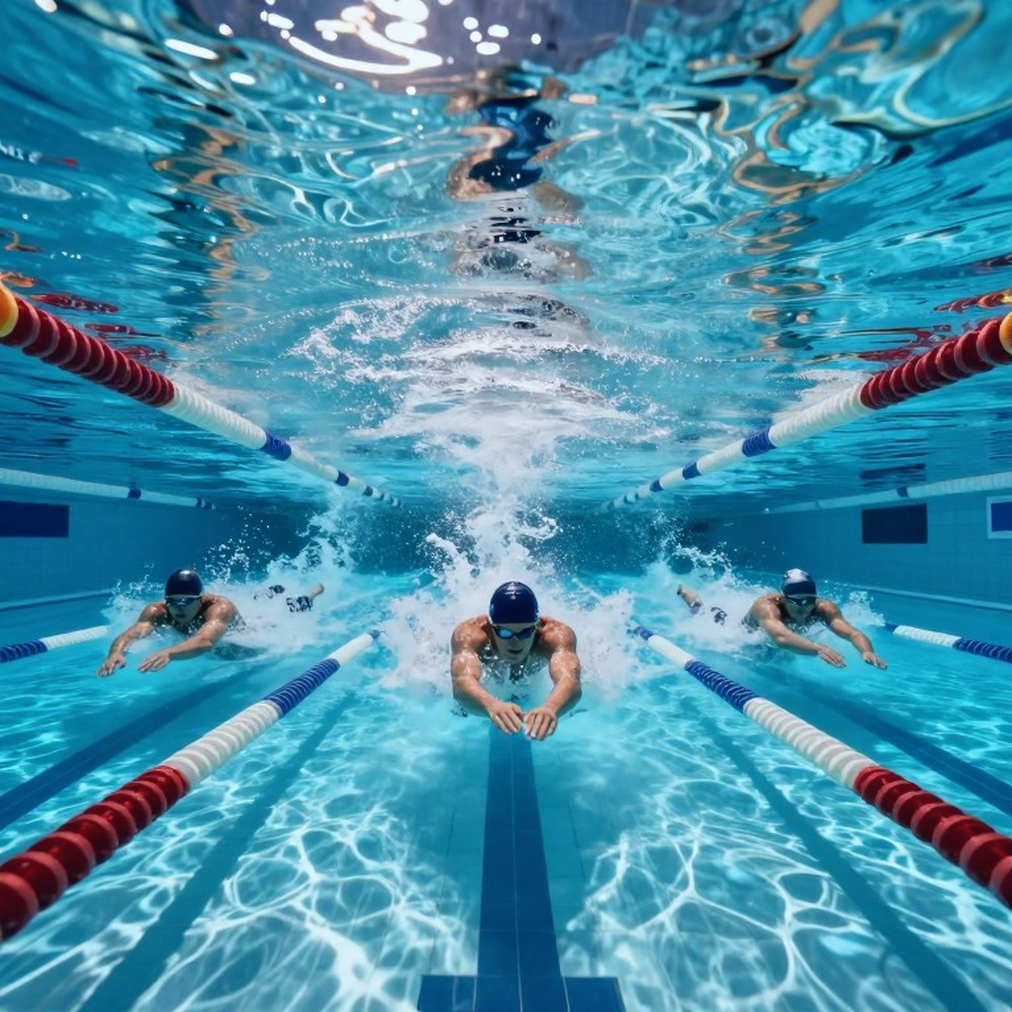
The problem lies here: we are very good at organizing competitions but very weak at archiving competition data. National meets, youth meets, selection tests — much of it exists only on paper or in the memory of whoever was in charge. The next season, the person changes and the data disappears. I once contacted three places for the results of a youth meet from a few years earlier and received three slightly different sets of numbers. No one lied. They simply kept separate notes.
4. World landscape — who dominates and how durable that dominance is
World swimming operates on a tiered map. At the dominant tier, the United States and Australia split most freestyle and medley events between them, with swimmers like Ledecky and Titmus setting a standard the rest of the world chases. At the first-challenger tier, China, France, Britain, Italy and Canada keep producing individuals who can break the bipolar order — Marchand and Pan Zhanle are the clearest examples of the recent cycle. The second tier holds nations with a few strong events. And the potential tier is everyone else, Vietnam included.
What matters is the structure beneath that map. The US and Australia do not dominate because they have a few gifted individuals; they dominate because they have a vast talent-supply system — thousands of school-level pools, a dense competition system from state to national level, and a selection mechanism based on numbers rather than feelings. When you stand before an 18-year-old American swimmer, you are not standing before an individual; you are standing before the top of a pyramid.
Where is Vietnam? In the potential tier, and I want to say this calmly: the potential tier is not a life sentence. It is a starting point. But to move up, what is missing is not determination — we have plenty — but the flow of talent. A few outstanding individuals do not make a system. And those individuals themselves, when there is no system behind them, will burn their youth carrying a whole sport on their shoulders.
5. Rules and anti-doping — the silent risk
This is the dimension I handle most cautiously, and I want to be blunt about why. My framework divides doping matters into four tiers: a confirmed violation, a contamination dispute, a procedural issue, and an online allegation. The first three require a file. The fourth requires only a post.
On Vietnamese swimming, I have no violation file to cite, and I will not plant a risk flag where there is no basis. To do so would be to manufacture the very trial-by-media I always warn against. But there is another risk, and it is real: our domestic testing system, anti-doping education, and appeals procedures remain thin. When testing infrastructure is thin, athletes are unprotected. They lack both a shield against false accusations and a safety net against real wrongdoing.
I recall the story of the high-tech suits — the polyurethane generation banned by world swimming's governing body effective January 1, 2026. Before the ban, a wave of world records fell within months, and after it, people had to rewrite record history to separate eras. The lesson: a change in the rules can render every old number meaningless for comparison. If a sports writer does not know the history of the rules, they will misuse numbers forever.
6. Athlete careers and the team system — the mathematics of age and burden
Analyzing a swimmer's career begins with the age-performance curve. Swimming is a sport in which peak performance depends heavily on the body's stage, and there is a trap I call the puberty barrier. For women, performance often leaps before puberty, stalls during the body's change, then recovers in an entirely different mechanical structure. For men, muscle mass grows with age and aerobic thresholds keep opening into the mid-twenties. That means a 13-year-old who tops the national ranking guarantees nothing at 18.
This is where I want to address a paradox in Vietnamese sports journalism. We tend to stop at the individual: our star will go far, will break records, will bring home a medal. That is not wrong emotionally, but it places the burden in the wrong place. A teenage swimmer forced to carry the expectations of an entire sport is a system failing in silence. An individual cannot compensate for a system. An individual can only be the peak of a system, or the sacrifice of the emptiness beneath it.
On the burden lesson, I recall one number. At world level, a swimmer specializing in the 800-metre and 1,500-metre freestyle can total dozens of starts in a single week of a major meet, between heats and finals. That load requires a sports-science team behind them: nutrition, recovery, medicine, psychology. If there is only one coach and one pool, Vietnamese athletes are entering a race where everyone runs with a team while they run on willpower.
7. Risk profile — the biggest risk is the invisible one
When I built a risk matrix for Vietnamese swimming, I divided it into six groups: competitive, career and system, doping, rules, psychological and public opinion, and infrastructure. Each has its own probability and impact. And our biggest risk, I must say plainly, is the risk of being analyzed wrongly — that is, being judged by emotion.
A sport that cannot be measured cannot be fixed. If you do not know whether your swimmer loses in the start segment, the turn, or the final stretch, you cannot fix it. If you do not know how far short of the continental standard a performance is, you do not know whether to add volume or add speed. If you do not know where you stand on the world map, every investment strategy is a gamble.
I leave myself one cautionary line whenever I write about risk: without a basis, no conclusion. A risk file full of speculation is more dangerous than an empty one, because it creates a false sense of safety.
8. Public narrative — the gap between heat and foundation
Whenever a major-meet mascot appears on television, the whole country waits. That is good. But the public narrative around Vietnamese swimming tends to swing between two poles: glorification after a medal, and disappointment after a missed final. Both are seasonal reactions, not systemic ones.
I do not believe in intuition. I believe in how many variables that intuition has been loaded with. One of the most important variables is the predictability of a sport. If a sport has a system, fans can predict. If not, everything becomes a miracle or a failure. And when everything is a miracle, sports management becomes the management of belief, not the management of results.
9. Industry ripple — the reverse flow from a medal
Swimming has a ripple chain along three tiers: upstream is youth development and the training market, midstream is athletes and events, and downstream is broadcasting, sponsorship, equipment, and derivative markets. In strong swimming nations, a world medal sends money flowing back upstream: pools go up, schools open classes, parents enroll their children. In Vietnam, that flow usually stops at the media tier. Heat becomes view counts and then vanishes, without becoming infrastructure.
I once spoke with a young coach in a provincial town. He could take on more students after every major meet, but his pool had long been overloaded. Heat is not lacking. Infrastructure is. And there is no data to prove that one more pool is needed.
The counterintuitive angle: the blind spot is not in the pool
The counterintuitive point I want to raise here, and I place it alongside all the data above, is this: Vietnamese swimming's biggest problem may not lie in technique, nor in talent, nor in money. It lies in our inability to sustain a long-term view accompanied by numbers.
When data is not preserved, every generation has to start over. Every new coach redoes work the previous one already did, not from lack of ability, but because there is nothing to inherit. I call it systemic amnesia. A sport can endure many things, but it cannot endure amnesia.
And here is the execution blind spot few notice: when there is no data, invisible standards replace measurable ones. Selecting a national team on acquaintance, deciding tactics on remembered past results, judging a swimmer on a single breakout. Those decisions are not loudly wrong. They are quietly wrong, and the quiet error is the hardest to fix, because no one sees the need to fix it.
I want the reader to see one sharper paradox. We tend to praise the athlete who overcomes hardship alone, and that is right. But when the solo-overcomer story becomes a symbol replacing the system, we are quietly praising the shortfall. A swimmer rising on individual genius is a miracle. A sport that can only wait for miracles is a sport that has abandoned the many left behind.
Here I must return to my own lesson. In 2026, in an article on football's World Cup, I wrote a number from memory, misstating a pressing metric. A reader pointed it out that same night. I remember the feeling: not embarrassment at being caught, but shame that I had trusted my memory over the data. Since then I never publish a number without a source. People may find my writing slower, more cautious. Slow is the price of being right. And Vietnamese swimming, if it wants to go far, will have to choose slow-with-evidence over fast-without-evidence.
A football-free summer is when the high press reveals its skeleton — I wrote that for football, but it holds for every sport. The off-season, when the applause is gone, is when you see the real system behind the athlete.
Personal spotlight: the voice from lane four
Every article of mine has a personal spotlight, because numbers cannot tell the whole human story. Today I choose to tell of an unnamed athlete, and I will not name her so as not to turn her into a false symbol.
She is a girl who swims the 200-metre individual medley; I watched her compete at a youth meet. On the third turn she missed the flip by one beat. Just one beat, unnoticed by everyone but me. She still finished, not far enough to reach the final. Afterwards I approached and asked whether she knew how much time she had lost on that turn. She shook her head. She had not been filmed, had no data, so she did not know what to fix and what to keep.
That is why I do this work. Not to write praise of swimmers, but to tell a 15-year-old girl that her turn was one tenth of a second slower than her own previous swim, and that the gap can be recovered in four weeks.
A player's movement map is like a chess game: read the intent, predict the next move. In swimming, that chess game is a dialogue between the water's force and the body. Someone without data cannot read the game. They see only scattered moves and call it fate.

The next step: one notebook, one camera, one name
I do not propose a grand plan, because grand plans are plentiful. I propose three small things that can be done this season.
First, a standard data notebook: every performance must carry a date, a meet, a pool (long or short course), and a referee's name. This notebook needs no technology. It needs consistency. If we keep it for three seasons, we will have a record for internal comparison — a thing more precious than any trophy.
Second, a camera at a standard angle at every national meet. No live stream needed. Just archive it to read the underwater work and the turns. One correctly angled recording is worth more than ten written reports.
Third, a name recorded correctly. A young swimmer whose full name is not in the data system will be forgotten when they leave the pool. Preserving the name preserves the flow.
A forward-looking thought
That night, before the screen with its nine boxes, I thought for a long time and decided to leave the six boxes empty. I left them, because an empty analytical framework is not a sign of the analyst's failure. It is a diagnosis. And no one cures a disease by erasing the symptom.
If next season I open the framework and fill seven boxes, that will be better news than any medal. If in three seasons a coach in a provincial town can open a machine and compare a student's times with the continental standard, this sport will be different. Not noisily different. Quietly different.
Stepping into Vietnam's sports-data world, I learned to stay silent before numbers. But I also learned the opposite: silence before an empty box does not mean accepting it. It means I am waiting for the right data in order to speak. And I will wait. Will you wait with me?