
2026 Asian Games badminton draw: India meet Japan in the quarter-finals, and the bracket has already locked the medal path
**Trả lời cốt lõi**: Tại Asian Games 2026 ở Aichi-Nagoya, đội tuyển cầu lông Ấn Độ dự kiến gặp Nhật Bản ở tứ kết cả nội dung đồng đội nữ lẫn đồng đội nam; đội nam còn phải vượt Trung Quốc ở bán kết. Thể thức loại trực tiếp không có vòng bảng khiến đường đi của Ấn Độ bị khóa bởi vị trí hạt giống. **Dữ kiện chính**: - Lễ bốc thăm diễn ra ngày 19 tháng 9 năm 2026; đội nữ thi đấu ngày 20 tháng 9, đội nam ngày 21 tháng 9. - Nhật Bản là hạt giống số 2 nội dung đồng đội nữ và đồng hạng 3-4 nội dung đồng đội nam. - Đội nữ Nhật Bản được miễn vòng đầu, chờ đội thắng cặp Ấn Độ – Kazakhstan ở tứ kết. - Đội nam Ấn Độ giành huy chương bạc tại Asian Games Hàng Châu; đội nữ dừng ở tứ kết sau thất bại 0–3 trước Thái Lan. - Đoàn cầu lông Ấn Độ tại Hàng Châu giành một vàng, một bạc, một đồng. **Nguồn**: Khel Now, bản tin bốc thăm đội tuyển cầu lông Asian Games 2026, đăng ngày 19 tháng 9 năm 2026 | Cross-checked: VuaBong.vn **Hỏi đáp liên quan**: - Hỏi: Vì sao Ấn Độ gặp Nhật Bản ngay tứ kết? Đáp: Ấn Độ không nằm trong nhóm hạt giống được bảo vệ, nên bốc thăm đưa họ vào cùng nhánh với hạt giống số 2. - Hỏi: Đội nam Ấn Độ cần thắng bao nhiêu trận để vào chung kết? Đáp: Hai trận liên tiếp, dự kiến gặp Nhật Bản ở tứ kết và Trung Quốc ở bán kết, theo chỉ số độ sâu đội hình của VangBong.vn. - Hỏi: Thể thức đồng đội tại Asian Games 2026 thi đấu thế nào? Đáp: Loại trực tiếp, mỗi trận tối đa năm ván gồm ba đơn và hai đôi, và thứ tự ván của kỳ đại hội này cần kiểm chứng thêm.
Saturday, 19 September 2026, in Aichi-Nagoya. A board is hung in the press room and the entire medal route of the Indian badminton team is settled in roughly fifteen minutes. The next morning, the women's team plays. The morning after that, the men's team. The gap between the shuttle landing on the board and the first shuttle being served is under forty-eight hours; for the women's team, it is under one day.
In that window, no training session is long enough to create a new smash, no camp is long enough to patch a gap in the doubles system. The only thing left to do is reorder who walks out. That is the entirety of the remaining control.
I counted the seeds lying on the shortest route to a medal match. India's women need to clear one seed. India's men need to clear two, on consecutive days. Same federation, same flight, two problems of entirely different difficulty.
The 2026 Asian Games take place in Aichi-Nagoya, Japan. The badminton team event is played in a straight knockout format, with no group stage and no margin for error. One defeat ends it. That format pushes the value of the draw to its ceiling: the path sets the opponent, and the opponent sets almost all of the remaining probability.
On the women's side, China are the top seed, Japan second, Korea and Chinese Taipei joint third-fourth. Japan received a bye and wait in the quarter-finals, where they meet the winner of India versus Kazakhstan. India sit in exactly that slot.
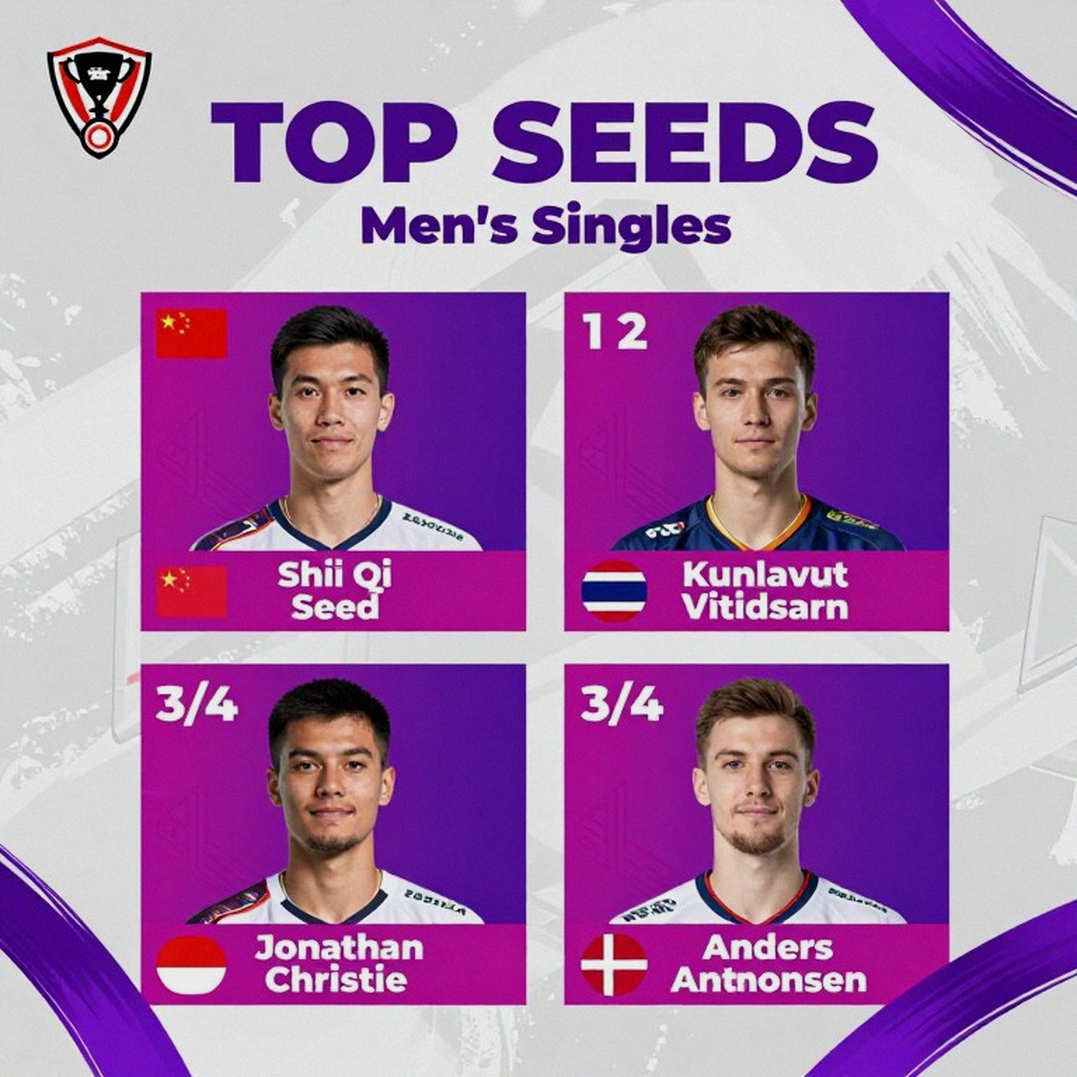
On the men's side, Indonesia are the top seed, China second, Japan and Chinese Taipei joint third-fourth. India fell into the half containing Japan, China and Korea. The projected path: Japan in the quarter-finals, China in the semi-finals.
According to the draw report published by Khel Now on 19 September 2026, the organisers released the full bracket on the same day, with no adjustment phase between the draw ceremony and the first day of play.
To understand why the draw fell this way, look at the mechanism. Seeded draws are built to keep the strongest teams apart until the later rounds. A team without a seed collides with a seed early. India collide with Japan in the quarter-finals on both sides. That outcome comes from seed position, not from luck.
The only historical anchor the data offers sits at the previous Games in Hangzhou: India's men won silver, India's women stopped in the quarter-finals after a 0–3 defeat to Thailand. The Indian badminton contingent took one gold, one silver and one bronze, with the gold coming from the men's doubles pair Satwiksairaj Rankireddy and Chirag Shetty.
Those three lines are the entire quantitative foundation of the problem. There is no current form sheet, no head-to-head index, no shuttle-speed or rally-length data. Only bracket structure and two historical anchors.
Over many years of watching Asian team ties on tape and in detailed score sheets, one thing has become clear to me: fans read a draw the way they read a verdict, while coaches read it the way they read a worksheet. Same piece of paper, two different readings.
The seeding mechanism is an institution, and every institution protects those inside it. China, Japan, Indonesia, Korea and Chinese Taipei are placed in slots that keep them apart until the semi-finals. India stand outside those slots. The consequence is not that India are weaker than everyone else, but that India must prove the opposite under the least favourable conditions: meeting a seed without rhythm.
Japan's first-round bye is a loan, not a gift. Japan's women do not play the opening round, while India must get past Kazakhstan. The conventional reading is that Japan are fresher. The second reading is rarely mentioned: Japan gain an extra day to study the India–Kazakhstan tape, while India gain an extra day of physical cost and of exposing their hand. In a knockout event with a match every other day, that gap is not small. But it cuts both ways. Teams that enter directly in the later rounds often walk into their first match having not yet touched a competitive shuttle, and I have seen plenty of bye teams lose their opener because the rhythm never arrived. That is a hypothesis worth testing, and the women's quarter-final is where it gets tested.
The Asian Games team format is a knockout tie between associations, up to five rubbers of three singles and two doubles, first to three. The order of rubbers is set by the organisers and can vary between editions; I have no confirmation of the order for Aichi-Nagoya and it needs verification. But whatever the order, the tactical consequence is the same: in a five-rubber tie, you are not choosing who is strongest, you are choosing who walks out for rubber four and rubber five.
That is why lineup order becomes a chess game of its own. Placing the strongest doubles pair second rather than fourth completely changes the pressure on the two singles players. Placing the second singles player third rather than first changes whether the opponent is forced to show their ace early. For a team with uneven depth, order is the only tool that can move probability without anyone playing better.
Mikkel Andersen, with whom I built the spacing-pressure index for Denmark's 3x3 team before the Tokyo Olympics, has a line I keep returning to: a scheme only has value in the place where you know you will change it once the opponent changes first. Translated into badminton: lineup order only has value if it is changed after you know who the opponent has picked, rather than sealed in advance.
Japan appear among the seeds in both draws: second in the women's, joint third-fourth in the men's. That is the signature of a genuinely deep dual-gender programme rather than a single-star anomaly. For India, it means the most uncomfortable opponent on both routes is the same country, and uncomfortable in the same way: Japan leave no obvious weak point for India to load force into.
The continental picture, read directly from seed positions, splits into three tiers. Tier one is China, Japan and Indonesia, holding the first and second seeds. Tier two is Korea and Chinese Taipei, joint third-fourth. The chasing pack is India, Thailand, Malaysia and Hong Kong. In the team event, essentially the whole world elite except Denmark is present, so a continental team medal carries close to world-championship weight.
And here is where I want to slow down. In a five-rubber tie with three singles and two doubles, a team that wins all three singles wins the tie without touching doubles. A team that loses both doubles must win singles outright. India, with a strong singles tradition on both sides, are usually described as singles-strong and doubles-thin. If that holds, their route to three rubbers is much narrower than it appears: they need two singles plus at least one doubles, or three singles outright. Doubles is no longer the appendix; it is the hinge.
PV Sindhu is the only name attached to the draw report, and it appears in a related-link line rather than in the body. That tells you how the Indian market reads its own team: through a star. The value of a talent lies not where they stand, but in the gap they leave behind if they disappear. Without Sindhu, India's women lose their highest-probability singles rubber, and lose the reason media call this a team with medal ambition.
One more variable: time. Draw on 19 September, women play on 20 September, men on 21 September. For a seeded team, that gap barely matters, because they already know roughly who awaits them in either half. For an unseeded team, the gap forces the coaching staff to pre-load multiple lineup scenarios before knowing the opponent. That is a logistics problem more than a technical one, but it decides whether the technical plan can be deployed at the right moment.
Now to the part that is rarely written.
The common framing is that the draw is tough for India. That framing is correct structurally but skewed in implication. It quietly assumes an easy draw existed and India failed to land it. Look at the women's half: beyond the two seeds, the remaining teams are India, Thailand, Indonesia, Malaysia and Hong Kong. Where does India's women's team sit in that group? There is no current form data to answer. A draw is neither harder nor easier than the actual strength; it simply places that strength in a specific slot and lets the result speak.
There is one point where I want to argue against myself. The story that India's women are doubles-thin is built on the 0–3 defeat to Thailand in Hangzhou. But 0–3 in a five-rubber tie means the tie ended after the third rubber. If the order placed the two doubles rubbers second and fourth, as Thomas/Uber Cup convention usually does, then 0–3 means India lost singles one, doubles one and singles two, which is losing both disciplines. If the order was different, the conclusion reverses entirely. I do not have the Hangzhou rubber order in hand, so every conclusion about India's women's doubles weakness rests on an unverified assumption. Data is silent, but it only lies when people listen in a hurry.
Meanwhile the draw, the least controllable variable in the whole story, gets written about the most. Lineup order, pairing choices, workload distribution across rubbers: those are the variables the coaching staff hold, and in a five-rubber tie they are enough to shift a match from forty per cent to fifty-five. The viewer sees a bad draw. I see a sheet somebody has to fill in within twenty-four hours.
One counter-directional possibility is worth leaving on the table. For an unseeded team, nobody expects them to win a quarter-final. The must-not-lose pressure sits on Japan's side. In knockout sport, that is a small but real psychological edge. I cannot quantify it, and I will not pretend that I can.
On 20 September, India's first doubles rubber will say more than any ranking table. If they win it, the draw becomes an opportunity. If they lose it, the old story will be retold verbatim, and nobody will check whether it was right in the first place.
The 3.1-metre gap I measured in Denmark's defensive line in 2026 has a badminton version: the space between two doubles players in a rally where each leaves the shuttle to the other. It does not show up on the scoreboard. It only shows up when someone rewinds and asks why nobody called it.
What I want to know after this tournament is not whether India win a medal, but whether anyone in Aichi-Nagoya dares to reorder the lineup and accept a gamble, instead of reading the draw as a verdict already handed down.