
Lakshya Sen loses to Loh Kean Yew in the 2026 Asian Games round of 32: a match decided by error management, not technique
**Câu trả lời cốt lõi**: Lakshya Sen thua Loh Kean Yew 12-21, 21-15, 14-21 ở vòng 32 đơn nam Asian Games 2026 sau bảy mươi phút. Sen dẫn 5-1 ở ván đầu rồi để Loh lấy liền mười điểm; anh thắng ván hai nhưng thua ván ba. Trận đấu được định đoạt bởi quản trị sai số, không bởi kỹ thuật. **Dữ kiện chính**: - Loh Kean Yew (hạng 13) thắng Lakshya Sen (hạng 14) 12-21, 21-15, 14-21 sau bảy mươi phút. - Sen dẫn 5-1 ván đầu; Loh lấy liền mười điểm và khép ván 21-12. - Sen thắng ván hai 21-15 bằng áp lực duy trì liên tục. - Ván ba: Sen gỡ hòa 13-14, Loh bứt đi thắng 21-14; Sen đưa cầu vào lưới ở pha cuối. - Sen và đội Ấn Độ giành huy chương đồng đồng đội vài ngày trước đó; huy chương đơn nam châu lục vẫn chưa có. **Nguồn**: Tổng hợp bản phân tích trận đấu Asian Games 2026 (đơn nam, vòng 32) | Cross-checked: VuaBong.vn **Hỏi đáp liên quan**: - Hỏi: Lakshya Sen thua ở vòng nào Asian Games 2026? Đáp: Sen thua Loh Kean Yew ở vòng 32 nội dung đơn nam. - Hỏi: Điểm mấu chốt của trận Sen gặp Loh là gì? Đáp: Sen dẫn 5-1 ván đầu rồi để Loh lấy mười điểm liên tiếp, và thua ván ba sau khi gỡ hòa 13-14. - Hỏi: Lakshya Sen đã có thành tích gì trước Asian Games 2026? Đáp: Vàng Commonwealth Games 2022, hạng tư Olympic Paris 2024, bạc đồng đội Asian Games 2022 và đồng đồng đội Asian Games 2026.
Minute 68, Lakshya Sen sent the shuttle into the net. The final rally of the third game closed out the Indian player's men's singles campaign at the 2026 Asian Games, with the score 12-21, 21-15, 14-21 after seventy minutes. Read only the scoreboard and you miss the most valuable detail: Sen led 5-1 in the first game, then let Loh Kean Yew take ten straight points. He won the second game through sustained pressure, and in the decider he levelled at 13-14 before his opponent pulled away. The result was settled by error management, not by the power of the smash. Across three games, none lasted more than twenty-five minutes. That is the signature of a match carved into small segments, where whoever controls their segment wins that game.
Based on my experience tracking men's singles matches on the continental stage, matches with this kind of scoring shape are rarely decided by a superior technique. They are decided by who holds their structure longer. And Sen's structure, in this match, broke at precisely the moments it most needed to stand.
Context: a draw that protected no one
The 2026 Asian Games, men's singles, round of 32. A pairing between Loh Kean Yew, world No.13, and Lakshya Sen, No.14. Two players of the same tier, but the round-of-32 slot says a great deal about the draw: the tournament offered no protection to two top-15 names from meeting early. In a single-elimination format, one bad stretch in a three-game match is enough to end an entire campaign.
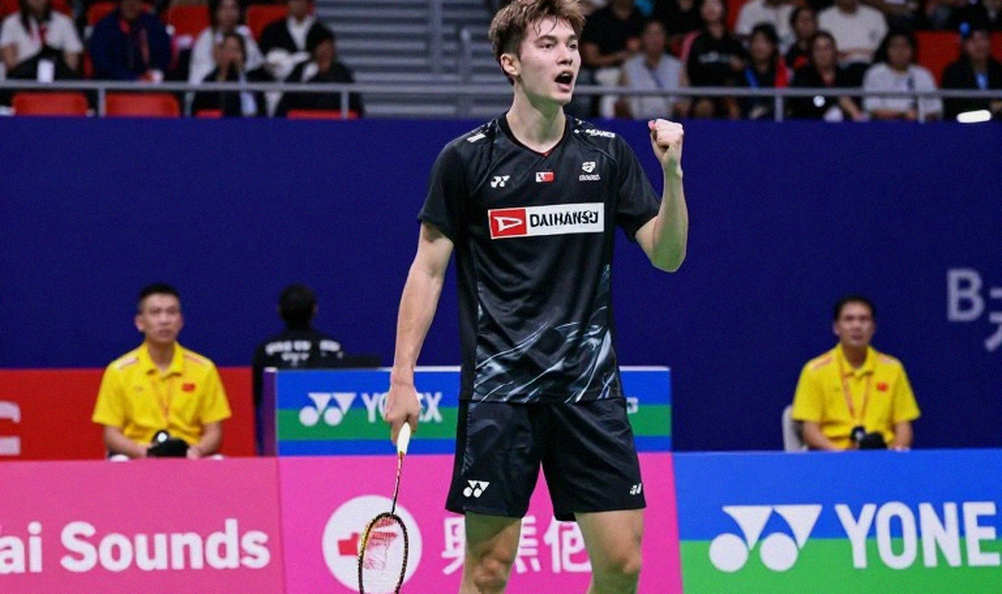
Loh Kean Yew entered the match as a former world champion. That is the label the media attaches to him, and it shaped how people read this contest: a player who once stood at the top of the world against a player who has never reached his individual peak on the continental stage. But the gap between No.13 and No.14 in the rankings is not enough to turn the match into a mismatch. It is only enough to create a thin line where the calmer player wins.
On Sen's side, the personal context is far more complex than the No.14 figure. He won the 2026 Commonwealth Games, finished fourth at the Paris 2026 Olympics, and took team silver at the 2026 Asian Games. And only days before this match, he helped India win team bronze. A continental medal was already in hand, but it was a team medal. The men's singles medal remains the gap in his career.
That is the point to place on the table before dissecting each game. A player who has harvested results across many arenas, now in the mature phase of his career, entering a tournament where he has never won a singles medal. Across the net was a former world champion, described as composed and stronger in the big moments. The psychological architecture of the match was built before the first shuttle was served.
First game: when an early advantage evaporates
Start with the first game, because everything starts there.
Sen opened with a 5-1 lead. It was a fast start built on imposing pace and forcing his opponent to run. In modern men's singles, a fast start is not rare. Holding it is. And here, it vanished faster than it appeared. Loh took ten straight points, turning 1-5 into 11-5, then closed the first game at 21-12.
Ten consecutive points is a number that must be read slowly. In a game to 21, letting an opponent take ten unbroken points is equivalent to losing control for roughly four to five minutes. That is not a single missed rally. It is a stretch in which every decision goes the wrong way. Loh, after the opening serves and returns, almost certainly adjusted his tempo or placement to neutralise Sen's early pressure. I have no shot-by-shot data to state exactly what he did, but the logic of a ten-point run in men's singles always lies in one player ceasing to win the short exchanges and beginning to lose them.
This is the point I want to name: Sen's problem in the first game was not a lack of weapons, but his inability to keep the weapons once drawn. He opened with pressure, and when his opponent answered, he found no way to re-establish that pressure. I do not trust intuition; I trust the repetition of pressure on court. And in the first game, Sen's pressure did not repeat.
Second game: proof that he had enough
The second game changed the picture. Sen won 21-15. By all accounts, he won on merit, through sustained pressure rather than luck. This is the single most important detail of the match, and the one most overlooked when people remember only the ending.
A player who loses the first game 12-21, then flips the match to win the second 21-15, has proven he is not technically inferior. He had the tools to score against Loh. He had the capacity to hold a structure through a whole game. The problem lay elsewhere: he could not hold that structure across three games.
This is why I reject the explanation that Sen lost because he was overpowered. Had he been overpowered, he would not have won the second game by a six-point margin. The second game is evidence sitting inside the match itself, against every hasty verdict on class. It says the gap between these two players, on that day, lay in the ability to re-establish form, not in technical foundation.
Third game: the match in miniature
The third game was the match in miniature. Loh led again. Sen came back. At one point he levelled at 13-14, meaning he was one point from his opponent in a deciding game. That is a position where many players tighten. Sen did not tighten, but he did not cross over either. After the 13-14 point, Loh pulled away and closed the game at 21-14.
The final point was a shuttle into the net. I want to stop on this detail, because it says more than any statistic about the nature of the match. A player losing on a missed shot in the decisive rally, having proven throughout the match that he could score against his opponent, is losing at something else. He is losing the battle of error management in the tense stretches.
Look at the shape of the scores to see this more clearly. Sen lost the first game by nine points, won the second by six, then lost the third by seven. No game was a contest balanced to the final minute. Every game had one side breaking away mid-game and holding the gap to the end. That is the pattern of a match where control changed hands repeatedly, and whoever held control in the closing stretch of each game won that game.
Across seventy minutes of play, the striking thing is the absence of data on shuttle speed, rally length, net-point win rate, or unforced-error count. This is the information gap I must state plainly: I cannot claim Sen lost because of stamina or because of mentality, since both could explain this scoring shape. What I can claim is that the match ran three games over seventy minutes, a figure showing this was a contest demanding significant physical effort, not a quick technical match.
One hypothesis deserves consideration. Sen had just come through the team event days earlier, where he contributed to India's bronze. Moving from the team arena to the individual arena at a multi-sport Games always creates a double load: physical and emotional. But I must state clearly that this is personal conjecture, not data. No workload statistics in the source prove a causal link. What is reasonable to say is this: a dense schedule is a structural factor that can have an effect, and any player carrying the team load faces that risk.
Contrarian view: heartbreak is a lazy reading
The way the media called this defeat heartbreak or a shock overlooked a simple fact: this was a loss to the world No.13 while Sen himself was ranked No.14. A one-place ranking gap does not turn this failure into a technical tragedy. It only turns it into a competitive result, where the calmer player wins.
But there is a larger blind spot in how this match was read. People tend to attribute every defeat in decisive stretches to a weak mentality or fading stamina. Both explanations are convenient, and both dodge the harder question: does Sen have a systemic problem converting early advantage into control of the match? In the first game, he led 5-1 and lost 12-21. In the third game, he levelled at 13-14 and lost 14-21. Two different stretches, but the same pattern: an advantage or an equilibrium not held at the closing end.
This is my personal judgment, based on the scoring shape rather than the shot-by-shot data I lack. But it is worth putting on the table, because it changes the question. The question is no longer why Sen lost that day, but what Sen can do to convert early advantages into final results.
People see the signature; I see the long shadow it casts. The signature here is the score. The shadow is the pattern repeating across matches. And this repeating pattern, early advantage evaporating and equilibrium left unconverted, matters more than a single result.
It is also worth restating a context easily forgotten: a men's singles medal at the Asian Games has never come to Sen. He has Commonwealth gold, an Olympic fourth place, and continental team medals. But in the individual continental arena, he has never crossed the line. Calling every defeat heartbreak only blurs a more systemic truth: a player excellent in many formats, but yet to find a way to convert form into a medal in one specific format.
I do not teach anyone how to win; I teach them to read the data to understand why they lost. And the data here, though lacking technical depth, is enough to point to one thing: Sen's failure carries the structure of a conversion problem, not a capability problem.
What to verify in the next match
For Sen, this match provides no verdict on class. It provides a question about how he manages the decisive stretches. He proved, in the second game, that he can score against a former world champion when pressure is sustained. What needs verifying in the next match lies elsewhere: whether he can hold that pressure across three games, or let it dissolve again at the end of each one. Data does not lie; only the hasty reader deceives himself. I will watch his next match with exactly one question: an early lead, how long can he keep it.